Have you ever watched a child press their hand against a sun-warmed rock and say, “This side is hot, but the other side is cold”? That small observation is the beginning of understanding Earth’s climate systems.
Our planet is not just a rock floating in space. It is a living, breathing machine made of air, water, ice, land, and living things. Scientists call this the climate system – and when children learn it, they never look at weather the same way again.
What is the Climate System?
Let’s meet the team:

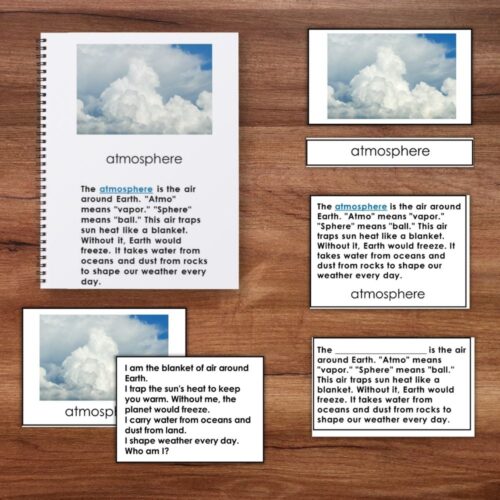
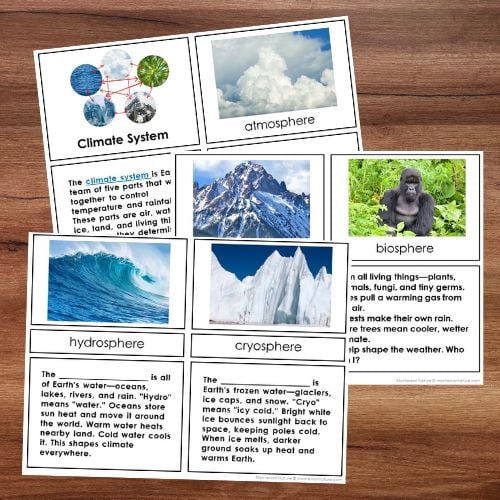
Atmosphere – the blanket of air around Earth. It traps heat like a cozy wrap. Without it, we would freeze.
Hydrosphere – all of Earth’s water: oceans, lakes, rivers, and even rain. Oceans store sun’s heat and move it around the world.
Cryosphere – Earth’s frozen water: glaciers, ice caps, and snow. Bright white ice bounces sunlight back to space, keeping the poles cold.
Lithosphere – Earth’s rocky outer layer: mountains, soil, and ocean floors. Dark rocks soak up heat; light sand bounces it back.
Biosphere – all living things: plants, animals, fungi, and germs. Plants pull a warming gas from the air and can even make their own rain.
These five systems work together. Change one, and the others respond. That is why our climate is so fascinating – and so fragile.
How to Teach Climate Systems to 6–9 Year Olds
Young children learn by touching and doing. Keep explanations short and activities physical.
Atmosphere Activity: The Blanket of Air
What you need: A cup of warm water, plastic wrap, and a rubber band.
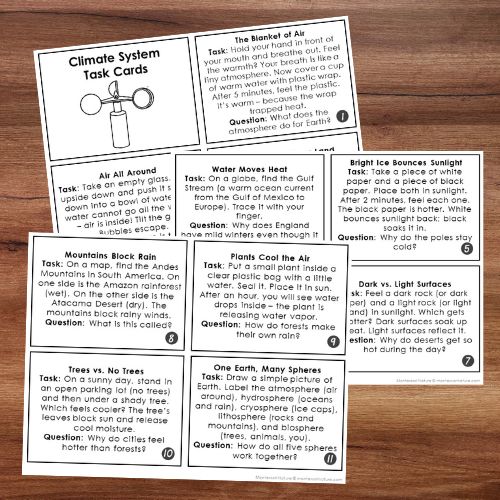
What to do: Cover the cup with plastic wrap and secure it. After 5 minutes, let the child feel the plastic. It is warm – the wrap trapped heat just like Earth’s atmosphere.
Ask: “What would happen if Earth had no air blanket?” (We would freeze at night.)
Hydrosphere Activity: Warm Water, Warm Land
What you need: Two small bowls, warm water, and cold water.
What to do: Fill one bowl with warm water, one with cold. Have the child place a hand above each bowl (not touching). Which hand feels warmer? Warm water heats the air above it.
Ask: “How do oceans keep nearby land warmer in winter?” (The water releases stored heat.)
Cryosphere Activity: Bright Ice Bounces Sunlight
What you need: White paper, black paper, sunlight.
What to do: Place both papers in the sun. After 2 minutes, feel each one. The black paper is hot; the white paper is cool. White bounces sunlight back.
Ask: “Why are the poles covered in ice and snow?” (The white ice reflects sunlight, keeping it cold.)
Lithosphere Activity: Dark Rock vs. Light Sand
What you need: A dark rock (or dark cloth) and a light rock (or white sand) – or just use dark and light paper again.
What to do: Leave both in sunlight. Feel them. Dark surfaces get hotter because they soak up sun rays.
Ask: “Why do deserts get so hot during the day?” (Dark sand and rocks soak up heat.)
Biosphere Activity: Plants Make Cool Air
What you need: A small houseplant, a clear plastic bag, and a little water.
What to do: Lightly water the plant. Seal it in the bag and place it in the sun. After an hour, you will see water drops inside – the plant released water vapor.
Ask: “How do forests make their own rain?” (Trees release water into the air, which can become clouds.)
How to Teach Climate Systems to 9–12 Year Olds (Deeper, More Abstract)
Older children can handle more complex ideas and real‑world connections. Encourage them to research and draw cause‑and‑effect chains.
Atmosphere: The Greenhouse Effect in a Jar
What you need: Two identical glass jars, two thermometers, a lamp, plastic wrap.
What to do: Place a thermometer in each jar. Cover one jar with plastic wrap. Shine the lamp equally on both. After 10 minutes, check the temperatures. The covered jar is warmer – it traps heat like greenhouse gases.
Discuss: How do humans affect the atmosphere? What is the difference between the natural greenhouse effect and global warming?
Hydrosphere: Ocean Currents and Climate
What you need: A large clear baking dish, water, blue ice cubes (frozen with a drop of blue food coloring), red warm water (colored red).
What to do: Fill the dish with room‑temperature water. Place a blue ice cube at one end (representing the Arctic) and gently pour a little red warm water at the opposite end. Watch the currents move. Cold water sinks and flows along the bottom; warm water stays on top and flows toward the cold.
Discuss: Why does England have mild winters even though it is far north? (The Gulf Stream carries warm water from the tropics.)
Cryosphere: Albedo and Melting Ice
What you need: A dark plate, a white plate, two ice cubes, and a sunny spot.
What to do: Place one ice cube on the dark plate and one on the white plate in the sun. Which melts faster? The dark plate absorbs more heat, melting its ice faster.
Discuss: What happens when polar ice melts and reveals dark ocean or ground? (The dark surface absorbs more heat, causing more melting – a feedback loop.)
Lithosphere: Rain Shadows
What you need: A world map or globe, a fan (optional).
What to do: Find the Andes Mountains in South America. On one side is the Amazon rainforest (wet). On the other side is the Atacama Desert (dry). Explain that mountains block rainy winds – the wind rises, drops rain on one side, then is dry on the other.
Discuss: Name another rain shadow desert (e.g., the Gobi Desert behind the Himalayas).
Biosphere: Trees and Local Temperature
What you need: A sunny day, a thermometer, a shady park and a nearby parking lot.
What to do: Take the children outside. Measure the temperature in the parking lot and then under a large tree. The tree is much cooler – leaves block sun and release water vapor.
Discuss: Why are cities hotter than nearby forests? (Fewer trees, more dark pavement – the “urban heat island” effect.)
How the Printable Brings It All Together
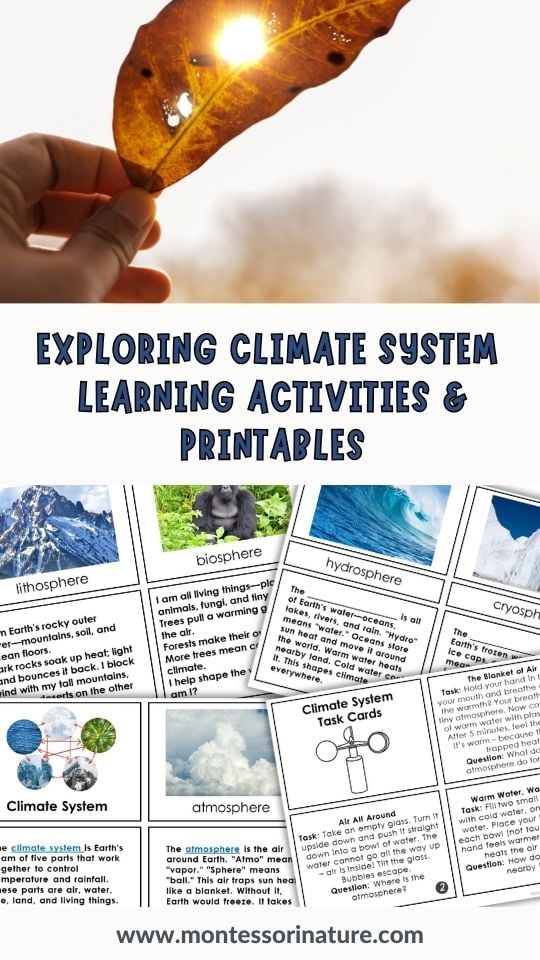
Teaching five systems with multiple hands‑on activities can feel like a lot to organize. That is why I created a Climate Systems printable that puts everything in one place.
What is inside?
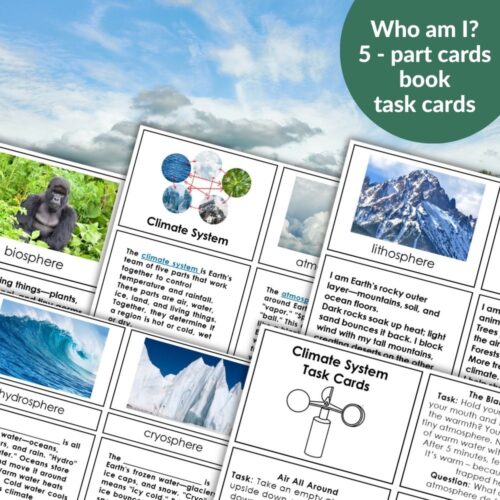
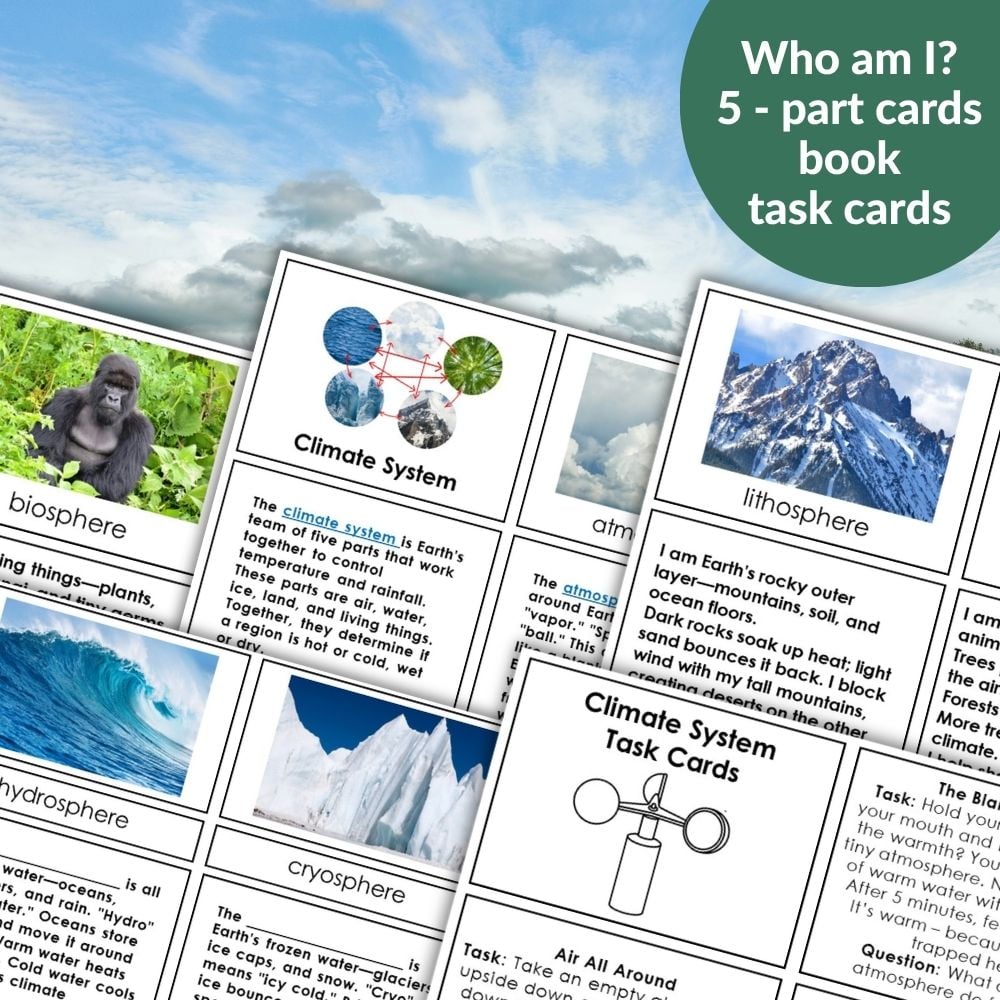
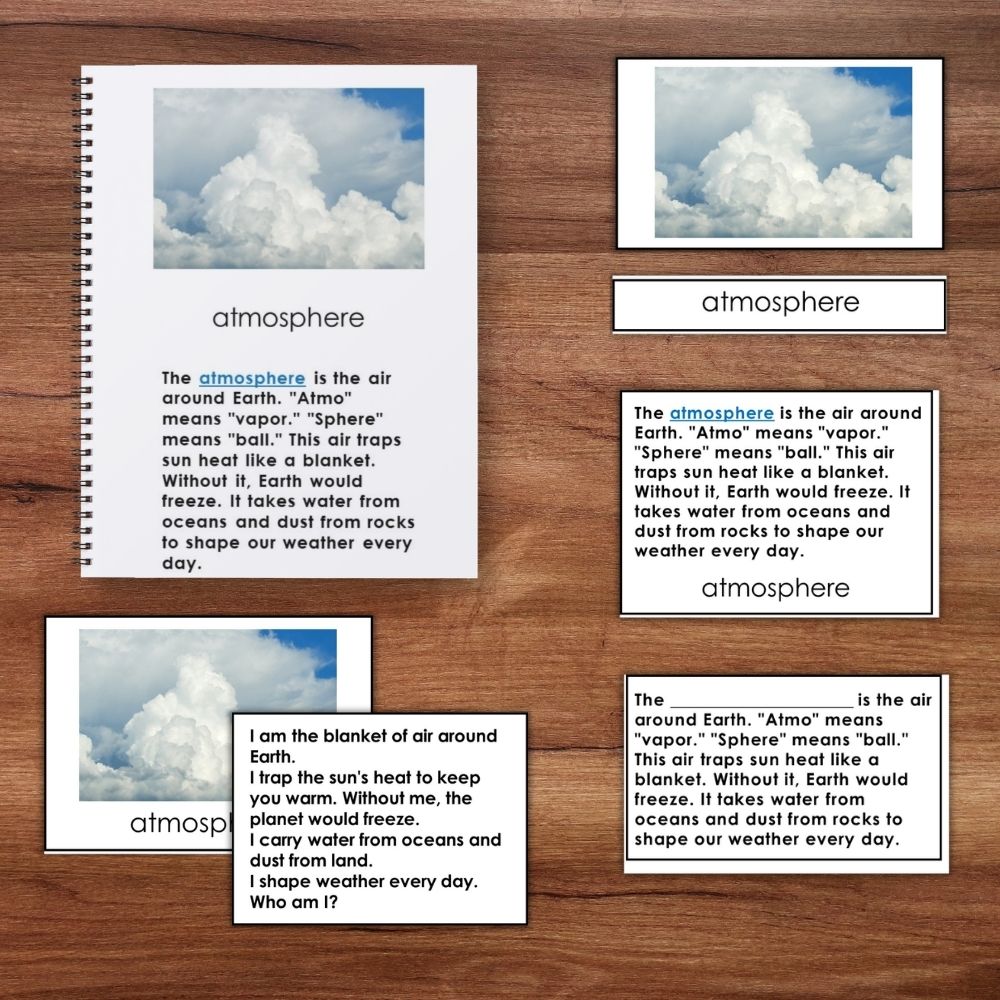
For each of the five spheres (atmosphere, hydrosphere, cryosphere, lithosphere, biosphere) you get:
Labeled picture card – clear, simple illustration
Definition card
Cloze (fill‑in‑the‑blank) 3 part cards – perfect for self‑testing
“Who Am I?” riddle card – a fun guessing game
Task cards – 11 hands‑on activities
How to use it:
6–9 year olds: Start with one sphere per week. Use the picture and definition cards for matching. Do one simple task card together. Keep the riddle cards for a Friday guessing game.
9–12 year olds: Give them all five spheres at once. Let them match the picture to the definition independently. Use cloze cards as a quiz. Then assign task cards for small-group work or individual research.
How it connects to the Imaginary Island project:
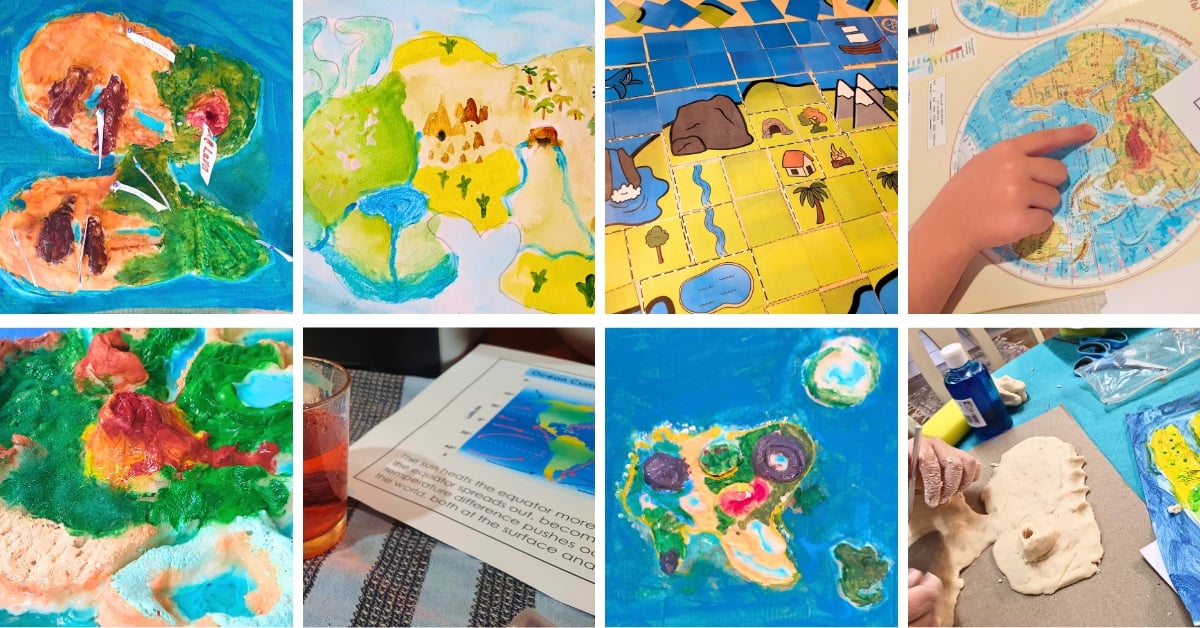
When children build their salt‑dough island, they can now decide:
Is their island near the equator (hot, lush biosphere) or near the poles (cryosphere ice caps)?
Does a warm ocean current (hydrosphere) flow past, keeping winters mild?
Are there mountains (lithosphere) that create a rain shadow on one side?
Is the atmosphere thick and warm, or thin and cold?
The cards turn “what’s the weather?” into a scientific design challenge.
Here is what the discovery process might look like in a classroom:
“My island is at 30°S,” announced Mira, pointing to her salt‑dough creation. “That means it’s in the southern temperate zone. So it has four seasons. But I’m adding a mountain range here – so the west side will be wet and the east side will be dry.”
She pulled out the lithosphere picture card and the “Who Am I?” riddle card for mountains. “The lithosphere shapes climate by blocking wind. That’s why I have a desert on the east side.”
That moment – when a child connects a real scientific principle to her own imaginary world – is what makes teaching climate systems so rewarding.
Earth’s climate systems are not just textbook words. They are the air we breathe, the water that moves around the planet, the ice that reflects sunlight, the rocks that soak up heat, and the living things that cool the air.
When children explore these systems with their hands – wrapping a cup, melting ice on dark and light plates, measuring a shady tree – they build knowledge that lasts. And when they apply that knowledge to their own Imaginary Island, they become not just students, but real climate scientists.
Earth’s Climate System 5 Part Cards and Book
This Climate System resource supports the Montessori Imaginary Island project in earth science and geography. It introduces Earth’s five spheres – atmosphere, hydrosphere, cryosphere, lithosphere, and biosphere – through 5‑part cards, a book, riddles, and hands‑on task cards.
This printable is also available on TPT
You Might Also Enjoy
-
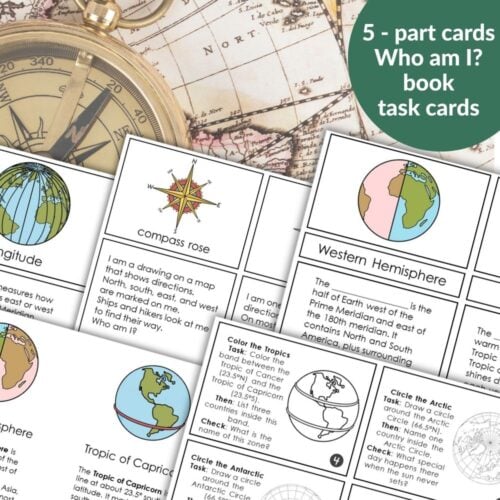
 Latitude and Longitude: Geographic Coordinate System 5 Part Cards and Book$7.10
 -
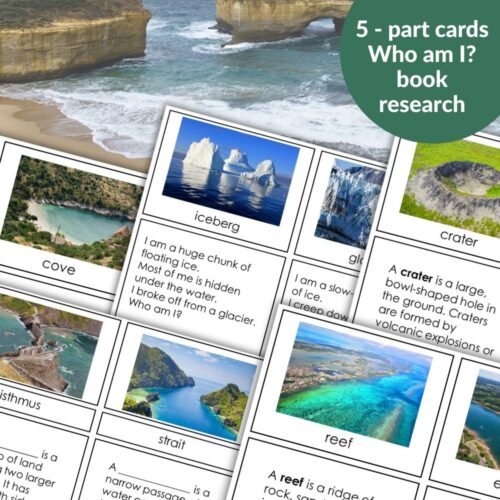
Inland and Coastal Features: Advanced Land and Water Forms 5 Part Cards and Book$8.10
-
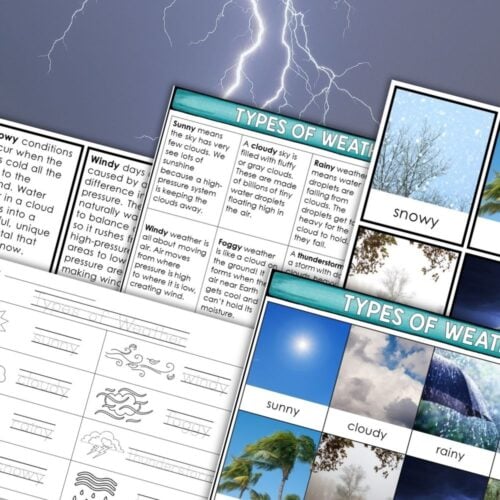
Types of Weather: 3-Part Cards Descriptions Worksheets$4.60
-
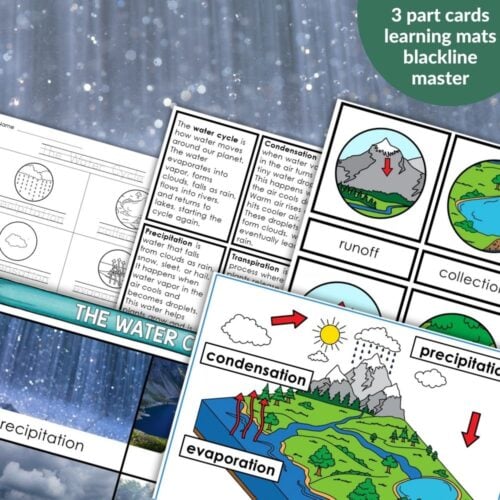
Water Cycle: 3 Part Cards Blackline Master Diagrams$4.40
-
Types of Clouds: 3 Part Cards Cloud Identifier Weather Report$4.90

About Anastasia | Anastasia is an early childhood teacher with over twenty years of experience in Montessori classrooms and homeschooling. With a Master’s in Information Science, she blends education and information design to create clear, organized, research-backed resources. As founder of Montessori Nature, she develops evidence-based, nature-inspired printables that support holistic child development and foster curiosity, independence, and a love of learning. Explore more in her shop and Teachers Pay Teachers store.