Have you ever wondered why a kangaroo hops across the Australian outback but not the forests of Thailand? Or why tigers stalk the jungles of Asia but are absent from the wilds of Australia? For a curious child, these questions are the starting gun for one of the most thrilling adventures we can take them on: the story of evolution.

Explaining millions of years of planetary change to a 5-9-year-old might seem daunting. But the secret lies not in complex timelines, but in storytelling. And the continents of Australia and Asia provide the perfect stage for this epic tale. By comparing their animals, we can make the grand concepts of evolution—like continental drift, adaptation, and isolation—tangible, exciting, and unforgettable for young minds.
This blog post will guide you through how to turn this scientific narrative into an engaging classroom or homeschool unit, complete with hands-on activities and a special printable resource designed to make learning stick.
The Great Continental Split: A Story of Drifting Lands

Around 200 million years ago, all the continents we know today were snuggled together in one giant supercontinent called Pangaea. Imagine it as a giant, connected puzzle. Then, very slowly, the puzzle pieces began to drift apart. This is the concept of continental drift.
How to explain it to children aged 5-9:
- The Jigsaw Puzzle: Show a map of the world and point out how the east coast of South America looks like it could fit into the west coast of Africa. Explain that long, long ago, all the continents were connected like a finished puzzle.
- The Slow-Motion Dance: Use a simple analogy: “The continents move so slowly—about as fast as your fingernails grow! But after millions of years, they ended up very far apart.”
- Australia’s Special Journey: Highlight Australia’s unique path. It broke away from the supercontinent early and became a giant, floating island. This isolation is the key to understanding its weird and wonderful wildlife.
Evolution in Action: Two Different Pathways
When Australia drifted away, it took a cargo of ancient animals with it. Isolated from the rest of the world, these animals evolved in their own unique direction, largely unaffected by the mammals that came to dominate elsewhere.
Asia’s Story: On the large, connected continent of Asia, animals had to compete with each other. Placental mammals—like tigers, elephants, and pandas—thrived. They could travel, adapt to new pressures, and spread across vast territories. This is why we see similar types of placental mammals (like big cats and bears) on different connected continents.
Australia’s Story: On its isolated island, Australia became a living laboratory for marsupial mammals. Marsupials give birth to tiny, underdeveloped young that continue to grow in a pouch. Without competition from placental mammals, marsupials evolved to fill every possible role in the ecosystem:
- The kangaroo became the grazer (like a deer in Asia).
- The Tasmanian devil became the scavenger (like a jackal in Asia).
- The numbat became the termite-eater (like an anteater in Asia).
- The sugar glider became the tree-dwelling glider (like a flying squirrel in Asia).
This is called convergent evolution—where unrelated animals in different parts of the world evolve to look and act similarly because they are adapting to similar environments. This is a fantastic “aha!” moment for children.
Bridging the Gap: Why Some Animals are on Both Continents
So, if Australia was so isolated, why do we see some animals, like certain birds, bats, and reptiles, on both continents?
- The Flyers: Birds and bats can fly! They could cross the ocean barriers that kept ground-dwelling mammals apart. This is why you might see similar owls or fruit bats in both regions.
- The Floaters: Some reptiles, like certain snakes and lizards, can survive long journeys on rafts of vegetation carried by ocean currents, eventually colonizing new lands.
- Recent Connections: During ice ages, sea levels dropped, and land bridges sometimes emerged between islands, creating temporary pathways for animals to walk across.
This nuance helps children understand that nature’s rules have fascinating exceptions.
Bringing the Story to Life: Classroom Activities for Ages 5-9
Now, how do we make this hands-on? Here are some activities that cater to different learning styles.
Activity 1: The Continental Drift Dance (Kinesthetic)
- How: Have a group of children pretend to be animals on Pangaea, all living together. Then, slowly, have them (as the continents) drift to different corners of the room. The “Australian” group becomes isolated and starts moving in a unique way (e.g., hopping like marsupials), while the “Asian” group develops different characteristics (e.g., prowling like placental cats).
- Why: It physically demonstrates isolation and divergent evolution.
Activity 2: Convergent Evolution Match-Up (Visual)
- How: Create cards with pairs of animals that look similar but are from different continents. For example: bily (Australia) vs. red panda (Asia). Challenge students to match the pairs and discuss why they are similar even though they are not related.
- Why: It makes the abstract concept of convergent evolution concrete and visual.
Activity 3: Build-A-Beast (Creative)
- How: Ask children to invent their own animal. First, have them spin a globe. If their finger lands on an isolated island, their animal might evolve into something really unique (like a platypus!). If it lands on a big continent, it might evolve to compete with others (like a fast-running predator). What adaptations would it need? A pouch? A duck bill? Sharp claws?
- Why: It encourages creative thinking and applies the principles of adaptation.
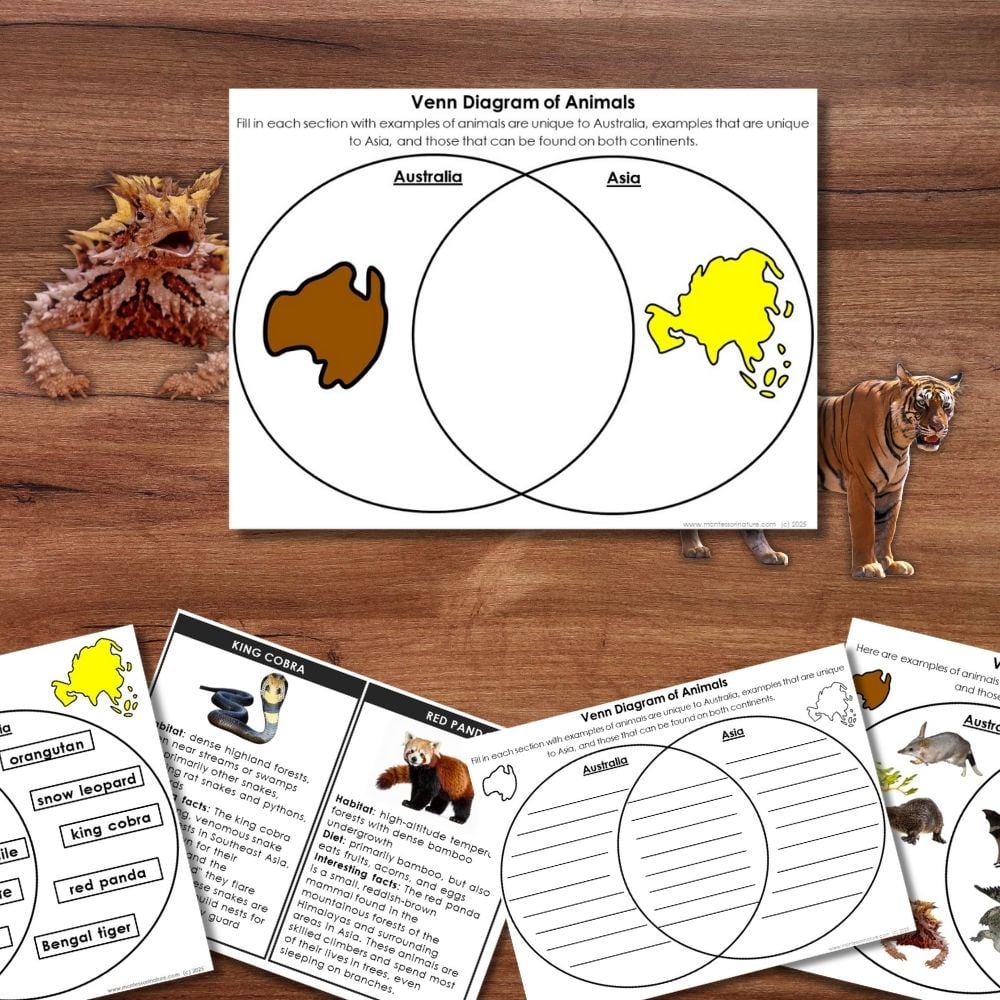
animals of asia and australia venn diagram
This resource is specifically designed to guide children through the critical thinking process of comparing and contrasting. Instead of just telling them the facts, the Venn diagram empowers them to discover the patterns for themselves.
How to use the printable naturally in your lessons:
- The Introduction: After telling the story of Pangaea and continental drift, introduce the Venn diagram as a “detective’s tool.” Explain that detectives compare clues to solve a mystery, and our mystery is: “How did the animals of Australia and Asia become so different?”
- The Group Investigation: Use the 15 animal fact info cards included in the printable. As a class or in small groups, read about each animal. Is it a marsupial only found in Australia? Place it on the Australia side. Is it a placental mammal from Asia? Place it there. Is it an animal, like a dugong or a kite, that could travel between the two? This is the exciting part—it goes in the overlapping “Both” section!
- Differentiation for Younger Learners: For your kindergarten and first-grade students, the picture sorting activity is perfect. They can match the animal pictures to the correct continent on a map or diagram without the pressure of reading, building their confidence and geographical awareness.
- Assessment and Fine Motor Skills: The sorting worksheets and velcro-based sorting activity allow you to assess understanding individually. The velcro activity is particularly good for developing fine motor skills, turning a science lesson into an integrated learning experience.
By sorting the animals, children visually see the result of millions of years of evolution. The pile of unique Australian marsupials and the pile of unique Asian placental mammals tell a clear story of isolation. The smaller “Both” pile sparks a deeper conversation about the exceptions to the rule.
Teaching evolution to young children isn’t about memorizing dates or complex terms. It’s about telling a compelling story of adventure, separation, and adaptation. The animal kingdoms of Australia and Asia offer a perfect, tangible case study. By combining storytelling, hands-on activities, and a structured tool like the Venn diagram printable, you’re not just teaching biology—you’re nurturing critical thinking, curiosity, and a lifelong sense of wonder about the natural world. You’re showing them that the world is full of stories, and science is the key to reading them.
Animals of Australia and Asia Venn Diagram
This printable Venn diagram resource is designed to help students compare and contrast the unique animals found in the diverse ecosystems of Australia and Asia. The activity encourages students to think critically about the differences and similarities between the two continents while learning about a variety of fascinating animals that inhabit these regions.
This printable is also available on TPT
You Might Also Enjoy


About Anastasia | Anastasia is an early childhood teacher with over twenty years of experience in Montessori classrooms and homeschooling. With a Master’s in Information Science, she blends education and information design to create clear, organized, research-backed resources. As founder of Montessori Nature, she develops evidence-based, nature-inspired printables that support holistic child development and foster curiosity, independence, and a love of learning. Explore more in her shop and Teachers Pay Teachers store.