The First Great Lesson, the Story of the Universe, is a cornerstone of the Montessori elementary experience. It fills children with awe and wonder about the birth of stars, the formation of our solar system, and the incredible journey of our planet Earth. This story doesn’t end with a cool, solid sphere; it emphasizes that Earth is a dynamic, living planet, still changing and full of energy. This is the perfect, respectful context for introducing one of Earth’s most dramatic processes: natural disasters.

Rather than presenting them as scary events, we can frame them as powerful forces that have been integral to shaping the world we live in—from carving out valleys with glaciers to creating rich, new soil with volcanic ash. This approach satisfies the children’s natural curiosity about events they hear about in the news and transforms fear into understanding.
Connecting Natural Disasters to the First Great Lesson
When we tell the First Great Lesson, we speak of particles attracting, of tremendous heat and cooling, of gases and liquids swirling. We can extend this narrative by explaining that the same laws of physics that formed the planets are still at work today.

- Volcanic Eruptions & Earthquakes: These are the most direct links. We can explain that the incredible heat from Earth’s formation is still trapped deep inside its core. This heat keeps the mantle moving, which in turn causes the giant tectonic plates to shift. When these plates collide, pull apart, or slide past each other, we feel an earthquake. The same heat and pressure can melt rock into magma, which sometimes finds a weak spot to burst through the crust in a volcanic eruption. We can remind children that without these processes, much of the Earth’s land, including many mountains and islands, would not exist.
- Tsunamis and Landslides: These are often secondary events. An undersea earthquake (from those shifting plates) can displace a huge amount of water, creating a tsunami. Similarly, heavy rain can saturate the soil on a slope, making it heavy and unstable, leading to a landslide. This shows children how Earth’s systems are interconnected.
- Weather-Related Disasters (Tornadoes, Hurricanes, Blizzards): These connect to another part of the Great Lesson: the cooling of the planet and the formation of the atmosphere and oceans. Disasters like tornadoes, tropical cyclones (hurricanes), and blizzards are massive demonstrations of the energy in our atmosphere. The sun heats the air and water, creating winds and storms as the planet seeks to balance this energy. These forces have always been part of Earth’s climate system, distributing heat and moisture around the globe.
By framing natural disasters within this grand, scientific story, we give children a sense of perspective. These are not random acts of destruction, but part of the ongoing story of our planet’s evolution.
Using the Natural Disasters Printable Resource in the Classroom
A comprehensive printable resource, like the one described, is an invaluable tool for making these abstract concepts tangible and accessible for children across the 5-9 age range. Here’s how to implement it progressively:
- For Ages 5-6 (Matching and Vocabulary): Begin with the 3-Part Cards. After a group lesson on a specific disaster (e.g., volcanoes), place the corresponding picture and control cards on a tray. The child’s work is to match the pictures and then the words, building vocabulary in a self-correcting way. The Blackline Master booklet can be used as coloring pages to reinforce the image and the word.
- For Ages 6-7 (Matching Definitions): Introduce the Definition Cards. The child can first match the 3-part cards and then find the corresponding definition, placing it next to the picture. This builds early reading comprehension. They can then create their own booklets by coloring the Blackline Master, cutting out the pages, and using the control cards to correctly label their images.
- For Ages 8-9 (Research and Synthesis): The child can use the entire set as a research station. They choose a disaster to study. They use the Definition Cards with Blanks as a quiz for themselves. Finally, they use the version of the Blackline Master with space for written descriptions to write their own sentences,. This fosters deep understanding and independent learning.
Hands-On Science Activities to Demonstrate the Forces of Nature
Concrete experiences are essential for understanding. These activities model the science behind the disasters in a safe and engaging way.
Activity 1: Modeling Tectonic Plates and Earthquakes
- Objective: To demonstrate how the movement of tectonic plates causes earthquakes.
- Materials: Several small, rough-textured rectangular sponges, a shallow tray of water, your hands.
- Step-by-Step Directions:
- Soak the sponges in water and then place them side-by-side in the tray. These represent Earth’s tectonic plates floating on the semi-liquid mantle.
- Divergent Boundary: Slowly pull two sponges apart. Notice the gap that forms between them. Explain that this is how mid-ocean ridges are formed.
- Convergent Boundary: Push two sponges together. Observe how the edges crumple and push upwards, modeling how mountains like the Himalayas are formed.
- Transform Boundary (Earthquake!): Place the sponges side-by-side again. Push one sponge forward and the other backward so they slide past each other. At first, they will stick due to friction (like locked plates). Then, they will suddenly slip, causing the sponges to jerk and water to splash. This “stick-slip” motion is exactly what happens along a fault line to cause an earthquake.
Activity 2: Erupting Volcano Model
- Objective: To simulate a volcanic eruption and observe the flow of lava.
- Materials: Play-doh or modeling clay, a small plastic water bottle, baking soda, vinegar, red food coloring, a tray.
- Step-by-Step Directions:
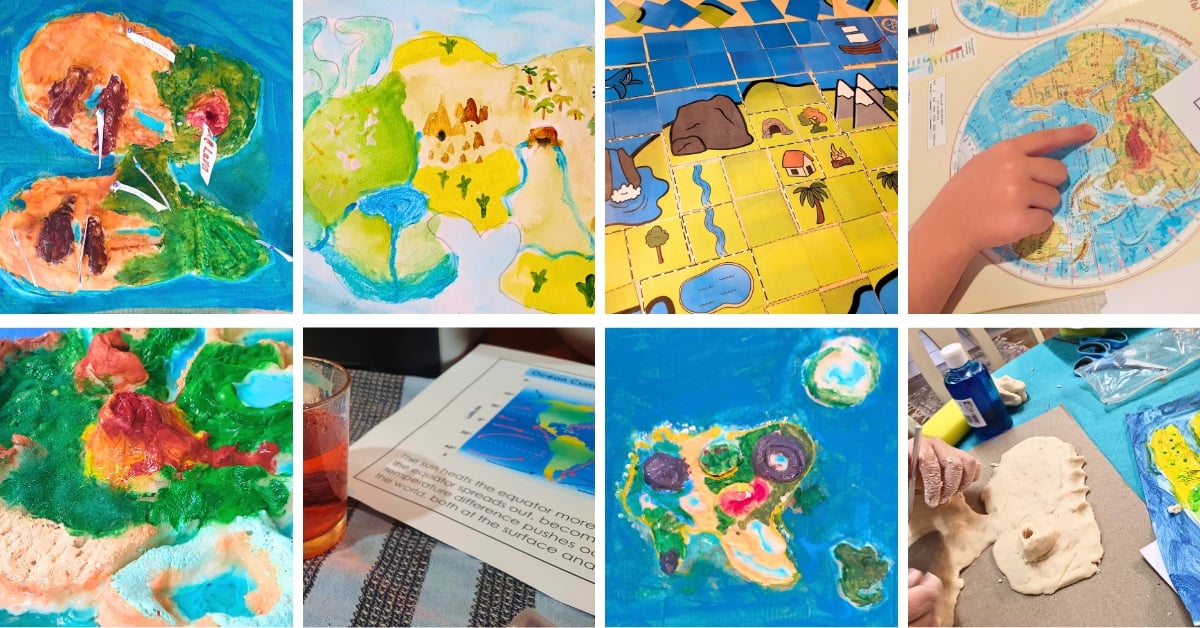
- Place the small plastic bottle in the center of the tray. Have the children build a mountain shape around the bottle using the play-doh, leaving the bottle’s opening uncovered. This is the volcano cone.
- Add 2-3 tablespoons of baking soda to the bottle.
- Add a few drops of red food coloring to the baking soda for effect.
- When ready for the eruption, slowly pour vinegar into the bottle. The chemical reaction between the acid (vinegar) and the base (baking soda) will produce carbon dioxide gas, forcing the colored liquid up and out of the “volcano,” simulating a lava flow. Discuss how pressure from gases builds up inside a real volcano.
Activity 3: Convection Currents in a Liquid (Modeling Hurricane Formation)
- Objective: To visualize how temperature differences in fluids create movement, which is the engine for storms.
- Materials: A large, clear glass baking dish, water, blue and red food coloring, two small glass jars or beakers, an ice cube.
- Step-by-Step Directions:
- Fill the large baking dish with room-temperature water. Let the water sit until it is completely still.
- Fill one small jar with very hot (but not boiling) water and add several drops of red food coloring.
- Place an ice cube in the other small jar and add blue food coloring.
- Carefully place both jars side-by-side on the bottom of the baking dish.
- Observe what happens. The red, warm water will rise from its jar and flow along the surface, while the blue, cold water will sink and flow along the bottom. This movement is a convection current. Explain that hurricanes form over warm ocean water. The warm, moist air rises (like the red water), creating a low-pressure area that pulls in surrounding air, which begins to spin due to the Earth’s rotation.
By combining the cosmic narrative of the First Great Lesson, structured printable materials for research, and hands-on experiments, we empower children. We replace anxiety with knowledge and fear with respect for the incredible, dynamic planet we call home. They learn that they are not just living on the Earth, but are part of its ongoing, powerful story.
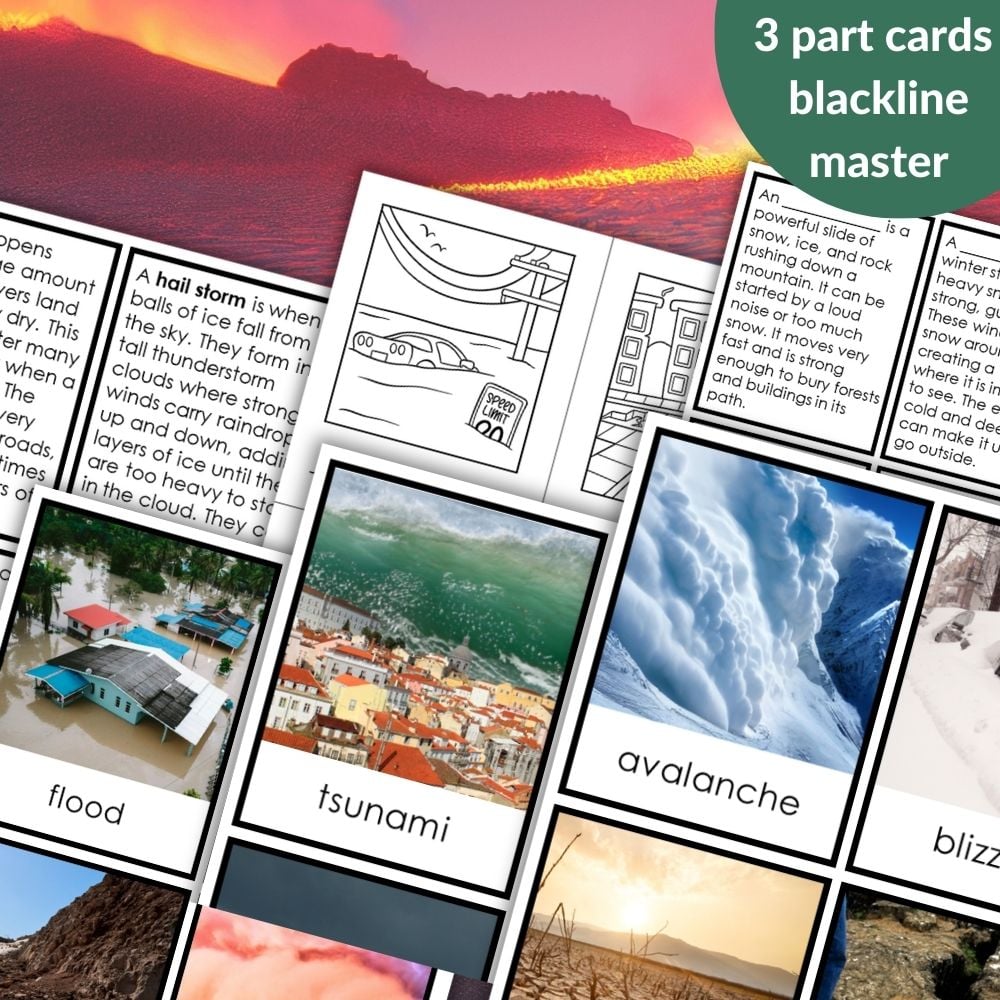
Types of Natural Disasters 3 Part Cards Blackline Master
This printable provides 3-part cards and blackline masters to explore 18 major natural disasters. It is designed for educators in Kindergarten through Grade 3 (approximately ages 5-9). The material is structured to support multi-sensory, differentiated learning in Montessori, homeschool, and standard elementary classroom environments.
This printable is also available on TPT
You Might Also Enjoy


About Anastasia | Anastasia is an early childhood teacher with over twenty years of experience in Montessori classrooms and homeschooling. With a Master’s in Information Science, she blends education and information design to create clear, organized, research-backed resources. As founder of Montessori Nature, she develops evidence-based, nature-inspired printables that support holistic child development and foster curiosity, independence, and a love of learning. Explore more in her shop and Teachers Pay Teachers store.