In the Montessori classroom, we see the world differently. A rain shower isn’t just an inconvenience; it’s a thrilling chapter in the epic story of our planet’s water cycle. A gust of wind is not merely a force that tousles hair—it is a tangible expression of the sun’s energy and the Earth’s eternal dance of balancing pressure.
This perspective is at the heart of Cosmic Education: helping the child understand their place in the interconnected universe, starting with the phenomena they can see and feel right outside their window. Weather is one of the most accessible and powerful gateways to this cosmic view.
By studying weather, we aren’t just learning meteorology; we are exploring the relationship between the sun, the Earth, the air, and water—the fundamental forces that make our existence possible.
Let’s explore main weather events through a cosmic lens.

The Sun: The Ultimate Driver
Every single weather event begins with the sun. Its radiant energy heats the Earth unevenly, creating temperature differences.
- Sunny & Clear: These conditions occur when a large mass of stable, high-pressure air settles over an area, holding clouds at bay. This allows us to directly experience the sun’s energy.
Water’s Journey: The Cosmic Cycle
The water that falls from the sky today is the same water that quenched the thirst of dinosaurs.
- Rainy & Drizzly: This is liquid precipitation, the most familiar phase of the water cycle where condensed water droplets become heavy enough to fall.
- Snowy & Icy: These occur when the air is cold enough for water vapor to freeze into intricate crystals (snow) or for rain to freeze on contact (ice).
- Foggy: Essentially a cloud on the ground, fog forms when the air near the Earth’s surface cools and can no longer hold its invisible water vapor.
- Hands-On Activity: Create a Cloud in a Jar. Pour hot water into a jar, place ice on the lid, and watch as condensation forms a “cloud.” Add a match for dust particles to demonstrate the role of condensation nuclei. This beautifully models how clouds, fog, and precipitation form.
The Air in Motion: The Great Balancer
Windy and Breezy conditions are the atmosphere’s way of seeking balance. Air tirelessly moves from areas of high pressure to low pressure.
Hands-On Activity: DIY Anemometer. Build a simple wind speed measurer using cups, straws, and a pencil. Children can observe how wind strength varies daily, connecting to the concept of energy transfer from the sun.
To construct a DIY anemometer, gather five small paper cups, two sturdy straws, a sharp pencil with an eraser, a push pin, and a stapler. Begin by stapling the rim of one cup to the end of a straw; repeat this with a second cup on the opposite end of the same straw. Take the second straw and staple a third cup to one end and a fourth cup to the other, ensuring all cups face the same direction.
Carefully pierce the center of both straws with the push pin, creating a pivot point, and then push the pin securely into the pencil’s eraser, allowing the straws to spin freely. Anchor the fifth cup upside down on the pencil’s tip to serve as a stable base. Once assembled, take the anemometer outside and hold it vertically in the wind; the cross of straws will rotate as the cups catch the air. Children can count the number of rotations per minute to compare daily wind speeds, providing a tangible measure of how solar energy differentially heats the Earth’s surface, creating atmospheric pressure imbalances that drive the wind.
The Dramatic Events: A Clash of Titans
- Stormy (Thunderstorms): These are atmospheric engines. Warm, moist air rises rapidly, creating towering cumulonimbus clouds. Inside, ice crystals and water droplets collide, building up electrical charges that are released as lightning and thunder.
- Tornado: A violently rotating column of air forming under specific conditions within a supercell thunderstorm. It is a powerful, focused example of wind and pressure differences.
- Hands-On Activity: Tornado in a Bottle. Connect two plastic bottles with a tornado tube connector. Swirling the water creates a vortex, providing a safe and mesmerizing model of how tornadoes spin.
To create a Tornado in a Bottle, begin by filling a 1-liter clear plastic bottle about three-quarters full with water; adding a few drops of food coloring and a pinch of glitter can make the vortex more visible. Securely screw a specialized tornado tube connector onto this bottle, or if one is unavailable, tightly connect a second empty bottle mouth-to-mouth using a waterproof circular connector or a large metal washer sealed with strong duct tape to prevent leaks. Once the bottles are connected, quickly flip the assembly so the water-filled bottle is on top.
With one hand supporting the bottom bottle and the other gripping the top, vigorously swirl the entire apparatus in a tight, fast circular motion for a few seconds before setting it down to observe. This swirling action imparts angular momentum to the water, forcing it to spin rapidly towards the center and down into the lower bottle, forming a mesmerizing, stable vortex that accurately models the low-pressure funnel and powerful spinning winds of a real tornado, demonstrating the conservation of angular momentum in a tangible way.
The Optical Illusions: Light Playing with the Elements
- Rainbow: A perfect example of the sun and water working in concert. Sunlight refracts (bends), reflects, and disperses inside raindrops, splitting into the spectrum of colors.
- Aurora: Charged particles from the solar wind are funneled by Earth’s magnetic field to the poles, where they collide with atmospheric gases to create shimmering curtains of light—a direct, visible link between our planet and the sun.
- Hands-On Activity: Prism & CD Rainbows. Use a prism or an old CD to catch sunlight and cast rainbows on the wall. Discuss how, just like in a raindrop, the light is being separated into all its beautiful colors.
Bringing Cosmic Weather into Your Classroom or Home
To help children internalize these awe-inspiring connections, they need the right tools. Concrete, hands-on materials allow them to touch, name, and understand the components of their world.
That’s why I created the Types of Weather Montessori 3-Part Cards printable.
This comprehensive resource is designed to minimize your prep time while maximizing learning. It includes:
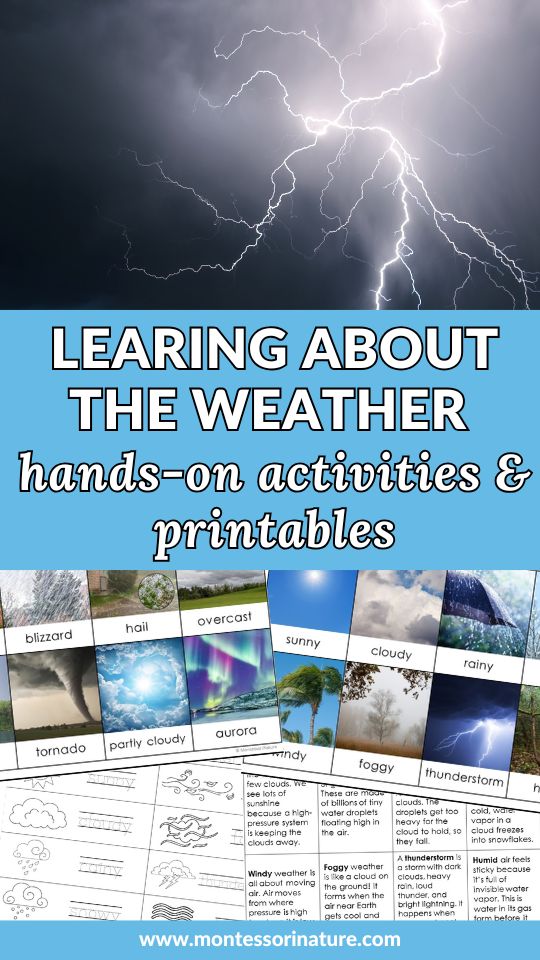
- 15 detailed weather events, from common (sunny, cloudy) to extraordinary (aurora, tornado).
- 3-Part Cards for building vocabulary and promoting independent discovery.
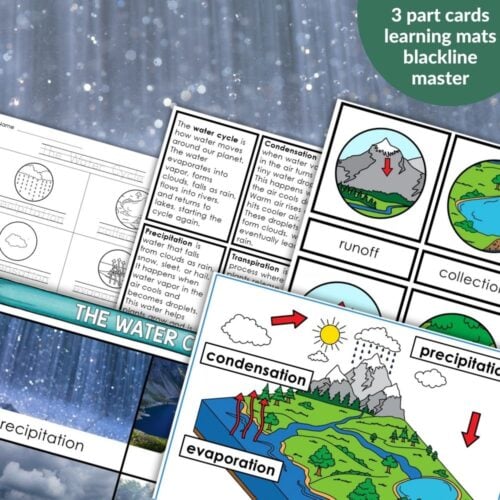
- Description Cards with child-friendly scientific explanations that gently introduce cosmic concepts like energy, cycles, and interconnection.
- Fill-in-the-blank cards and tracing worksheets (in print and cursive) to reinforce learning and integrate language skills.
- Low-prep activity mats to make setup simple, so you can focus on guiding the child’s exploration.

Types of Weather: 3-Part Cards Descriptions Worksheets
This Types of Weather Montessori-inspired printable is designed for kindergarten and elementary learners (ages 5-9) and provides hands-on materials to explore 16 distinct weather events, from sunny and cloudy to hail and blizzards.
This printable is also available on TPT
You Might Enjoy


About Anastasia | Anastasia is an early childhood teacher with over twenty years of experience in Montessori classrooms and homeschooling. With a Master’s in Information Science, she blends education and information design to create clear, organized, research-backed resources. As founder of Montessori Nature, she develops evidence-based, nature-inspired printables that support holistic child development and foster curiosity, independence, and a love of learning. Explore more in her shop and Teachers Pay Teachers store.