Captivate your young learners by introducing them to the capybara—the world’s largest rodent and a true keystone species of its habitat. This gentle giant offers a perfect gateway to explore themes of animal adaptation, life cycles, and ecosystem interdependence. To make your lesson planning easier and more effective, we’ve designed a Montessori-inspired Capybara Printable Pack that transforms complex biological concepts into hands-on, child-directed activities. These materials are perfect for creating captivating shelf works, science centers, or small group projects that will spark curiosity and foster a deep love for the natural world.

The capybara (ka-pee-BAR-ah) is the largest rodent in the whole world! Its scientific name is Hydrochoerus hydrochaeris, which is a big, fancy way of saying “water hog.” And that’s a perfect name because they absolutely love the water. They are part of the rodent family, which also includes squirrels, beavers, and mice. But don’t worry, this giant rodent is a gentle, plant-eating herbivore.
These wonderful creatures are found in South America, in countries like Brazil, Venezuela, and Colombia. Their favorite homes are places with lots of water, like marshes, swamps, rivers, and ponds. Why? Because they are semi-aquatic mammals, which means they spend a lot of their life in and around the water. It’s where they eat, play, hide, and even nap!
A Body Built for the Water

Capybaras have amazing bodies that are perfectly designed for their watery world.
Swimming Champions: Their feet are partially webbed, which means there is a little bit of skin between their toes. This makes their feet perfect paddles for swimming! They can dive and swim gracefully to escape danger or just to cool off.
Built-in Snorkel: Have you ever used a snorkel to see underwater? Capybaras have their own built-in one! Their eyes, ears, and nostrils are all located on the top of their head. This lets them see, hear, and breathe while almost their entire body is hidden underwater—a perfect way to stay safe from predators.
Quick-Dry Fur: What do you think covers a capybara’s body? They have rough, sparse hair that dries incredibly fast after a swim. This helps them stay comfortable and not get too cold.
The Circle of Life: A Capybara’s Life Cycle
One of the most fascinating things to learn about any animal is its life cycle—how it is born, grows, and lives its life. The capybara’s life cycle is all about family.
Newborn Pups: A baby capybara is called a pup. They are born precocial, which is a scientific word meaning they are ready for action right from the start! They are born with their eyes open, a full coat of fur, and can even walk and swim on their very first day. A mother capybara usually has between 2 to 8 pups at a time.
Life in the Crèche: The pups don’t just stay with their own mom. In a capybara herd, all the mothers help take care of all the babies! This group of babies is called a crèche (say: kresh). It’s like a big, happy daycare where everyone looks out for each other. The pups nurse from their mother but will also start nibbling on grass very quickly.
Adolescents: After about 16 weeks, the young capybaras are weaned, meaning they stop drinking their mother’s milk and eat only plants. They are now adolescents. They still stay with the protective family herd, learning how to be proper capybaras by watching the adults. They play and practice all the skills they will need.
Adults: By the time they are about 18 months old, they are all grown up! Adults spend their days grazing on grasses, swimming, and keeping watch for danger. A dominant male, who has a special scent gland on his nose called a morillo, will lead the group and protect their territory.
A capybara can live for 8 to 10 years in the wild. Their whole life is spent in their herd, which is their family. This social structure is their greatest strength and helps keep everyone safe.
A Day in the Life: Habitat and Diet
What is it like to be a capybara? Their day is pretty relaxing! They are most active during the early morning and late afternoon (this is called being crepuscular). During the hot midday sun, you’ll often find them resting in a muddy wallow or floating calmly in the water.
Their favorite food is grass! They are herbivores and graze just like cows. In fact, an adult capybara can eat up to 8 pounds of grass in a single day! They also love to eat aquatic plants, fruits, and even tree bark. Their teeth never stop growing, so all that chewing helps to wear them down and keep them just the right length.
Fascinating Fun Facts!
The Best Chair Ever: Capybaras are known for being incredibly calm and friendly. It is very common to see birds, monkeys, and even rabbits sitting on a capybara’s back! They don’t seem to mind at all.
Chatty Creatures: They talk to each other all the time! They make many sounds like purrs, whistles, barks, and squeaks to communicate with their herd.
Fast Runners: Even though they are large and seem slow, they can run as fast as a horse for a short distance if they need to escape danger!
Underwater Naps: They can hold their breath for up to five minutes and can even sleep in the water with just their noses poking out.
Ancient Relatives: Millions of years ago, the ancestors of capybaras were twice as big as they are today—almost the size of a bear!
Bringing Learning to Life with Montessori Printables
For teachers and parents looking to deepen this exploration, hands-on learning is key. A Montessori-inspired Capybara Printable Pack is a wonderful resource to have. This type of printable offers a variety of activities like life cycle diagrams, 3-part cards for vocabulary building, and labeling exercises for parts of the capybara. Children can work on sequencing skills by ordering the life cycle stages, improve their fine motor skills through cutting and pasting, and conduct their own research using simple information cards. These materials are designed for individual or small group work, allowing children to follow their curiosity and learn at their own pace, perfectly aligning with the Montessori method of fostering independence and a love for discovery.
The capybara teaches us wonderful lessons about the importance of family, community, and living peacefully with others.
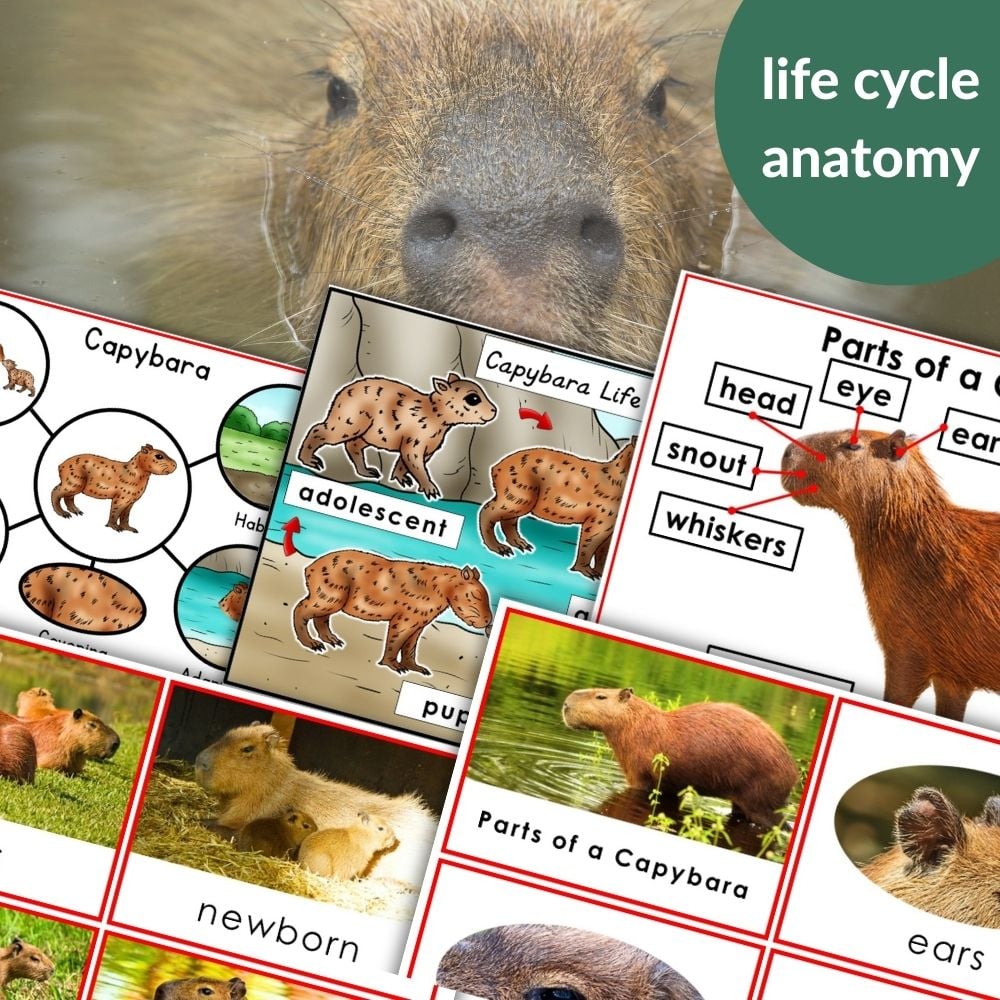
Parts of a Capybara Life Cycle Activities 3 Part Cards Blackline Master
Ideal for kindergarten and Grades 1–3 students, the Capybara Life Cycle and Parts of a Capybara printable provides a collection of Montessori-inspired hands-on activities designed for individual quiet shelf work, centers, or small group lessons in homeschool or classroom settings.
You Might Enjoy
About Anastasia | Anastasia is an early childhood teacher with over twenty years of experience in Montessori classrooms and homeschooling. With a Master’s in Information Science, she blends education and information design to create clear, organized, research-backed resources. As founder of Montessori Nature, she develops evidence-based, nature-inspired printables that support holistic child development and foster curiosity, independence, and a love of learning. Explore more in her shop and Teachers Pay Teachers store.