The story of a blue whale is a story that captures the majesty of nature, the wonder of science, and the importance of caring for our planet. This isn’t just a unit study; it’s the epic tale of the largest animal to have ever lived on Earth, a story that can captivate young minds and inspire future stewards of our world.
Here’s a narrative framework you can adapt to tell this incredible story to your students.
The Story of the Ocean’s Gentle Giant
“Gather around, everyone. I want to tell you about a true giant of the sea, an animal so big that its heart is the size of a small car and its call can be heard by other whales hundreds of miles away. This is the story of the blue whale.
Our story begins not in the ocean, but on the land. A very, very long time ago—over 50 million years—the ancestors of today’s blue whales were land animals! They looked very different, a bit like a wolf. Over millions of years, these animals began spending more time in the water. Their bodies slowly changed: their front legs became powerful flippers for steering, their back legs disappeared, and their tails grew into wide flukes that powered them through the water. They became the magnificent, fully-aquatic whales we know today .


So, how did this animal become the largest of all time? The secret lies in its dinner. You might think a giant needs to eat other giant animals, but blue whales eat some of the smallest creatures in the ocean: tiny shrimp-like animals called krill. A single blue whale can eat millions of krill in one day ! To do this, they have an amazing tool in their mouth: baleen . Instead of teeth, they have hundreds of bristly plates made of the same material as your fingernails. They take a huge gulp of water, then push the water out through the baleen, trapping the krill inside—like a giant spaghetti strainer catching the spaghetti! This incredibly rich food source, available in the cold polar waters, gave them the energy to grow to such an unbelievable size .
Now, let’s talk about their family life. A baby blue whale, called a calf, is born already longer than your classroom! It drinks its mother’s rich milk and gains 200 pounds every single day . The mother and calf share a strong bond, swimming together on long migrations from cold feeding grounds to warmer waters where the calf is born. These whales are also the loudest animals on the planet, using low-frequency rumbles to talk to each other across vast, dark ocean distances .
For a long time, humans and blue whales had a difficult relationship. People hunted them for their blubber, which was made into oil, and their baleen, which was used in products like umbrellas and corsets. This hunting sadly made them endangered . But the story doesn’t end there. People learned how important these giants are and now work to protect them. Why are they so important? Even their poop helps the ocean! It provides nutrients for tiny plants called phytoplankton, which are food for krill, and the cycle of life continues .
So, the next time you look out at the ocean, remember the incredible story of the blue whale. It’s a story of an ancient journey from land to sea, a gentle giant that eats the tiniest food, and a reminder that we all have a part to play in protecting the wonderful creatures in our world.”
Blue Whale Printables
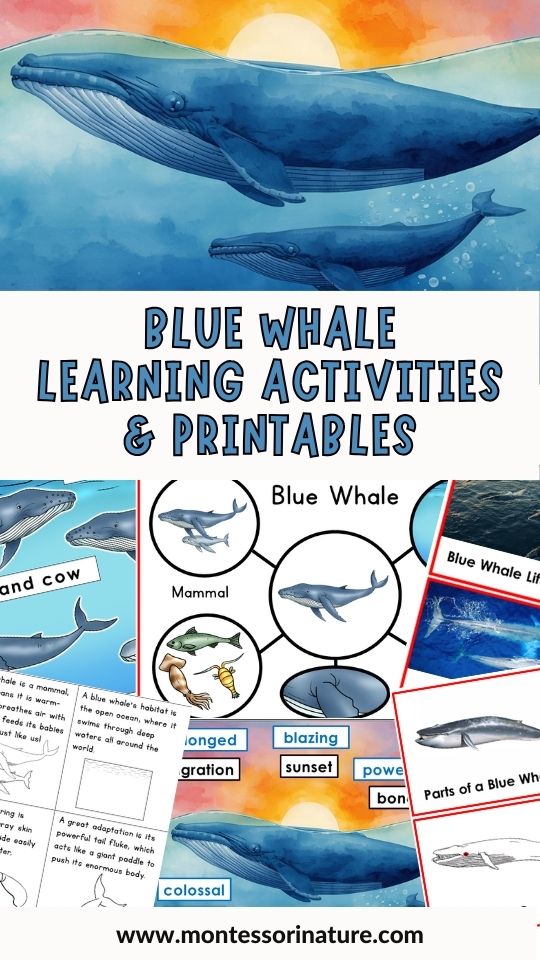
This story provides the perfect foundation for hands-on learning. As you tell this tale, you can use Blue Whale Printables to make the learning tangible and unforgettable.
When you describe their evolution and anatomy, hand out the “Parts of a Blue Whale” diagram. Let children point to the “flukes,” “baleen plates,” and “blowholes” as you say the words. This turns complex vocabulary into an interactive game.
When you talk about their life cycle, use the 3-part cards to sequence the story: from the massive newborn calf, to the nurturing mother, to the independent adult. This visual timeline helps cement their understanding of growth and family bonds.
To discuss their role in the ecosystem, use the “Food Chain” 3 part cards and diagram. Children can physically place the blue whale in the center of a food web, connecting it to the krill it eats and the human activities that can both harm and protect it.
By combining this epic story with tactile, Montessori-inspired printables, you’re not just teaching facts. You are helping children construct the whale’s story themselves, fostering a deep sense of wonder and responsibility for one of our planet’s most magnificent inhabitants.
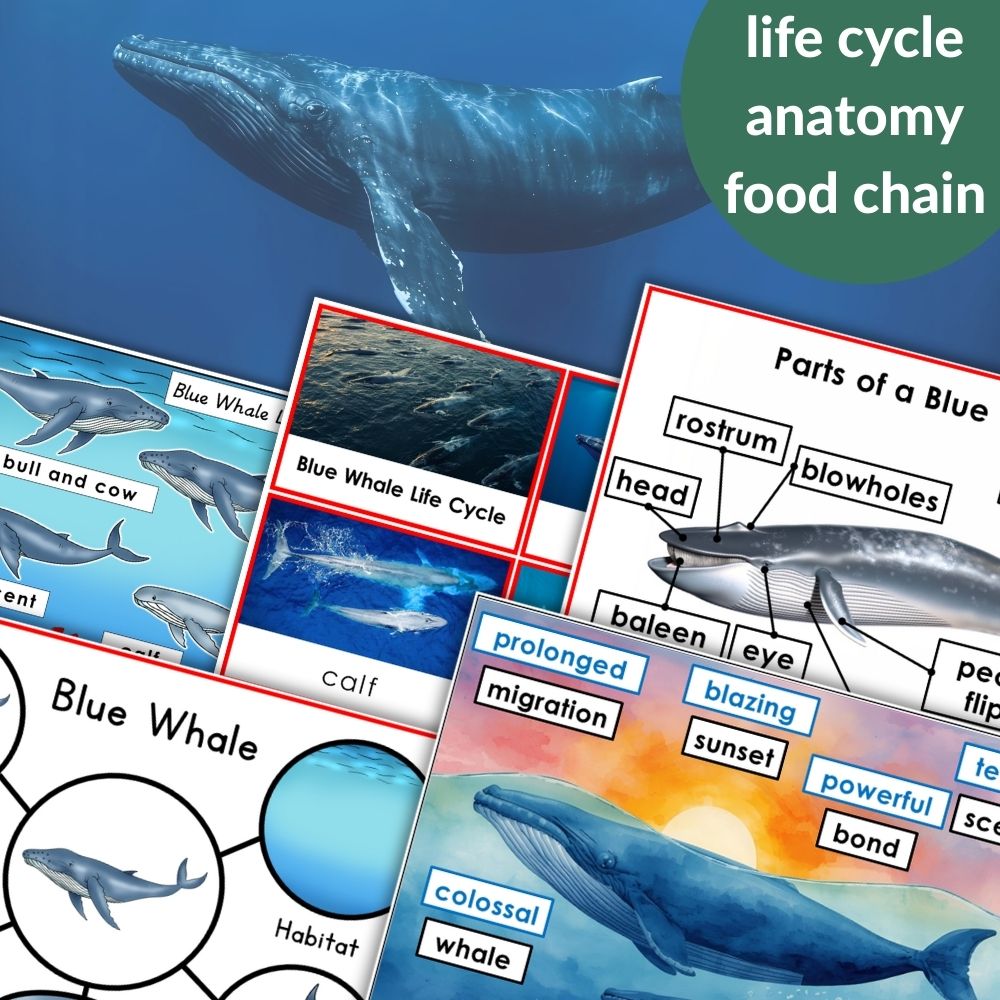
Parts of a Blue Whale Life Cycle Activities 3 Part Cards Blackline Master Poster
Suitable for preschool, kindergarten, and Grade 1-3 students, this Whale Life Cycle and Parts of a Whale printable provides a collection of Montessori-style hands-on activities. Perfect for individual shelf work, learning centers, or small group lessons in both homeschool and traditional classroom environments.
This printable is also available on TPT
You Might Also Enjoy


About Anastasia | Anastasia is an early childhood teacher with over twenty years of experience in Montessori classrooms and homeschooling. With a Master’s in Information Science, she blends education and information design to create clear, organized, research-backed resources. As founder of Montessori Nature, she develops evidence-based, nature-inspired printables that support holistic child development and foster curiosity, independence, and a love of learning. Explore more in her shop and Teachers Pay Teachers store.