Imagine the Earth, more than half a billion years ago. There are no dinosaurs, no fish, no plants on land, no creatures crawling or swimming or flying. The oceans are dark and quiet, filled only with single-celled organisms drifting in the currents. Then, something remarkable happens. Some of those single cells begin to work together. They form a colony. They divide tasks—some cells pull in water, others trap food, still others build a tiny skeleton. This collaboration gives rise to the first multicellular animal on Earth. That animal is the sponge. Its scientific name is Porifera, and it is still with us today.
For Montessori teachers and homeschooling parents preparing the Second Great Lesson: The Coming of Life, the story of Porifera offers a tangible, concrete teaching point. Sponges help children understand that life did not appear all at once. It began simply, with creatures that had no brains, no hearts, no organs—only a porous body and a quiet determination to survive. By studying sponges, children can touch the oldest branch of the animal family tree and begin to grasp the immense sweep of evolutionary time.
What Is a Sponge?
At first glance, a sponge does not look like an animal. It does not move. It has no face, no eyes, no mouth. It clings to a rock or shell and stays there for its entire life. Yet a sponge is very much alive. It pumps water through its thousands of tiny pores, filtering out bacteria and bits of food. It grows. It reproduces. It can live for centuries, even millennia.

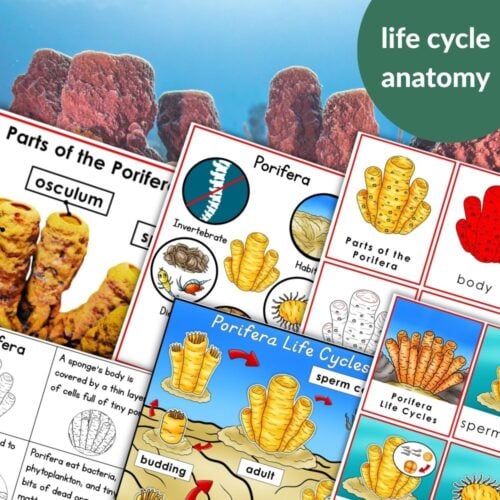
The name Porifera comes from Latin: porus meaning “pore” and ferre meaning “to bear.” A sponge is a pore-bearer. Its body is covered in tiny holes called ostia, through which water enters. Inside, a central cavity called the spongocoel collects the water. Then the water exits through a large opening at the top called the osculum. This simple plumbing system is the sponge’s entire way of eating, breathing, and eliminating waste.
Despite its simplicity, a sponge has a skeleton. Embedded within its soft body wall are thousands of tiny, hard structures called spicules. Some spicules are made of glass (silica), others of chalk (calcium carbonate). These spicules give the sponge its shape and protect it from predators. The sponge was the first animal to invent a skeleton—a revolutionary innovation that would later allow animals to grow larger and more complex.
A Quiet Revolution: The Sponge’s Place in Evolution
The Second Great Lesson tells children that life on Earth began in the ocean, with tiny, simple creatures. Porifera are the oldest evidence we have of that story. Fossil sponges have been found in rocks over 600 million years old, long before the Cambrian explosion that produced most other animal groups. Sponges were the pioneers.
Why does this matter? Before sponges, life was single-celled. Each cell fended for itself. Sponges were the first animals to develop specialized cells—different cells with different jobs. Some cells, called choanocytes, wave tiny tails to create a water current. Other cells, called porocytes, form the pores. Still others produce the spicules. This division of labor was a giant leap forward. It allowed animals to become larger, more efficient, and more adaptable. Every complex animal that followed—from jellyfish to insects to humans—owes its existence to this ancient innovation.
When children study sponges, they are not learning about a strange, isolated creature. They are learning about the foundational design of animal life. They are seeing, in a living animal, the first solution to the problem of how to build a body.
Fascinating Facts to Share with Children
The Oldest Living Animals
Most people think of giant tortoises or whales as long-lived, but deep-sea sponges put them to shame. Some glass sponges have been estimated to be over 2,000 years old. They were alive when the Roman Empire fell. They are still alive today, quietly filtering the cold, dark water.
The Water Filtering Champion
A sponge the size of a grape can filter more than 20 liters of water every single day. That is about five gallons. In a single year, that tiny sponge cleans over 7,000 liters—enough to fill a small swimming pool. Sponges are the unsung heroes of ocean water quality.
The Only Moving Stage
Adult sponges never move. They attach to a surface and stay there for the rest of their lives. But baby sponges, called larvae, are free-swimming. Covered in tiny hairs called cilia, they drift and paddle through the ocean for a day or two. Once they find a good spot, they settle down forever. That brief journey is the only movement a sponge will ever experience.
The Clone Maker
Sponges can reproduce without a partner. A small bump called a bud grows on the parent’s body. The bud enlarges as cells divide. Eventually, it breaks off and drifts away. It grows into a new sponge that is genetically identical to its parent. This process is called budding.
The Meat-Eating Sponge
Most sponges are peaceful filter-feeders. But some deep-sea sponges have a darker side. Carnivorous sponges trap tiny crustaceans on a velcro-like surface and slowly digest them. They are proof that even the simplest animals can evolve surprising strategies for survival.
The Sponge Life Cycle: A Story of Transformation
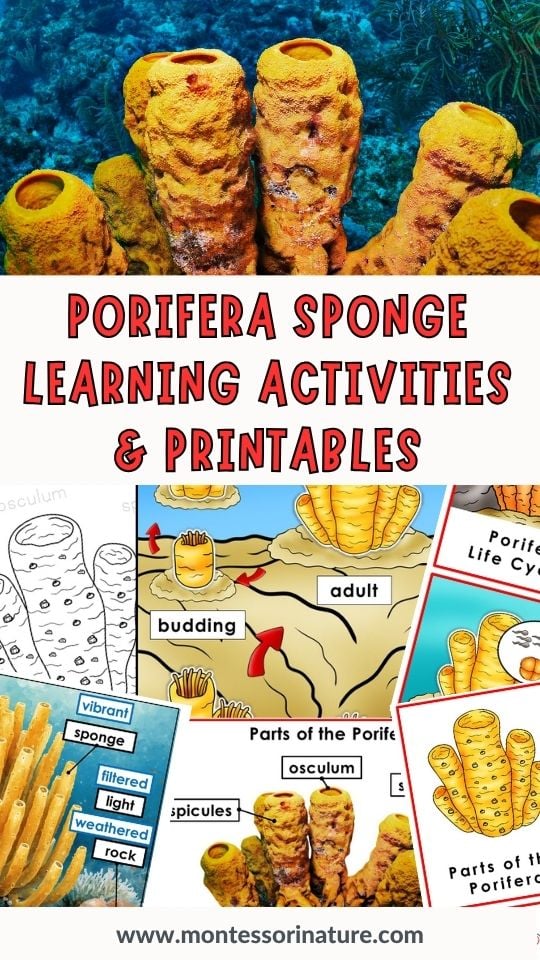
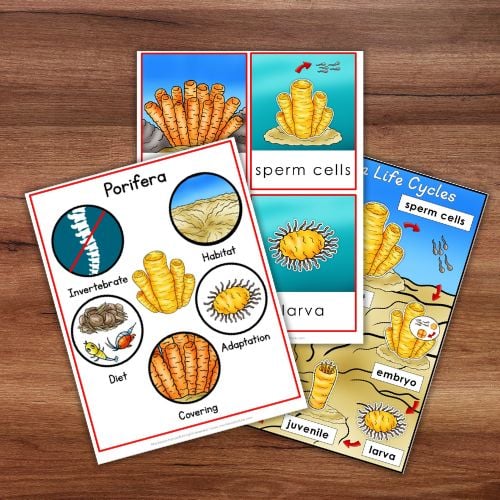
A sponge begins as a sperm cell released into the water. When another sponge filters that water, it captures the sperm and fertilizes its eggs inside its body. The fertilized egg becomes an embryo, protected by the parent. Then the parent releases a tiny, free-swimming larva. For a few hours or up to two days, the larva drifts through the ocean, searching for a suitable place to settle. This is the only time a sponge can move. When it finds a rock or shell, it attaches permanently and begins its transformation. It grows pores and canals, becoming a young sponge. Finally, it matures into an adult sponge, ready to reproduce and begin the cycle again.
This life cycle is a powerful lesson in patience and adaptation. The sponge does not rush. It does not chase. It waits for the current to bring what it needs, and it thrives.
The Parts of a Sponge: A Simple Blueprint
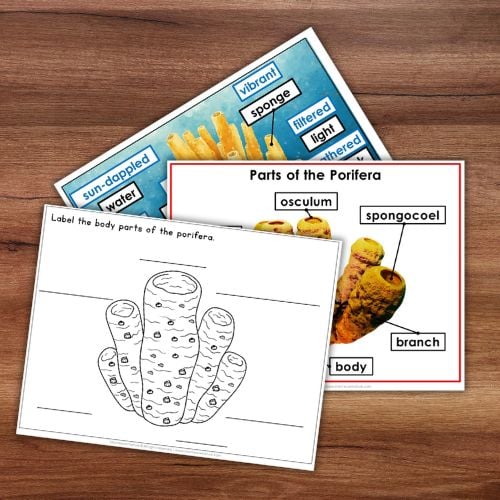
A sponge’s external anatomy is beautifully simple. The osculum is the large opening at the top where filtered water exits. The pores (ostia) are the tiny holes covering the body where water enters. The body wall is the outer layer of cells that surrounds the central cavity. Inside, the spongocoel is the hollow space where water collects before leaving. And hidden within the body wall are the spicules, the tiny, hard structures that form the sponge’s skeleton.
Each part has a specific job, and all work together to keep the sponge alive. This is the first example in evolution of specialized cells cooperating to sustain a single organism—a concept that children can see and touch with the right materials.
Hands-On Activities for Young Learners
The Water Filtration Demonstration
Fill a clear container with water and add a few drops of food coloring or a sprinkle of sand. Show children a natural sea sponge or a kitchen sponge. Explain that sponges filter water just like this, removing tiny particles. Pour the dirty water through a sponge into a second container. Children can see how the sponge traps particles while cleaner water passes through. This concrete experience makes the abstract concept of filter-feeding tangible.
Life Cycle Sequencing
Using life cycle cards, children arrange the stages in order. This simple activity builds sequencing skills and reinforces biological concepts. For older children, information cards with fill-in-the-blank options challenge them to recall key facts.
Spicule Observation
Real sponges contain tiny, hard spicules. For a safe, hands-on alternative, give children different types of kitchen sponges (coarse, fine, natural cellulose). Have them feel the textures and compare them. Explain that real sea sponges have tiny glass or chalk spikes inside them—their built-in skeleton.
Label the Parts
Using a labeled diagram, children identify the osculum, pores, body wall, and spicules. Tracing and writing worksheets provide practice for emerging writers. A student booklet allows children to create their own reference guide, reinforcing the vocabulary through repetition.
Budding with Play Dough
Roll a ball of play dough to represent a parent sponge. Create a small bump (bud) on the side. Show children how the bump grows larger. Then break off the bud and roll it into a separate ball. Explain that this is how sponges reproduce by budding—the new sponge is an exact copy of the parent.
A Resource for the Second Great Lesson
To bring these lessons into the classroom, the Porifera Sponge Learning Pack provides a complete set of Montessori-inspired materials. Children can explore the parts of a sponge with 3-part cards and labeled diagrams. They can sequence the life cycle with information cards and cut-and-paste worksheets. Characteristics posters and student booklets invite children to document their learning, while an adjective activity encourages creative language use.
This resource is designed for independent exploration, allowing children to follow their curiosity at their own pace. It serves as a natural supplement to the Second Great Lesson, giving children concrete materials to explore after hearing the story of how life began on Earth.
Sponges are the simplest animals on Earth, but they have an extraordinary story to tell. They were there at the dawn of animal life, over 600 million years ago. They invented the first skeleton and the first specialized cells. They have survived ice ages, continental shifts, and mass extinctions. And they are still here, quietly filtering the oceans, living for thousands of years, and reminding us that even the humblest creatures have a place in the grand story of evolution.
For teachers and homeschooling parents, sponges offer a perfect entry point into zoology, evolution, and the Second Great Lesson. With hands-on activities, fascinating facts, and carefully designed materials, children can discover that the first animals are still among the most wonderful.

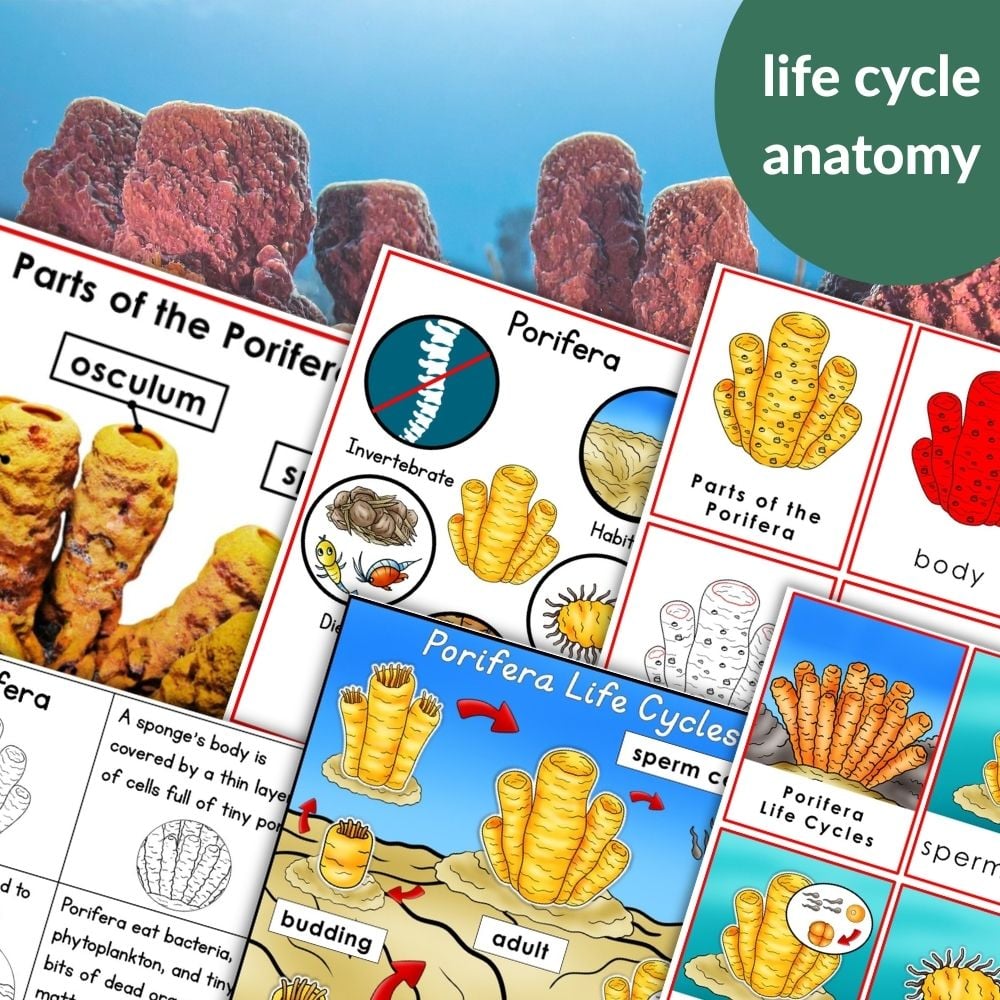
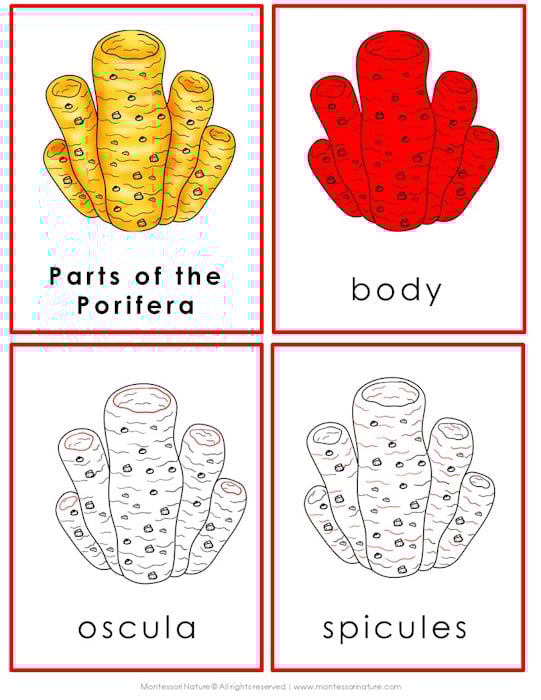
Parts of the Porifera Sponge Life Cycle Activities
This printable learning pack provides a hands-on introduction to Porifera (Sponge), the simplest of all multicellular animals. Designed for preschool, kindergarten, and Grades 1–3 students, this resource offers Montessori-inspired activities suitable for individual shelf work, learning centers, or small group lessons in homeschool and classroom settings.
You Might Also Enjoy


About Anastasia | Anastasia is an early childhood teacher with over twenty years of experience in Montessori classrooms and homeschooling. With a Master’s in Information Science, she blends education and information design to create clear, organized, research-backed resources. As founder of Montessori Nature, she develops evidence-based, nature-inspired printables that support holistic child development and foster curiosity, independence, and a love of learning. Explore more in her shop and Teachers Pay Teachers store.