Have you ever looked at a map with a child and heard them ask, “Why is that island shaped like a ring?” or “Can an island be made of coral?” If so, you already know that islands capture a child’s imagination like few other landforms.
Let’s explore the wonderful world of types of islands – from volcanic peaks rising out of the ocean to tiny coral atolls and even human‑made archipelagos.
Why Teach Types of Islands?
When children learn that not all islands are the same, something clicks. An island is no longer just “land surrounded by water.” It becomes a story:


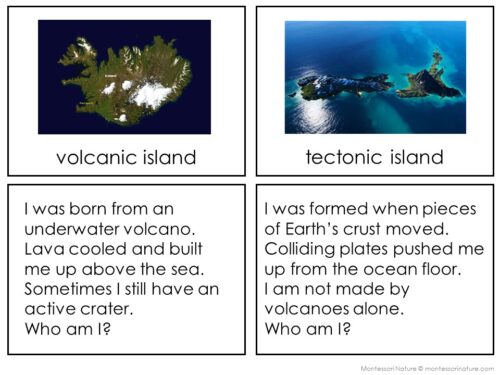
- A volcanic island is a tale of fire and lava building up from the seafloor.
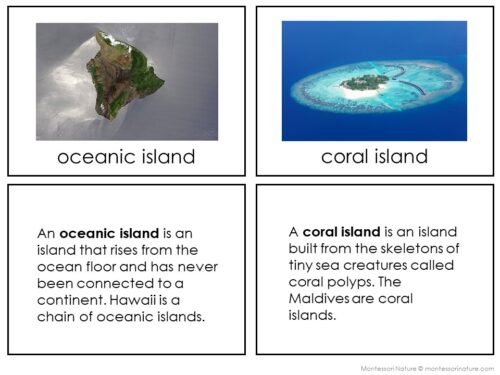
- A coral island is a slow, patient story of tiny animals building reefs over thousands of years.
- A tidal island is a magic trick – connected to the mainland at low tide, then cut off when the water rises.
- A barrier island is a protector, shielding the coast from storms.
These stories are perfect for elementary geography and science. They mix Earth’s processes (plate tectonics, volcanism, coral growth) with real‑world places children can find on a globe.
Hands‑On Science Activities for Exploring Island Types
Before we look at any printable, let’s get our hands dirty. These activities use simple materials and are perfect for a Montessori classroom or a homeschool kitchen table.
Activity 1: Build a Volcanic Island in a Bowl
What you need: A small bowl, sand or clay, baking soda, vinegar, red food coloring.
What to do: Shape the sand or clay into a cone inside the bowl, leaving a small crater at the top. This is your underwater volcano. Add a spoonful of baking soda into the crater. In a cup, mix vinegar with a few drops of red food coloring. Pour the vinegar into the crater. Watch the “lava” erupt and flow down the sides. Once the eruption stops, you will see that the cone has grown – just like a real volcanic island building itself above sea level.
What children learn: Volcanic islands form through repeated eruptions. Each layer of lava adds height until the volcano breaks the ocean’s surface.
Activity 2: Create a Coral Island (Atoll) with Play Dough
What you need: Play dough in two colors (green for land, blue for water), a small round cookie cutter.
What to do: Roll out blue play dough as the ocean. Use green play dough to form a small ring – not a solid circle, but a ring with a lagoon in the middle. That ring is a coral atoll. Explain that the atoll started as a volcanic island. Coral grew around it. Then the volcano sank, leaving only the ring of coral.
What children learn: An atoll is a coral reef that forms a ring around a sunken volcano. The Maldives and the Marshall Islands are famous atolls.
Activity 3: Model a Tidal Island
What you need: A shallow baking pan, clay, water, a small sponge.
What to do: Build a clay island close to the edge of a larger clay landmass (the mainland). Leave a narrow strip of clay connecting them – this is the “tidal causeway.” Pour water into the pan until it covers the low strip but not the island. That is high tide. Use a sponge to remove water until the strip reappears. That is low tide. The island is now connected to the mainland.
What children learn: A tidal island is only an island at high tide. Mont Saint‑Michel in France is a famous example.
Activity 4: Barrier Island in a Baking Pan
What you need: A long baking pan, sand, water, a small fan (optional).
What to do: Build a flat mainland coast along one long edge of the pan. In front of it, shape a long, narrow sandbar parallel to the coast – this is your barrier island. Pour water gently into the pan so the barrier island separates the open water from the lagoon behind it. If you have a fan, blow gently across the water to create small waves. Watch how the barrier island protects the mainland.
What children learn: Barrier islands absorb wave energy, protecting lagoons and coastal wetlands. The Outer Banks of North Carolina are barrier islands.
How the Printable Resource Helps (And Fits the Imaginary Island Project)
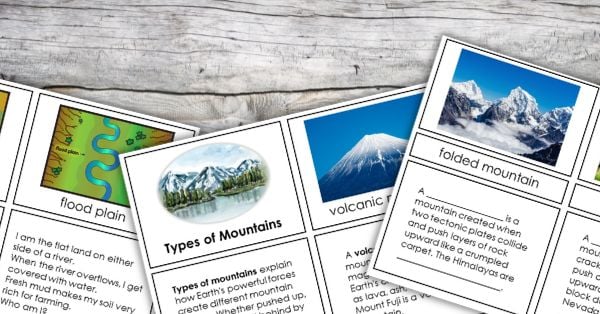
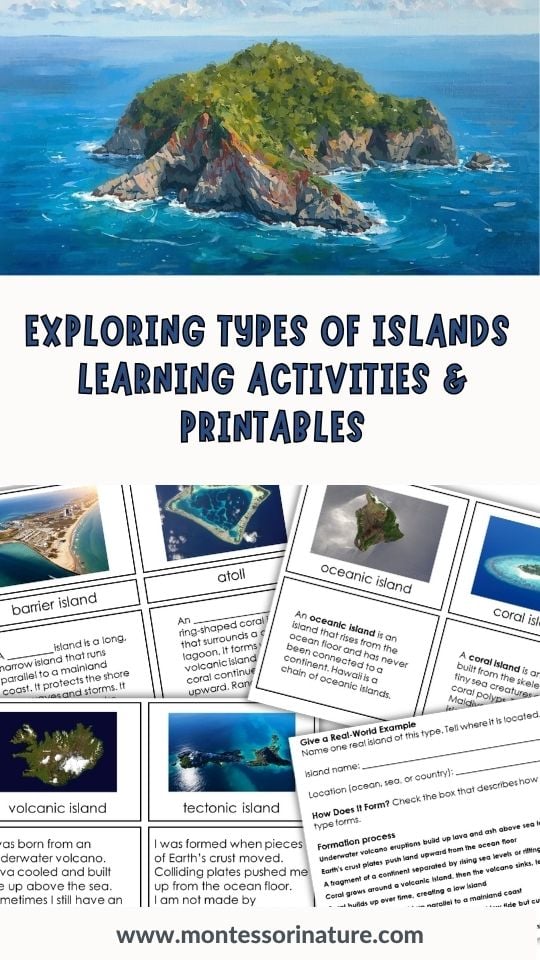
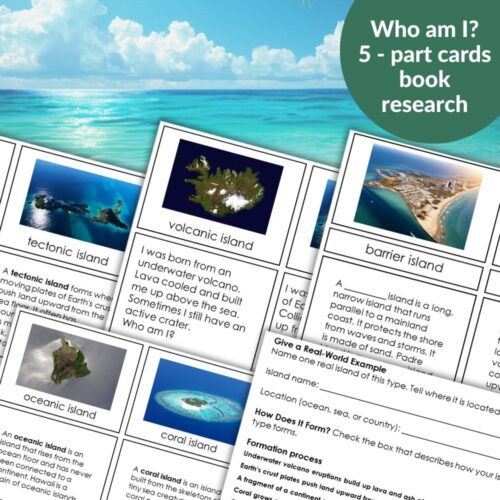
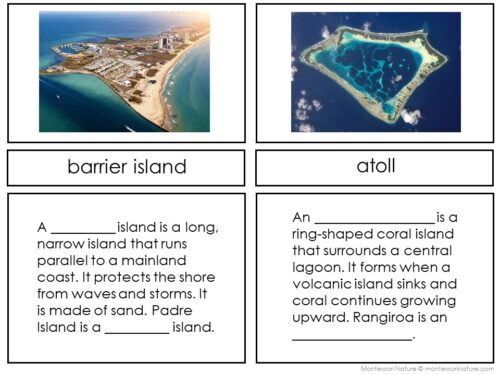
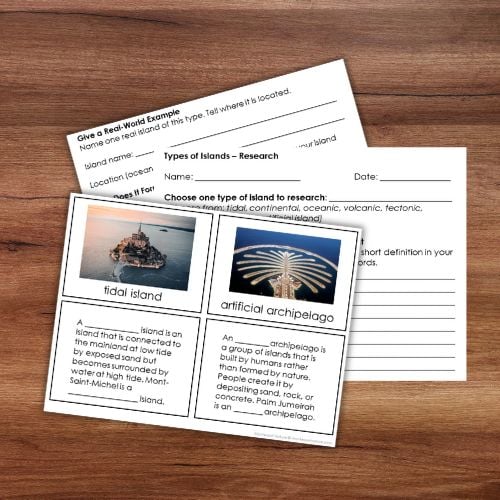
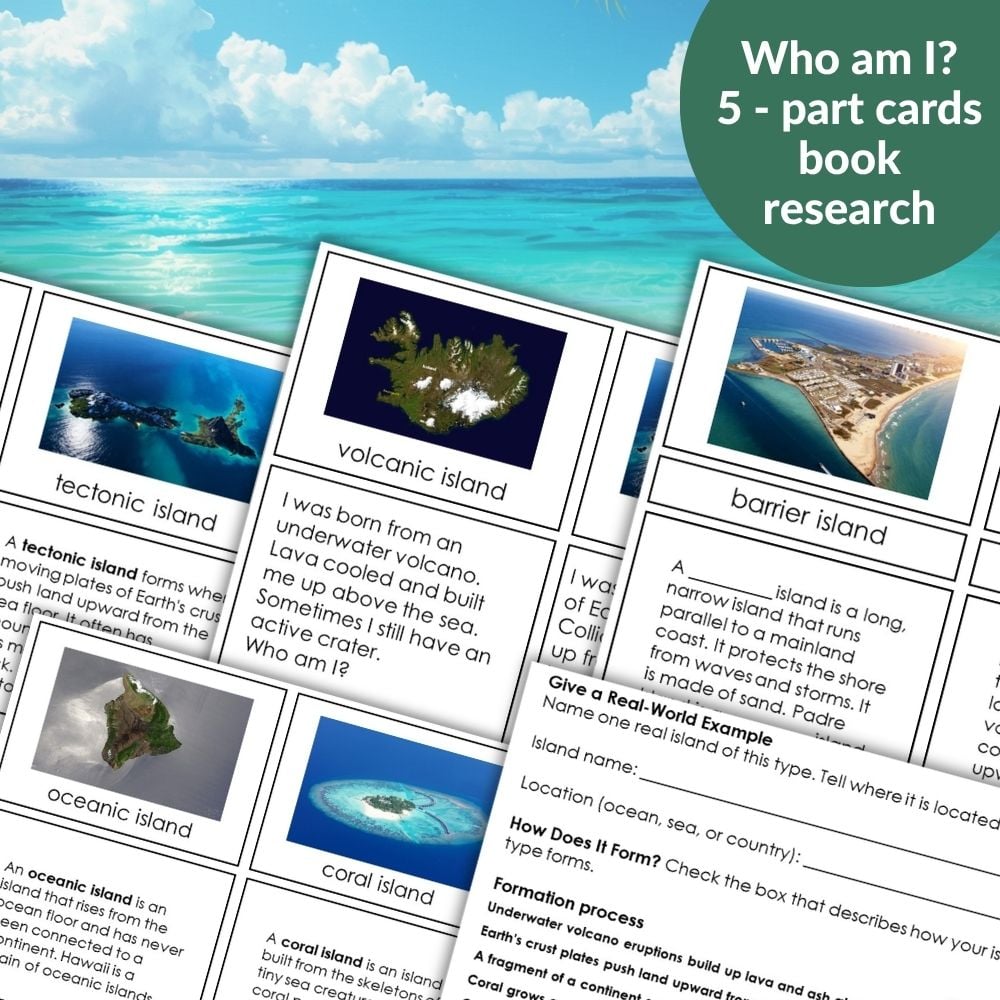
Now, let me tell you about a resource I created that makes teaching island types so much easier. It is a set of Types of Islands – Picture Cards, Definition Cards & Research Worksheet.
What’s inside?
The resource covers 10 island types:
tropical island, tectonic island, volcanic island, oceanic island, tidal island, barrier island, coral island, continental island, artificial archipelago, atoll
For each type you get:
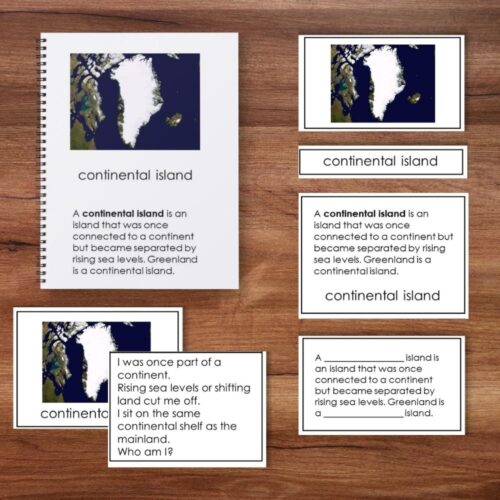
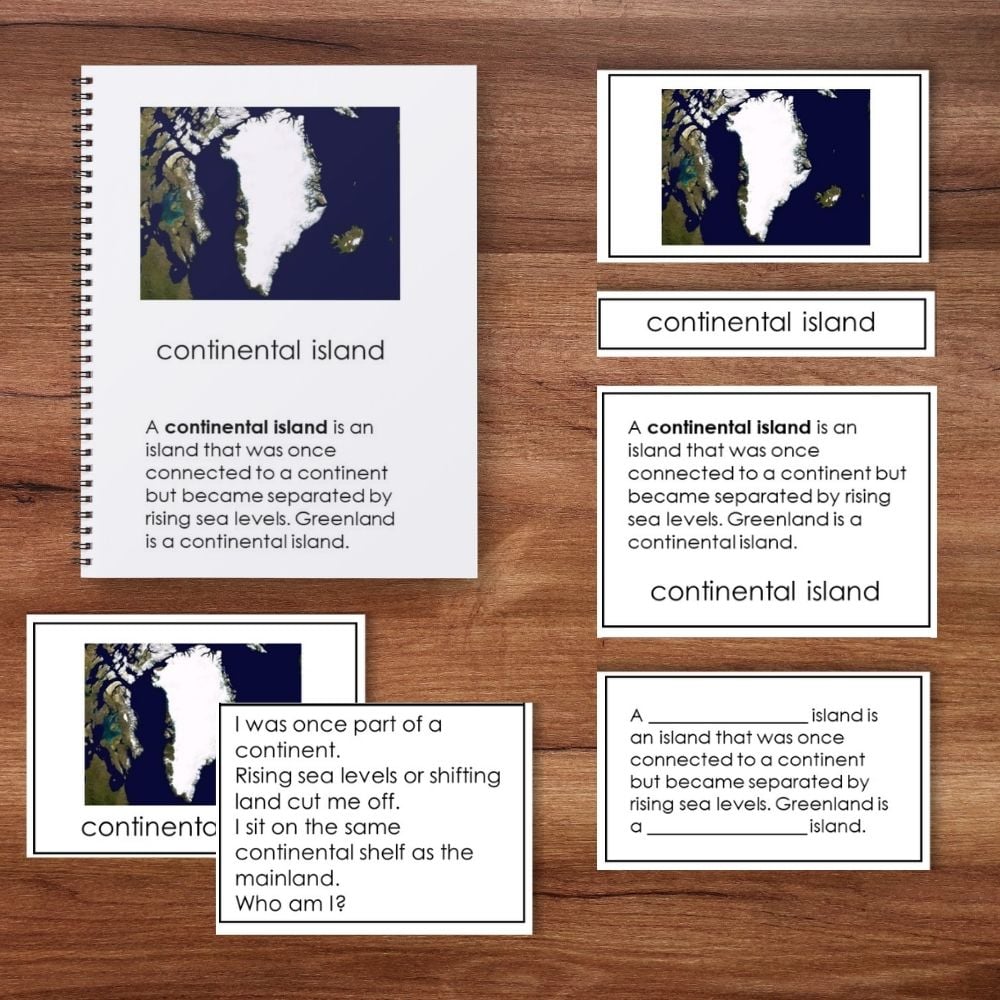
- A labeled picture card – clear, simple, and accurate.
- A definition card – a short 30‑word definition, easy for a 6‑year‑old to read.
- A cloze card (fill‑in‑the‑blank) – the same definition with the island name removed. Perfect for matching games and self‑checking.
- Plus a research worksheet where a child can dive deep into one island type: draw it, define it, give a real‑world example, write their own questions, and compare types.
How it guides the Imaginary Island project
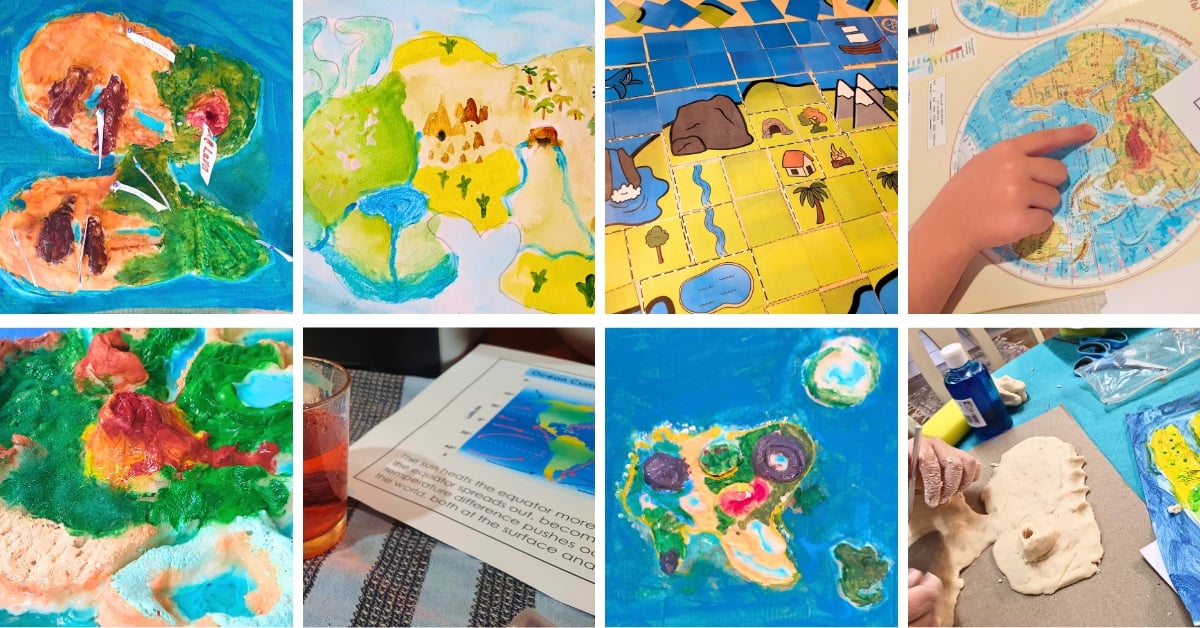
If you do the Montessori Imaginary Island project, you know that children build a large island in salt dough or clay and draw a topographic map. Often, they want to add smaller islands offshore. But what kind?
Without guidance, a child might just poke random lumps of dough. With these cards, they make purposeful choices.
A child studies the picture and definition of a barrier island and decides to sculpt a long, narrow island protecting their main coast. Another child reads about atolls and creates a ring of dough around a sunken volcano. A third child learns about tidal islands and builds one connected by a low strip of land that will “disappear” when they paint the water.
The cards answer the question: “What should I make?”
Using the Printables with Different Ages (6–9 vs. 9–12)
One of the things I love about this resource is how flexible it is.
For children ages 6–9:
Introduce only 4–6 island types at first (volcanic, coral, barrier, tropical, tidal).
Have them match picture cards to definition cards with your help.
Bind the matched pairs into a little reference book with a metal ring.
For the research worksheet, they only complete the drawing, the definition (copying from the card), and the real‑world example.
During salt dough time, ask them to add one offshore island and tell you its type.
For children ages 9–12:
Give them all 11 types at once.
Let them match picture to definition independently. Then use the cloze cards as a quiz.
Challenge them to sort the island types by how they form (volcanic, tectonic, coral, continental) vs. where they are (tropical, tidal, barrier).
Complete the full research worksheet for one island type – including writing two thoughtful questions and presenting to a small group.
In the Imaginary Island project, they must add at least three different island types offshore and write a short label for each.
A Sample Conversation from My Classroom
“I want to put an island here,” said Sam, pointing to a spot on their salt‑dough map.
“What kind?” I asked.
Sam pulled out our ring‑bound island reference book. “I think a barrier island. Look, it’s long and narrow and protects the mainland. That’s what I want.”
They shaped a thin ridge of dough parallel to their coast. Then they reached for the labels and wrote “Barrier Island” on a tiny flag.
That moment – where a child uses a resource to make an informed decision – is why I created these cards.
Islands are more than just dots on a map. They are volcanoes, coral cities, sand bars, and tidal wonders. With a few simple hands‑on activities and a clear set of picture and definition cards, your students will never look at an island the same way again.
And when they build their own Imaginary Island in salt dough, they will know exactly what kind of little island belongs off its shore.
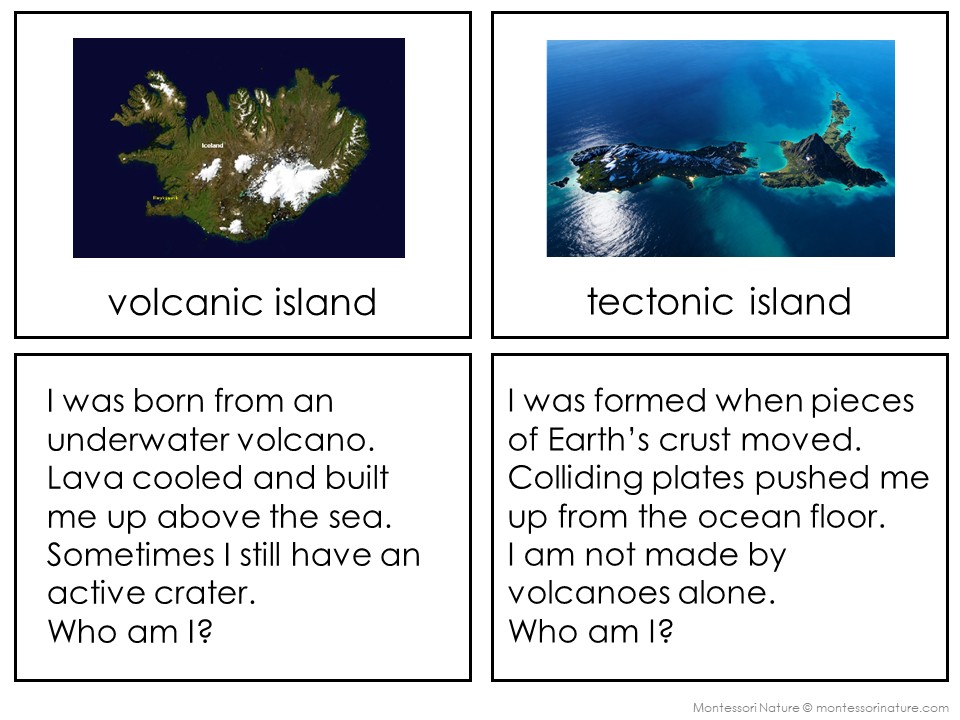
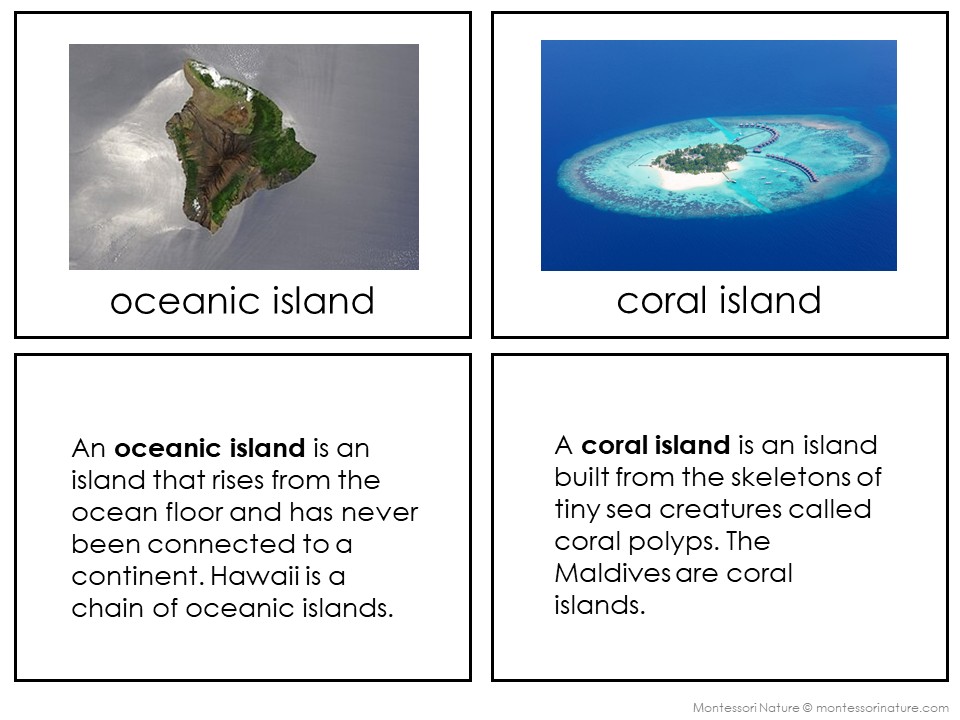
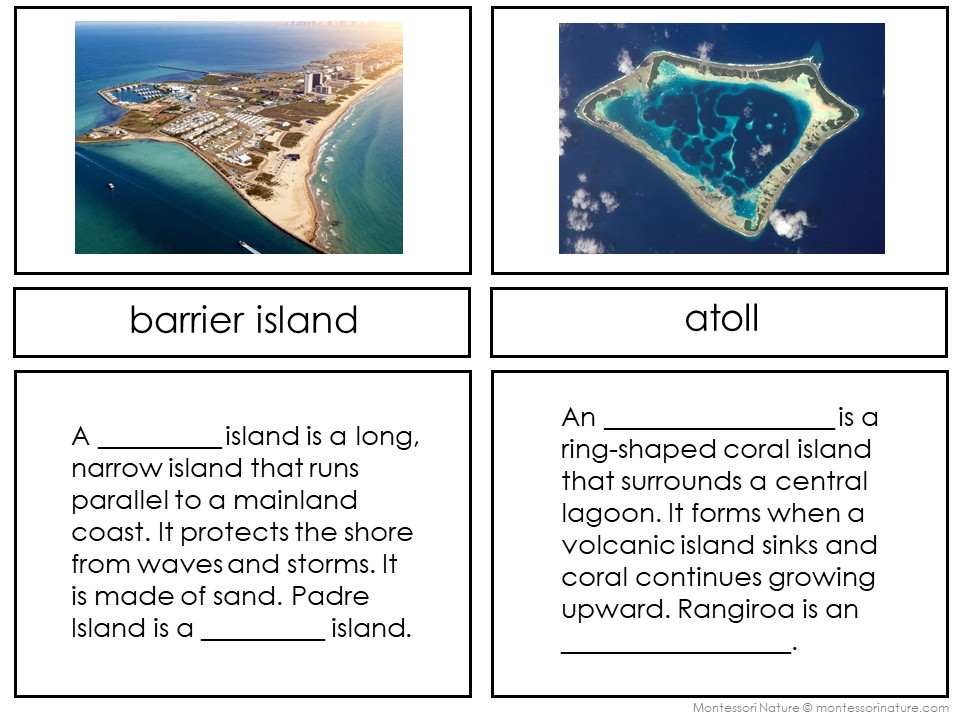
Types of Islands 5 Part Cards and Book
This Types of Islands resource supports the Montessori Imaginary Island project in both earth science and geography. It introduces 10 island types through 5‑part cards, a book, riddles, and a student research worksheet. Before children can create their imaginary Island, they can decide what kind of island it is. Is that a volcanic island or a coral atoll? This resource gives them the answers.
This printable is also available on TPT
You Might Also Enjoy

About Anastasia | Anastasia is an early childhood teacher with over twenty years of experience in Montessori classrooms and homeschooling. With a Master’s in Information Science, she blends education and information design to create clear, organized, research-backed resources. As founder of Montessori Nature, she develops evidence-based, nature-inspired printables that support holistic child development and foster curiosity, independence, and a love of learning. Explore more in her shop and Teachers Pay Teachers store.