Have you ever watched a single ant carry a crumb five times its size? Or followed a steady line of ants marching across the sidewalk, each one following the same invisible trail? If you have, you already know—ants are extraordinary.
These tiny insects have been roaming the Earth for over 140 million years. They were here when dinosaurs roamed. They have survived ice ages, droughts, and everything in between. Today, there are over 15,000 species living almost everywhere except Antarctica.
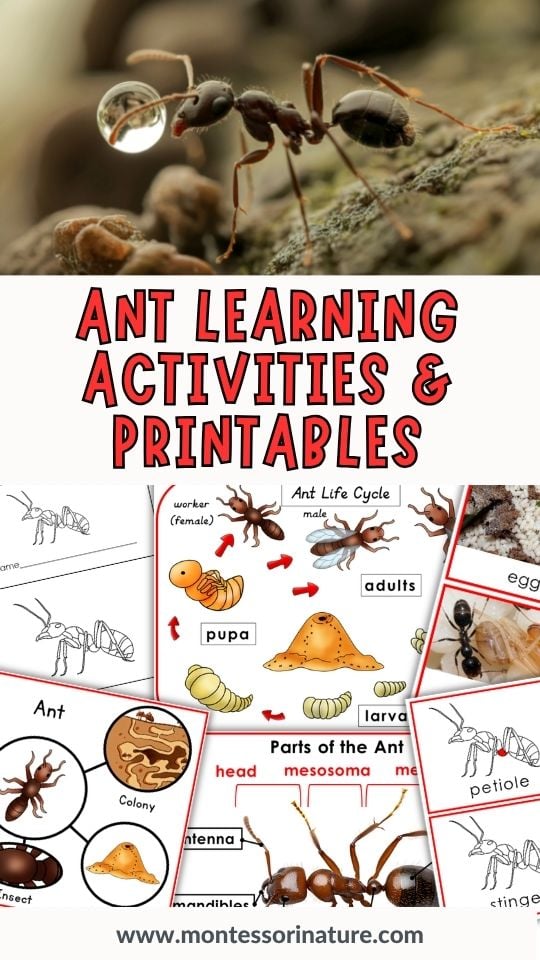
For children, ants offer a perfect window into the natural world. They are small enough to observe up close, fascinating enough to spark endless questions, and everywhere enough to study any time of year. Whether you are teaching a spring unit, a bug study, or following the Second Great Lesson on the coming of life, ants belong in your classroom.
What Makes Ants So Amazing?


Let me share a few facts that never fail to capture children’s imaginations.
Ants Are Super Strong
An ant can carry 10 to 50 times its own body weight. That would be like a child lifting a car. Their muscles are thick compared to their tiny size, giving them incredible strength.
Ants Have Two Stomachs
One stomach is for the ant’s own food. The other is a “community stomach” called the crop. When an ant finds food, it fills its crop and later shares it with hungry nestmates by regurgitating. They literally feed each other!
Ants Talk with Smells
Ants cannot speak or hear the way we do. Instead, they communicate using chemicals called pheromones. They leave scent trails for other ants to follow. Different smells mean different messages: “Food here!” “Danger!” “Follow me!”
Ants Are Farmers and Herders
Leafcutter ants cut leaves and carry them underground to grow fungus. They eat the fungus, not the leaves. Other ants keep aphids like tiny cows, protecting them and “milking” them for sweet honeydew.
Some Ants Are Living Food Storage
Honey pot ants have special workers that are fed so much sweet liquid that their abdomens swell into golden, grape-sized balls. Nestmates tap these living storage tanks when food runs low.
Queen Ants Live for Decades
Worker ants live only a few weeks or months. But a queen ant can live over 20 years. Some queens have lived nearly 30 years—laying millions of eggs over their lifetime.
Bringing Ants into Your Classroom: Hands-On Activities
The best way to learn about ants is to observe them. Here are simple, Montessori-friendly activities that invite children to explore ants through science, practical life, and art.
Science Activity: Build an Ant Observation Station
What you need: A small ant farm (or a clear jar with a dark paper sleeve), soil, a few ants, cotton balls, water, and tiny bits of fruit or honey.
What to do:
Set up the ant farm where children can watch without disturbing it. Cover the sides with dark paper so ants build tunnels against the glass. Peek under the paper each day. Children can draw what they see: tunnels, chambers, ants carrying food, and maybe even eggs or larvae.
What they learn: How ants work together, how they build their homes, and how they care for their young.
Practical Life Activity: Tweezing “Ant Food”
What you need: A small bowl, tweezers, tiny pom-poms or beads (food), and a second bowl (the nest).
What to do:
Invite the child to use tweezers to move each “food” piece from the foraging area to the nest. This mirrors how worker ants carry food back to their colony.
What they learn: Fine motor control, concentration, and an appreciation for how hard ants work.
Science Sorting: Ant Diet vs. Ant Predators
What you need: Two sorting mats labeled “Ant Food” and “Ant Predators,” plus picture cards of various items (nectar, seeds, fruit, anteater, bird, spider, etc.).
What to do:
Children sort the cards into what ants eat and what eats ants. Then discuss: Why do ants have so many predators? How do they protect themselves?
What they learn: The ant’s place in the food chain and ecological relationships.
Language Activity: Follow the Scent Trail
What you need: A cotton ball dipped in a mild scent (peppermint or vanilla extract), a plain cotton ball, and a blindfold.
What to do:
Blindfold a child (or have them close their eyes). Place the scented cotton ball a short distance away. Can they find it using only their nose? Then explain how ants leave invisible scent trails for their sisters to follow.
What they learn: How ants communicate and find their way home.
Art Activity: Draw a Cross-Section of an Ant Nest
What you need: Paper, pencils, crayons, and reference images of underground ant nests.
What to do:
Invite children to draw what lies beneath the ground. A queen in her chamber. Tiny eggs in a nursery. Workers digging tunnels. Larvae being fed. This is a wonderful follow-up after observing a real ant farm.
What they learn: The hidden structure of ant colonies and the division of labor.
Outdoor Activity: Ant Watcher’s Journal
What you need: A small notebook, pencil, magnifying glass, and a quiet spot near an anthill.
What to do:
Sit quietly and observe. What are the ants doing? Are they carrying food? Building their nest? Following a trail? Children draw what they see and write one or two sentences. Repeat over several days to notice patterns.
What they learn: Patience, observation skills, and real scientific inquiry.
Bringing It All Together with the Ant Learning Pack
To help you organize these lessons and give children beautiful, accurate materials to work with independently, I created the Ant Life Cycle and Anatomy Printable. This complete resource includes everything you need for a thorough study of ants.
Inside, you will find:
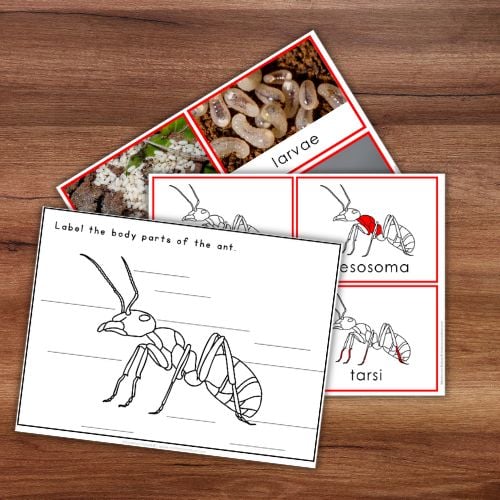
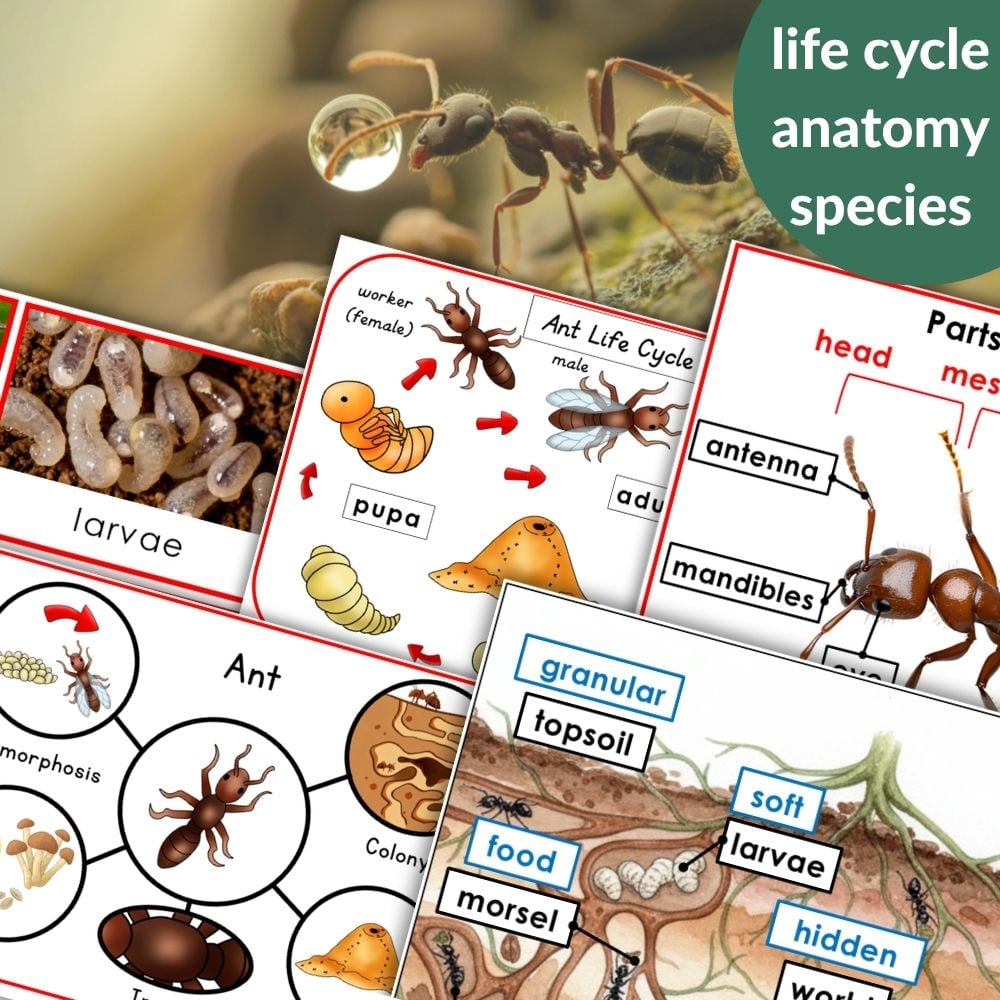
Parts of an Ant – Diagrams, 3-part cards, information cards, and student booklets for learning ant anatomy
Ant Life Cycle – Diagrams, 3-part cards, information cards, cut-and-paste worksheets, and tracing strips
Types of Ants – 3-part cards and information cards for ten fascinating species from around the world
Characteristics and General Information – Color posters, blackline masters, and a student reader about ants
Extended Activities – An adjective labeling activity for language enrichment
The materials are designed for children ages 3 to 9. Younger children can match picture cards and trace labels. Older children can read information cards, complete fill-in-the-blank activities, and write their own booklets. Every activity is self-paced and child-led, perfect for Montessori shelf work, learning centers, or homeschool study.
Ants are everywhere, yet they remain hidden in plain sight. We step over them, ignore them, or worse, sweep them away. But when we stop to watch—really watch—we enter a world of cooperation, strength, and quiet purpose.
Children naturally slow down. They kneel in the dirt. They follow a line of ants with their eyes. They ask, “Where are they going?” and “How do they know the way?” These are the beginnings of scientific thinking.
So this spring, let the ants be your teachers. Set up an observation station. Carry pom-poms with tweezers. Draw tunnel systems on paper. And let your children discover that even the smallest creatures have extraordinary stories to tell.
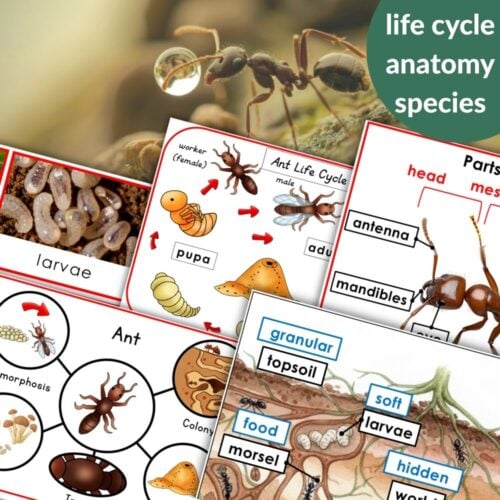
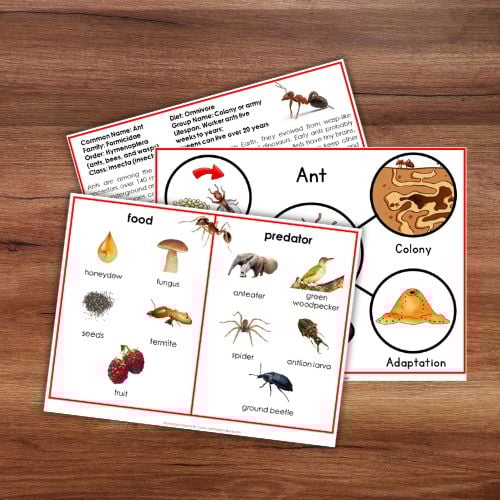
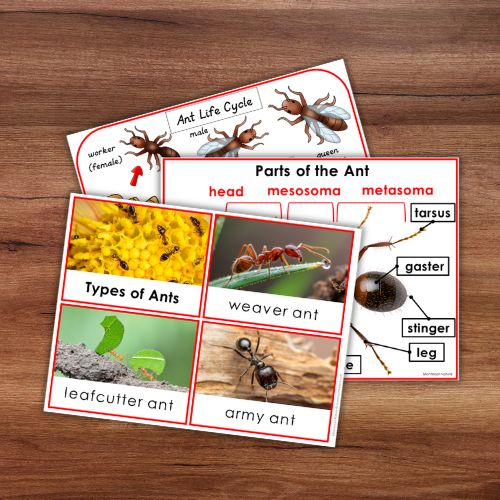
Ant Life Cycle and Anatomy Activities 3 Part Cards Blackline Master
Are you searching for ant printables, insect life cycle activities, or hands-on zoology materials for your Spring Unit and Bug Study? This comprehensive Ant Learning Pack offers a Montessori-inspired exploration of one of nature’s most fascinating insects. With realistic illustrations, 3-part cards, information cards, labeling diagrams, and student booklets, children will discover the ant life cycle, anatomy, types of ants, and fascinating adaptations that make ants such successful creatures.
This printable is also available on TPT
You Might Also Enjoy


About Anastasia | Anastasia is an early childhood teacher with over twenty years of experience in Montessori classrooms and homeschooling. With a Master’s in Information Science, she blends education and information design to create clear, organized, research-backed resources. As founder of Montessori Nature, she develops evidence-based, nature-inspired printables that support holistic child development and foster curiosity, independence, and a love of learning. Explore more in her shop and Teachers Pay Teachers store.