There is a moment in early spring when the world feels like it’s holding its breath. The snow has melted, the ground is soft, and then you hear it—a cheerful “cheerily, cheer-up, cheerily” song ringing through the morning air. The robins are back.
For generations, the return of the American Robin has been nature’s way of telling that spring has truly arrived. Montessori teachers and homeschooling parents have a beautiful opportunity to use this familiar visitor as a gateway for meaningful, hands-on learning. The robin is not just a bird; it is a living curriculum.
The Robin as Your Springtime Co-Teacher
When children spot that first robin running across the lawn, their curiosity awakens naturally. “Why is it tilting its head?” “What is it looking for?” “Where did it come from?” These questions are pure gold. They are the beginning of scientific inquiry, and the robin provides all the answers waiting to be discovered.
Observing robins teaches children about seasonal cycles. They watch as robins arrive, build nests, lay their famous blue eggs, and raise their young. This real-life drama unfolds right outside the classroom window or in the backyard, making abstract concepts like life cycles concrete and visible.

Robins also teach about adaptation. Children can observe how robins run across lawns, stop, and tilt their heads to listen for worms underground. They notice how the birds’ diets change from worms in summer to berries in winter. These observations lead to deeper conversations about how animals survive and thrive in their environments.
Lessons from the Robin’s World
The Wonder of Migration
“Why do robins leave in winter?” This question opens a door to geography, climate, and animal behavior. Children learn that robins follow food, traveling south when berries become scarce and returning north when insects and worms emerge in spring. Some robins don’t migrate at all, teaching us that animals, like people, make different choices.
The Art of Nest Building
A robin’s nest is a masterpiece of engineering. Watching a robin carry twigs, grass, and mud to a building site inspires children to appreciate the skill and effort involved. They learn that the female does most of the building while the male guards her—a lesson in partnership.
The Miracle of New Life
The pale blue eggs in a robin’s nest capture every child’s imagination. Watching the parents take turns incubating, then feeding hungry hatchlings, then teaching fledglings to fly—this is a story of family, care, and growth that resonates deeply with young children.
The Web of Life
Robins eat worms and insects and are themselves eaten by hawks, cats, and other predators. This simple food chain introduces children to ecological relationships and the interconnectedness of all living things.
Bringing Robin Learning to Life in Your Classroom
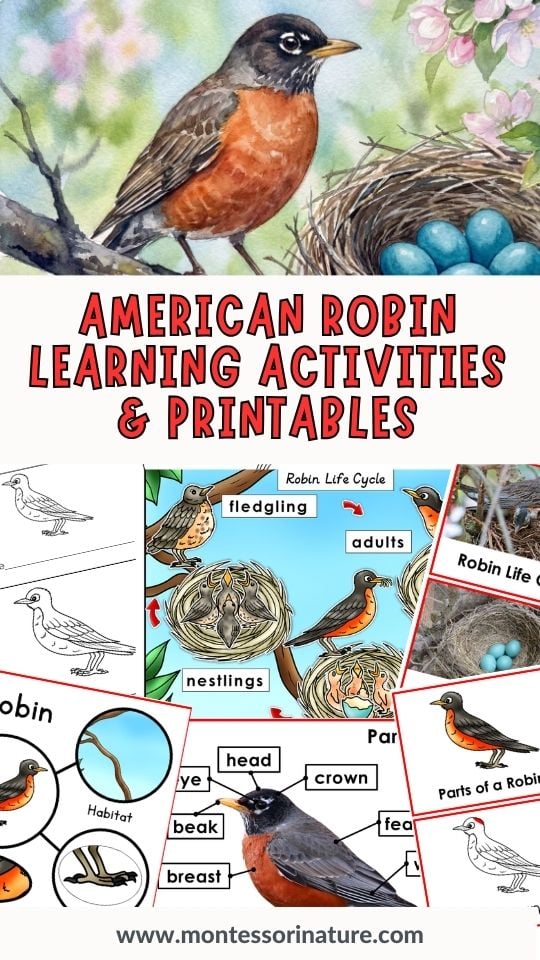
Hands-on learning happens when children can touch, see, and manipulate materials. That’s why we created the American Robin Life Cycle and Anatomy Printable—a complete Montessori-inspired resource that transforms robin observations into hands-on discovery.
A child sits with the Parts of a Robin 3-Part Cards, matching picture cards to labels, learning words like “crown,” “eye,” and “beak.” Later, they use the same vocabulary to label a robin diagram, their fingers tracing the words as they write.
Another child sequences the Robin Life Cycle Cards, arranging them from eggs to hatchlings to chicks to fledglings. They internalize the story of growth while building logical thinking skills.
At the science shelf, a pair of children use the Diet Sorting Cards, deciding which foods robins eat and which animals might eat robins. They are constructing their own understanding of food chains through active, hands-on work.
The “My Book About Robins” student booklet sits on a tray, inviting children to draw, color, and write about what they’ve learned. This becomes their personal record of discovery, something they can return to again and again.
For older children, the Anatomy Diagram Adjective Activity challenges them to describe each robin part with vivid language, combining science with language arts in a creative way.
A Spring Tradition in the Making
When you bring Robin studies into your classroom, you create something more than a lesson. You create a tradition. Each spring, children will watch for the first robin with new eyes. They will understand what that bird is doing, why it tilts its head, and what those blue eggs mean. They will become observers, questioners, and nature lovers.
The American Robin, that familiar visitor to every lawn, becomes a teacher of patience, observation, and wonder. And with the educational materials, you can guide that learning in ways that respect the child’s natural curiosity and the Montessori principles of hands-on, self-directed exploration.
So this spring, when you hear that first cheerful song, invite your children to follow it. The robin has so much to teach. Let’s help them listen.
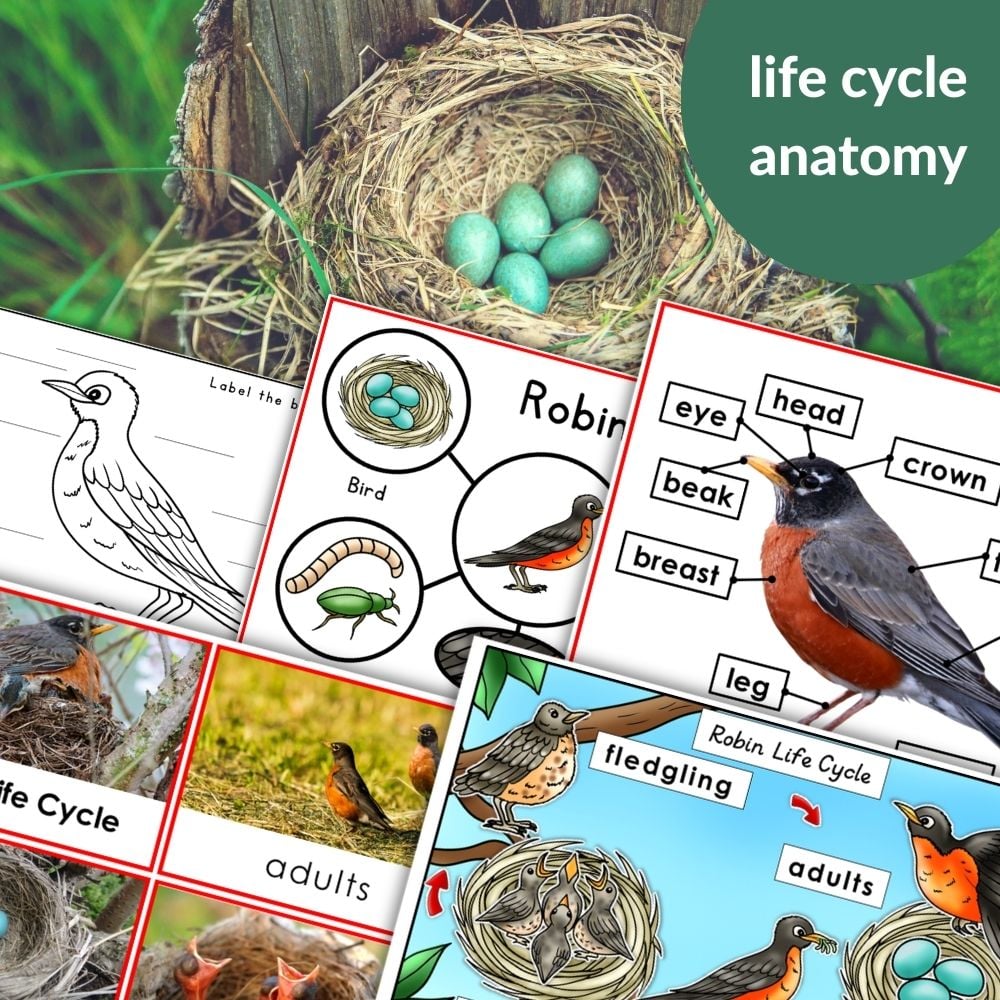
Parts of an American Robin Life Cycle Activities
Suitable for preschool, kindergarten, and Grades 1–3 students, this American Robin Life Cycle and Anatomy printable offers a comprehensive collection of Montessori-inspired hands-on activities perfect for individual shelf work, learning centers, or small group lessons in homeschool and classroom settings.
This printable is also available on TPT
You Might Also Enjoy



About Anastasia | Anastasia is an early childhood teacher with over twenty years of experience in Montessori classrooms and homeschooling. With a Master’s in Information Science, she blends education and information design to create clear, organized, research-backed resources. As founder of Montessori Nature, she develops evidence-based, nature-inspired printables that support holistic child development and foster curiosity, independence, and a love of learning. Explore more in her shop and Teachers Pay Teachers store.