Picture the classroom this winter. Outside the window, the world might be gray and bare, but inside, educators have the power to transport the young learners to one of the planet’s most magical and extreme places: the Arctic. This is not a realm of simple snowmen, but a dynamic, icy environment where survival is an art form, and every creature is a masterpiece of adaptation.
At the center of this frozen world, one animal captures the imagination like no other—the narwhal, the legendary “unicorn of the sea.” This creature is more than just a curiosity; it is the perfect gateway for a rich, multidisciplinary exploration that connects science, culture, and environmental stewardship. By journeying with the narwhal, we can help our students, aged 5-9, build a profound and lasting connection to our natural world.

A Whale Built for Ice
To understand the narwhal is to understand the Arctic itself. This is not a visitor but a true resident, living year-round in the frigid waters around Canada, Greenland, and Russia. Its entire existence is intertwined with the sea ice, which provides shelter, hunting grounds, and the very air it breathes through cracks and leads.


Every part of the narwhal tells a story of brilliant adaptation:
The Tusk: That iconic spiral is not a horn but a giant tooth, and it’s a marvel of nature. While it may play a role in social displays, cutting-edge science reveals it’s also a super-sensory organ. Its surface is porous, with millions of nerve endings that can detect tiny changes in water temperature and salinity. Imagine having a built-in tool that can “taste” the ocean!
The Blubber & Body: A narwhal’s body is about 50% fat—a thick, insulating blubber layer that is essential for life in freezing water. Its rib cage can even compress during incredibly deep dives, which can reach over 1,800 meters (nearly 6,000 feet) to hunt for Greenland halibut on the seafloor.
The Streamlined Form: Noticeably absent is a large dorsal fin. Instead, narwhals have a low dorsal ridge. This sleek design is no accident; it prevents ice from scraping their backs as they navigate under vast, shifting ice sheets.
Teachers of the North: Inuit Knowledge
Our scientific understanding of this elusive whale is profoundly deepened by the knowledge of the Inuit, the Arctic’s original scientists and stewards. For generations, Inuit communities have observed narwhals not as distant subjects but as vital neighbors.
The relationship is one of deep respect and sustenance. The Inuit rely on the narwhal for maqtaaq (skin and blubber), a nutrient-rich food, and for raw materials. This subsistence hunting is a regulated, cultural practice that continues today. More than hunters, the Inuit are astute observers. They identified that narwhal pods travel in complex social structures at different depths—a fact that corrected scientific population estimates, increasing them from 80,000 to over 170,000 individuals. They can even distinguish distinct “personalities” and physical traits between narwhal groups from different regions. This “way of knowing,” or Qaujimajatuqangit, is a testament to a holistic understanding we strive to emulate: seeing the animal within its entire ecological and cultural context.
Bringing the Story to Life: Montessori-Inspired Explorations
A thematic unit on the narwhal and the Arctic is a perfect opportunity for the hands-on, child-led learning that defines the Montessori approach. Here are a few ways to make the concepts tangible.
- The Blubber Experiment: Feeling the Adaptation
Concept: Insulation and animal adaptation.
Activity: Fill two bowls with ice water. Have a child place one bare finger in the first bowl. For the second bowl, create a “blubber glove” by sealing a thick layer of vegetable shortening inside a plastic bag. The child places their other finger inside this bag and then into the icy water. The immediate, dramatic difference in sensation makes the purpose of blubber unforgettable.
- Arctic Habitat Sensory Bin: Building the Biome
Concept: Arctic ecology and animal habitats.
Activity: Create a mini Arctic in a large bin. Use a base of “snow” (baking soda and conditioner mix or cotton balls) on one side. Add blue-tinted water and icebergs (frozen water in muffin tins) to the other. Provide figurines of narwhals, belugas, polar bears, and seals. As children arrange the scene, guide them with questions: “Where does the narwhal breathe?” “Where might a polar bear wait?” “Is this animal a predator or prey for the narwhal?”
- Camouflage & Color Exploration: The Changing Arctic
Concept: Animal camouflage and seasonal change.
Activity: Discuss how many Arctic animals, like the fox, change color with the seasons. Provide children with white and brown felt pieces or construction paper against a white “winter” background and a brown “summer” background. Ask them to place toy animals on the matching background and discuss why blending in is important for both hunter and hunted.
- Life Cycle Sequencing: The Story of Growth
Concept: Biological life cycles.
Activity: Using simple cards or drawings, children can sequence the narwhal’s life stages: calf (born in summer, staying close to mom), adolescent (developing its tusk), and adult. This connects beautifully to broader lessons on mammalian traits—they are warm-blooded, breathe air, and nurse their young.
Your Gateway Resource: The Narwhal Nature Study Printable
To weave all these threads together seamlessly in your classroom, a structured resource can be invaluable. The Narwhal Life Cycle and Anatomy Printable is designed specifically for this purpose. It transforms fascinating facts into interactive, hands-on learning that aligns perfectly with a child’s natural curiosity.
This printable pack helps children construct their own understanding through:
Labeling Activities: Identifying the tusk, dorsal ridge, fluke, and blubber makes complex anatomy accessible.
Sequencing Work: Arranging life cycle stages builds logical thinking and narrative skills.
Vocabulary Building: Terms like “echolocation,” “bottom feeder,” and “adaptation” become part of their expanding lexicon.
Integrated Learning: Sorting activities for “Food vs. Predators” connect science to broader ecological concepts.
By starting with the captivating story of the narwhal, we open a door. We invite children to marvel at adaptation, respect indigenous wisdom, and grasp the delicate balance of an ecosystem. In doing so, we’re not just teaching about a whale; we’re nurturing the next generation of curious minds and compassionate caretakers for our wondrous planet.
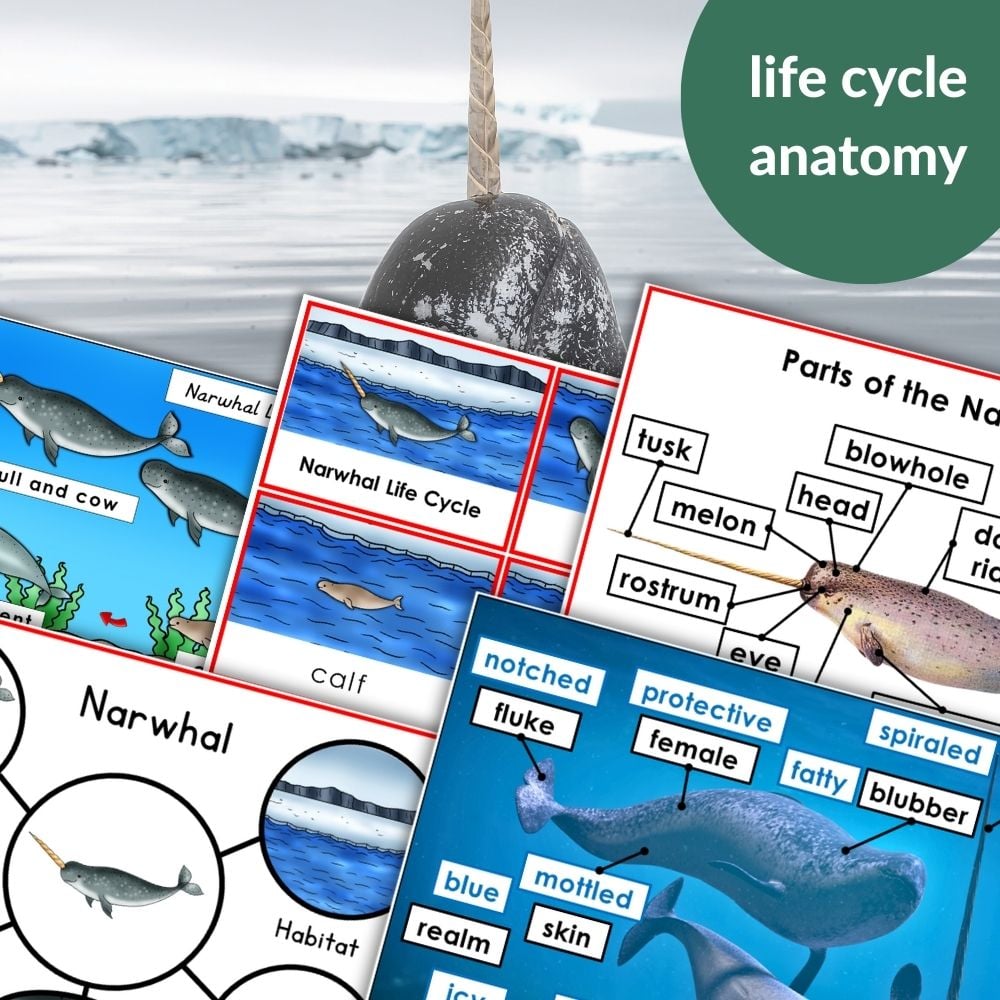
Parts of a Narwhal Life Cycle Activities 3 Part Cards Blackline Master Poster
Suitable for preschool, kindergarten, and Grades 1–3 students, this Narwhal Life Cycle and Anatomy printable offers a variety of Montessori-inspired hands-on activities perfect for individual shelf work, learning centers, or small group lessons in both classroom and homeschool settings.
This printable is also available on TPT
You Might Also Enjoy
About Anastasia | Anastasia is an early childhood teacher with over twenty years of experience in Montessori classrooms and homeschooling. With a Master’s in Information Science, she blends education and information design to create clear, organized, research-backed resources. As founder of Montessori Nature, she develops evidence-based, nature-inspired printables that support holistic child development and foster curiosity, independence, and a love of learning. Explore more in her shop and Teachers Pay Teachers store.