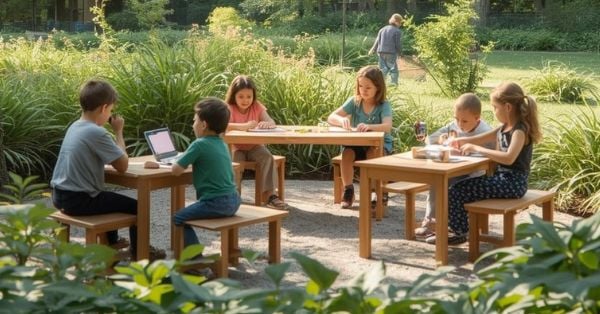
How to create the conditions where naughtiness disappears and children flourish
There is a passage in Montessori’s 1946 London Lectures that speaks directly to something I’ve seen with my own eyes, again and again. It’s about the quiet power of environment and the profound impact of love.
She writes:
“In our plan for the education of little children we must create an attractive environment. Into this environment we must put everything that is good for the mind, along with an understanding and affectionate person…. Naughtiness will disappear if we give children the right environment at a sufficiently early age. This environment must provide a great deal of mental food and warm, loving treatment.”
I read these words and I feel both a deep sense of relief and a profound responsibility.

Relief, because Montessori is telling us something so simple: when children are placed in the right environment, with the right nourishment and the right love, difficult behaviors naturally fade. The “naughtiness” we struggle with isn’t a permanent flaw in the child. It’s a symptom of something missing in their world.
Responsibility, because she’s also telling us: the environment is our work. Not just the physical space, but the quality of our presence. The warmth of our treatment. The richness of what we offer their minds.
This isn’t about perfection. It’s about intention. About creating spaces and relationships where children can flourish.
So what does this look like in practice? How do we create environments that are truly attractive, mentally nourishing, and filled with loving warmth?
Here are some steps I’ve been gathering.
1. Create an Environment That Attracts, Not Just Contains
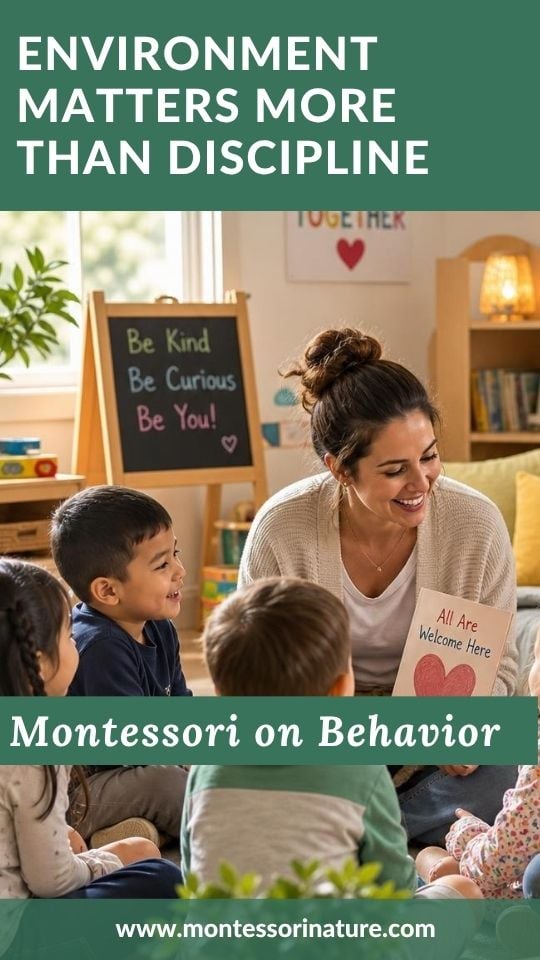
Montessori says “attractive environment.” Not just functional. Not just safe. Attractive. Beautiful. Worthy of the child. This is about more than aesthetics—it’s about what the space communicates to the child’s soul.
Actionable step this week:
Look at your environment—classroom or home—through the eyes of a child. Ask:
- Does this space invite me in?
- Is there beauty here? A plant? Soft light? A carefully arranged shelf?
- Does it say, You belong here. This is for you. This is worthy of you.
This week, make one small change to increase the attractiveness of your space. A vase with fresh flowers. A shelf arranged with care. A corner with a soft rug and a basket of beautiful materials.
The environment speaks before you say a word.
2. Fill the Environment With “Everything Good for the Mind”
Montessori doesn’t limit mental food to academics. She means everything that nourishes the growing mind: beauty, order, language, culture, nature, art, music, meaningful work.
Actionable step this week:
Take inventory of what you’re offering your child’s mind. Ask:
- Are there opportunities for discovery and wonder?
- Are there books, images, objects that speak to their curiosity?
- Is there a connection to nature, to art, to the wider world?
- Are the materials on the shelf rich and inviting, or tired and neglected?
Add one new source of “mental food” this week: a beautiful picture book, a collection of natural objects, a simple piece of art, a new song to sing together.
3. Be the “Understanding and Affectionate Person”
Montessori says we must put into the environment “an understanding and affectionate person.” That’s you. Your presence is the most important element of the child’s world.
Actionable step this week:
Reflect on your own presence. Ask yourself:
- When a child approaches me, do I seem glad to see them?
- Do I listen with patience, even when I’m tired?
- Do I offer warmth freely, or only when behavior is “good”?
- Can a child count on me to understand, not just correct?
This week, practice one small shift in your presence: a warmer greeting, a slower response, a softer tone. Let your affection be visible, not withheld.
4. Trust That “Naughtiness Will Disappear”
Montessori’s claim is bold: “Naughtiness will disappear if we give children the right environment at a sufficiently early age.” Not just reduced. Disappear. This is a profound trust in the child’s nature.
Actionable step this week:
When you see challenging behavior, pause before reacting. Instead of asking “What’s wrong with this child?” ask “What’s missing from this environment?” or “What need is going unmet?”
- Is the child bored? Hungry for meaningful work?
- Is the space chaotic or overwhelming?
- Is the child seeking connection and not finding it?
- Is the rhythm off—too rushed, too slow, too unpredictable?
Address the environment, and the behavior often resolves itself.
5. Provide “A Great Deal of Mental Food”
Montessori says “a great deal” of mental food. Not a little. Not occasional. A great deal. Children’s minds are voracious. They need rich, sustained nourishment.
Actionable step this week:
Look at your child’s daily diet of experiences:
- Are they spending time outdoors, observing, wondering?
- Are they hearing rich language—stories, conversations, poems?
- Are they being exposed to music, art, culture?
- Are they engaged in meaningful work that challenges their minds?
This week, add one new form of mental nourishment. A trip to the library. A nature walk with observation. A new piece of music to listen to together. A conversation that stretches their thinking.
6. Offer “Warm, Loving Treatment”—Unconditionally
Montessori emphasizes “warm, loving treatment.” Not love that’s earned or conditional. Not warmth that appears when behavior is good and disappears when it’s not. Steady, reliable, present love.
Actionable step this week:
Reflect on whether your warmth is conditional. Are you more loving when things go well? Do you withdraw warmth when children are difficult?
This week, practice offering warmth consistently:
- A gentle touch on the shoulder, even when you’re frustrated.
- A kind word, even when they’ve made a mistake.
- A hug, even when they’re having a hard day.
- A loving gaze, just because they’re here.
- Let your treatment be a constant, not a reward.
7. Start Early—But It’s Never Too Late
Montessori says “at a sufficiently early age.” She knew that the earlier we provide the right environment, the deeper the foundation. But while early is ideal, change is possible at any age.
Actionable step this week:
If you’re just discovering these ideas, don’t despair. Start where you are. Make one small change this week. Then another. Then another.
If you’ve been doing this work for years, keep going. The effects compound over time. Your consistency is building something beautiful.
8. See Environment and Love as One Gift
Montessori doesn’t separate the physical environment from the loving person. They’re part of the same gift. The space and the warmth together create the conditions for transformation.
Actionable step this week:
Look at the interplay between space and relationship:
- Does the environment support your warmth, or work against it?
- Are you able to be loving because the space is orderly and calm?
- Can the child trust both the space and you?
This week, align your space and your presence. Let them work together to say: You are welcome. You are safe. You are loved.
A Simple Challenge for This Week
Choose one of these steps—just one—and try it.
- Make your environment more attractive.
- Add one new source of mental food.
- Practice being an understanding, affectionate presence.
- Trust that addressing the environment addresses behavior.
- Add a new form of mental nourishment.
- Offer warmth unconditionally.
- Start where you are, and begin.
- See environment and love as one gift.
Then notice what shifts. In the children. In you.
Montessori’s words about environment and love aren’t just a strategy. They’re a vision of how children are meant to be raised.
An environment that says you matter. A mind that’s nourished with good things. A presence that’s understanding and warm. This is what children need. Not just to behave, but to thrive.
And when they get it? The “naughtiness” fades. Not because they’ve been controlled, but because they’re whole. They’re satisfied. They’re living in a world that meets their deepest needs.
That’s our work. Not to fix children. But to create the conditions where their best selves can emerge.
And that work is beautiful.
You Might Enjoy




About Anastasia | Anastasia is an early childhood teacher with over twenty years of experience in Montessori classrooms and homeschooling. With a Master’s in Information Science, she blends education and information design to create clear, organized, research-backed resources. As founder of Montessori Nature, she develops evidence-based, nature-inspired printables that support holistic child development and foster curiosity, independence, and a love of learning. Explore more in her shop and Teachers Pay Teachers store.