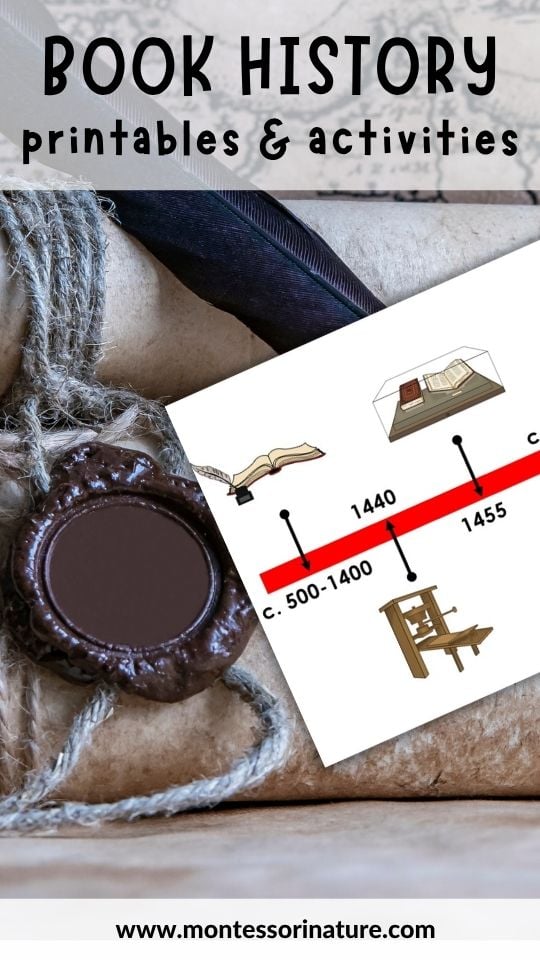
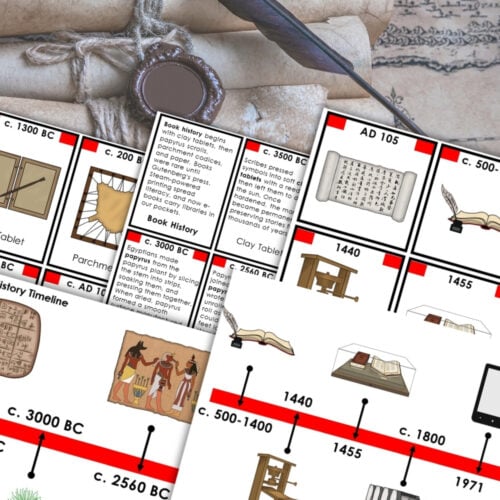
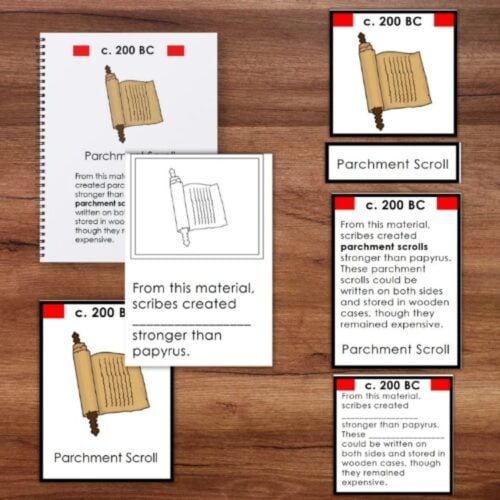
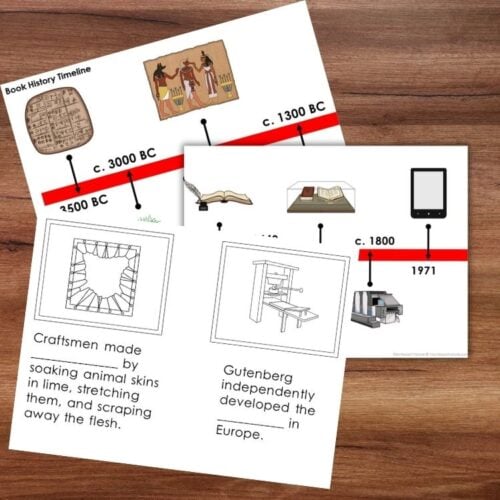
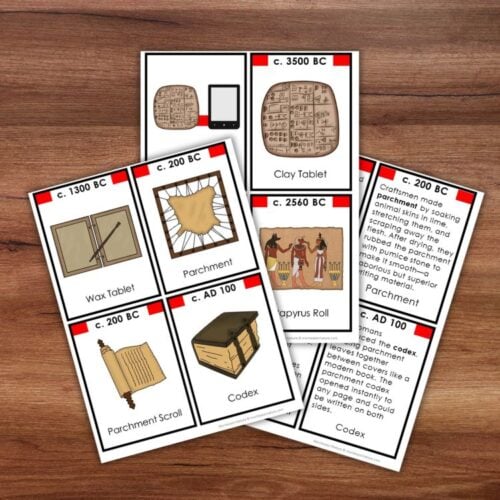
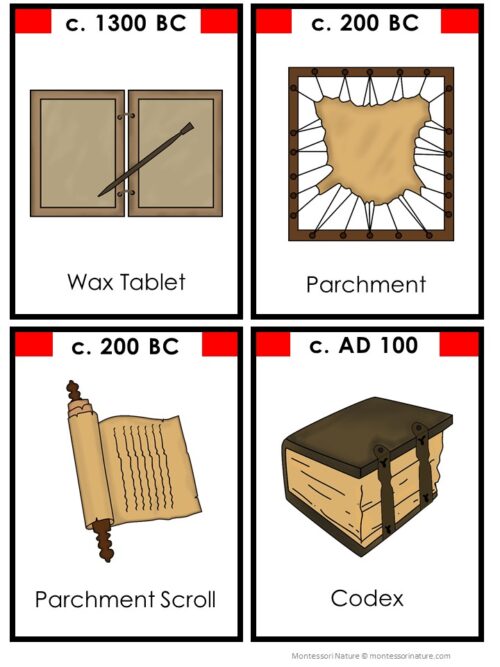
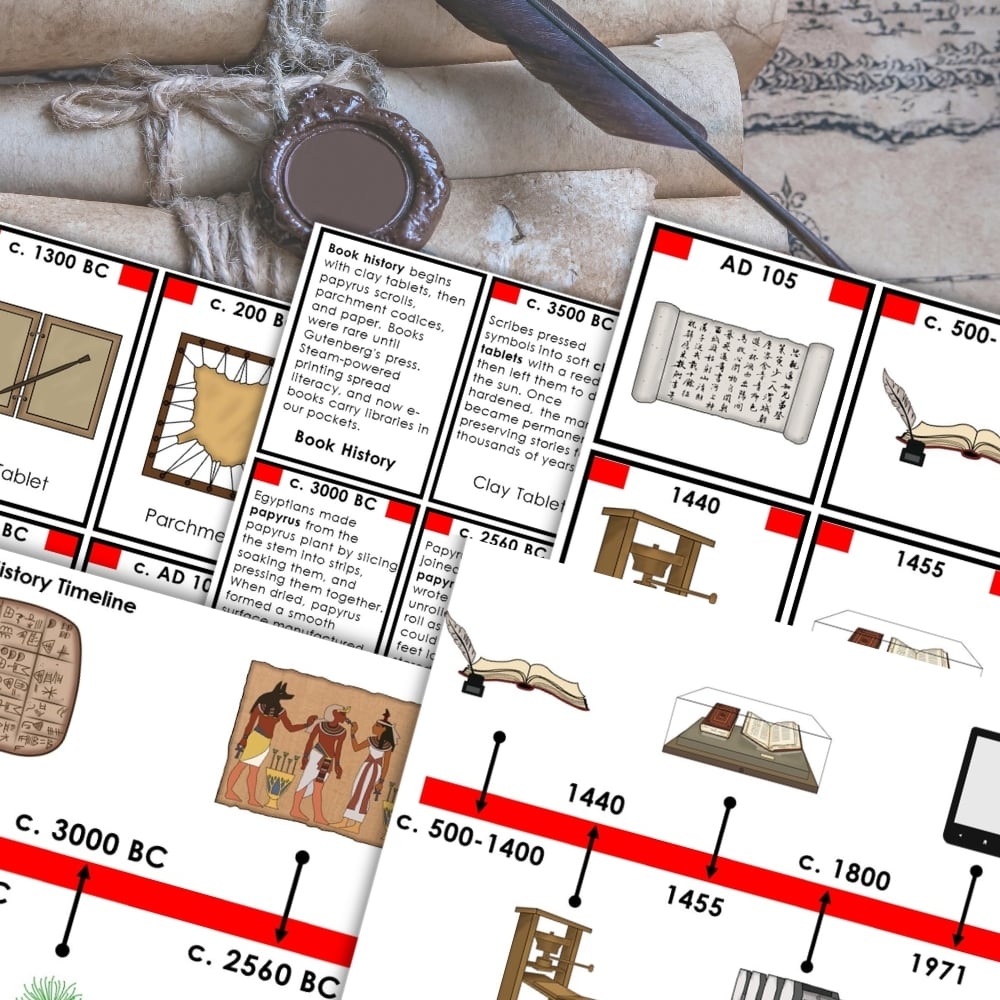
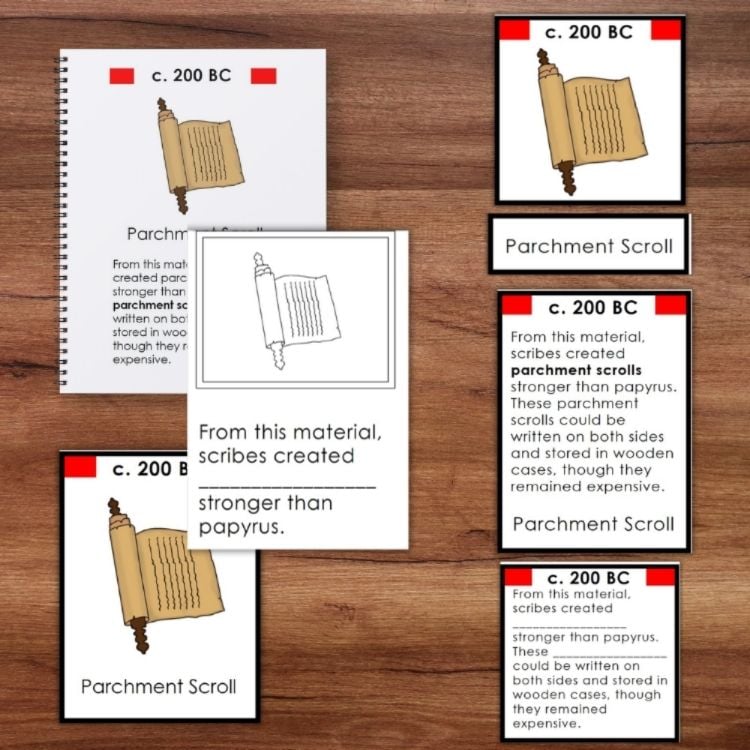
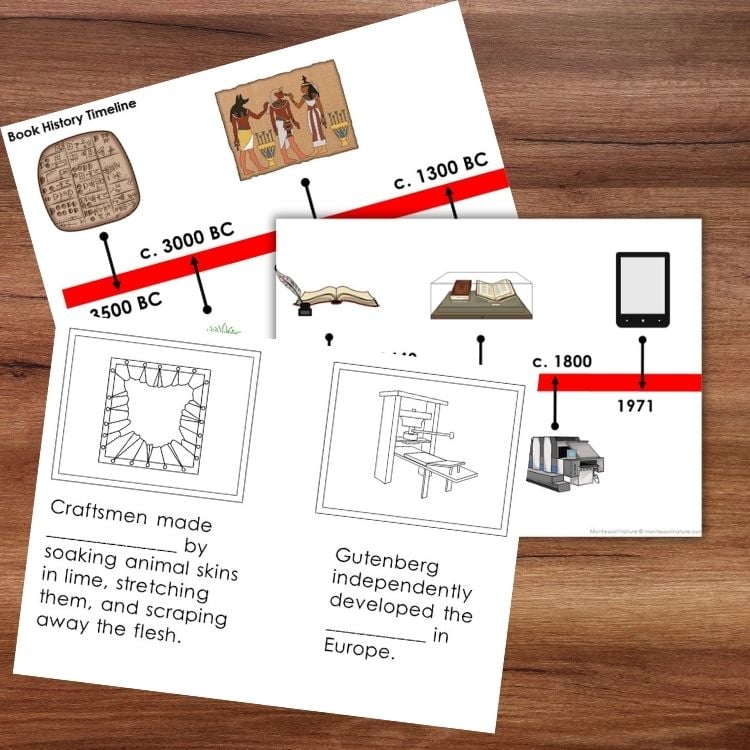
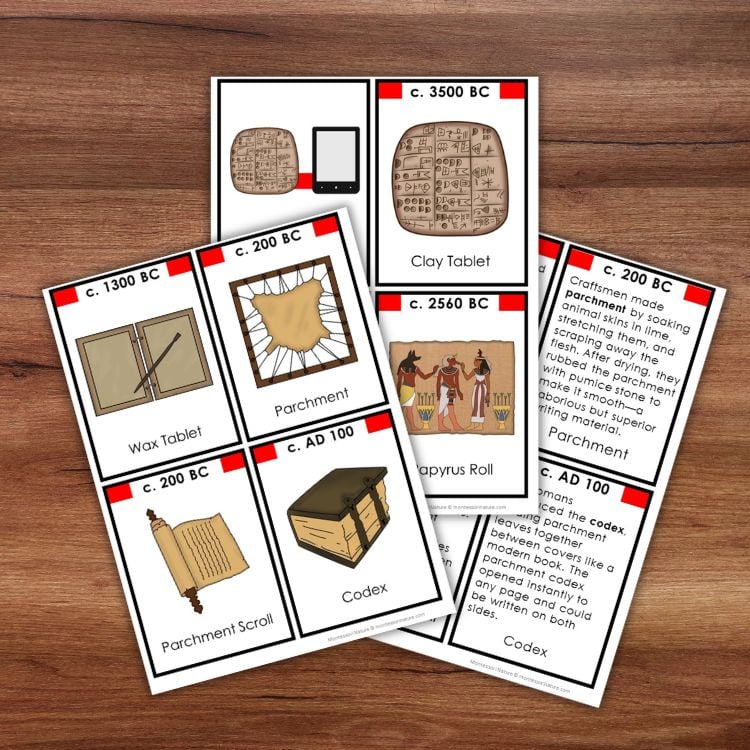
This Book History printable includes 5‑part cards for each format—Clay Tablet, Papyrus Scroll, Wax Tablet, Parchment Codex, and so many more. There are definition cards, cloze cards, and control cards for independent self-correction. I included a timeline overview in both color and blackline, plus a student booklet for coloring and writing.
And best of all, there is an easy-to-assemble book that requires no cutting—just folding and stapling. It contains pictures, terms, and definitions, perfect for independent reference.
We’ve used it to create timelines, research projects, and map activities. We’ve compared scrolls to codices and discussed why early Christians favored the codex. We’ve explored the contributions of Chinese inventors, Korean artisans, and Islamic scholars.
My students have pressed symbols into clay, written on wax tablets with styluses, and created their own illuminated manuscript pages.
They have seen, firsthand, how human creativity has built upon itself—each invention solving a problem, each format improving upon the one before it.

And through it all, they have come to understand a profound truth: books are not just objects. They are the containers of our shared humanity.
I remember the first time I held a book that was truly mine. It was a worn paperback, the spine cracked from countless readings, the pages soft with age. I didn’t just read that book—I lived in it. I carried it everywhere, folded page corners to mark my place, and traced the words with my finger as I fell into worlds far beyond my own.
That book, like every book before it, was part of a story much older than mine. A story that begins not with printing presses or paper, but with a fundamental human need: the need to understand, to remember, and to share.
The Human Need for Knowledge
In Montessori education, we talk about Fundamental Human Needs—the basic requirements that all people, across time and culture, have worked to fulfill. We need food and shelter, yes. But we also need love, spirituality, art, and perhaps most profoundly, knowledge.
We need to know where we came from. We need to record what we have learned. We need to pass wisdom from one generation to the next, so that our children can build upon the discoveries of those who came before them.
This need for knowledge is not new. It is as old as humanity itself. And it is this very need that gave birth to the book.
From Clay to Scroll: The First Pages
Imagine a scribe in ancient Mesopotamia, pressing a sharp reed into soft clay. The sun is hot, and the clay is drying quickly. He works with care, because these marks—these tiny wedges—will outlive him. They will speak to his grandchildren’s grandchildren, telling them of harvests and kings and gods.
This was the beginning. The clay tablet was heavy and fragile, but it preserved stories for thousands of years. It was a response to a deep, aching human need: the need to be remembered.
Then came the Egyptians, who discovered that the papyrus plant, growing wild along the Nile, could be sliced, soaked, and pressed into a smooth surface. Papyrus scrolls were lighter, longer, and easier to store. For the first time, knowledge could travel. Scrolls were carried on ships, traded across seas, and read in distant lands.
But still, people sought something better.
The Codex and the Church
The Romans gave us the codex—pages bound together between covers, much like the books we know today. It was portable, durable, and easy to use. You could open it to any page instantly, without unrolling a cumbersome scroll.
And who embraced this new technology with the most fervor? The early Christians.
They needed to spread their scriptures quickly and widely. They needed texts that could be carried by missionaries, hidden during persecution, and shared among communities. The codex became the vessel for their faith. It was not just a practical choice—it was a spiritual one.
For centuries, monks in monastic scriptoriums painstakingly copied sacred texts by hand. These illuminated manuscripts were works of art, decorated with gold leaf and vibrant colors. Each one took months or even years to complete. They were rare. They were precious. They were chained to library shelves to prevent theft.
The church preserved knowledge through the Dark Ages. Not just religious texts, but ancient Greek and Roman writings too. Monks labored over their copies, fulfilling a need they may not have fully understood: the need to preserve human thought, to keep the flame of knowledge alive.
The Paper That Changed Everything
While Europe was copying books by hand, the rest of the world was innovating.
In AD 105, a Chinese court official named Cai Lun invented paper. He mixed mulberry bark, hemp, and rags into a pulp, pressed it through a screen, and let it dry. The result was lightweight, cheap, and revolutionary.
By AD 750, Islamic scholars had established paper mills across the Middle East. The House of Wisdom in Baghdad became a center of learning, where texts from Greece, India, and Persia were translated and preserved. Books were no longer just for monks and kings—they were becoming accessible to anyone who sought knowledge.
The Printing Revolution
In AD 1230, Korean artisans created the world’s first movable metal type. They were pioneers of mass communication, but their invention remained largely unknown to the West.
Meanwhile, in Europe, a German inventor named Johannes Gutenberg was working on his own version. Around AD 1440, he developed a printing press with movable metal type. Each letter was a raised block arranged into words, coated with ink, and pressed onto paper.
Books were no longer copied by hand. They were printed.
By AD 1455, the Gutenberg Bible became the first major book printed in Europe. About 180 copies were made, and they changed everything. Books could be made faster, cheaper, and in greater numbers. Knowledge was no longer locked away in monasteries or royal libraries.
It was for everyone.
Spreading Literacy to the Masses
In the early 1800s, steam-powered rotary presses and cheap pulp paper allowed publishers to print millions of books daily. The steam printing press spread literacy to the working class. People who could never have afforded a handwritten manuscript could now buy newspapers, pamphlets, and books for a few pennies.
The world became more literate, more informed, and more connected.
Then came the digital age.
In AD 1971, Michael Hart typed the Declaration of Independence into a computer, creating the first ebook. Today, ebooks carry entire libraries in our pockets. We can access the world’s wisdom with the swipe of a finger.
The Story Continues
The story of books is not just a story about technology. It is a story about us.
It is about our fundamental need to know and be known. It is about our drive to preserve what we have learned and share it with others. Every clay tablet, every papyrus scroll, every illuminated manuscript, every printed page, and every digital screen is a testament to this human longing.
We want to understand the world.
We want to leave something behind.
We want to connect.

You Might Also Enjoy
-
 Earth History Timeline Bundle
 -
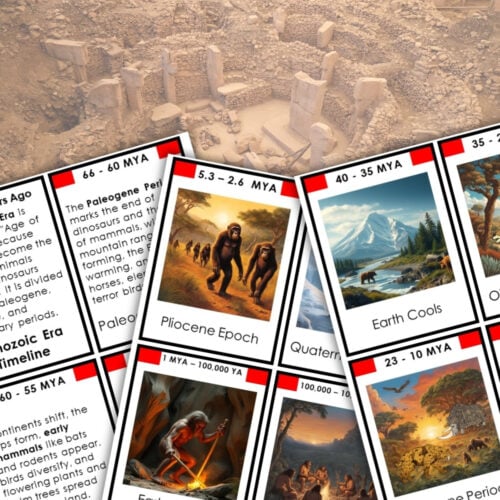
Cenozoic Era Timeline Second Great Lesson Earth History 5 Part Cards$6.00
-
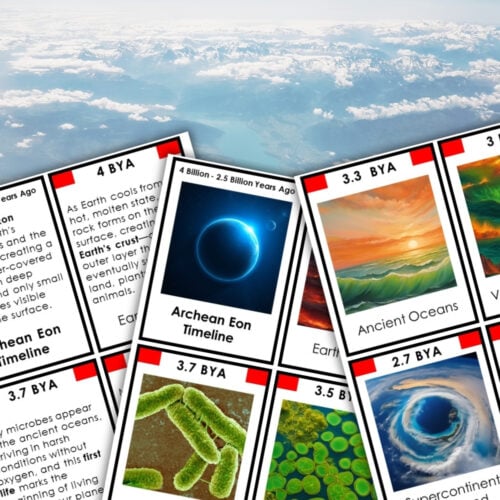
Archean Eon Timeline Second Great Lesson Earth History 5 Part Cards$4.60
-
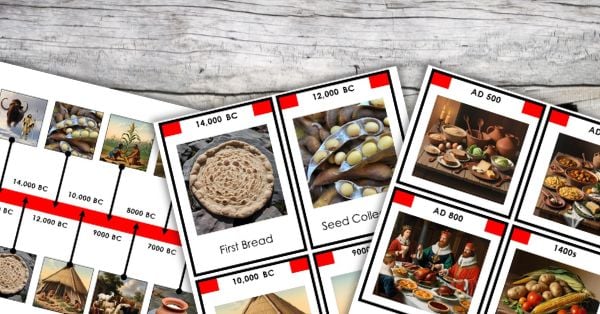
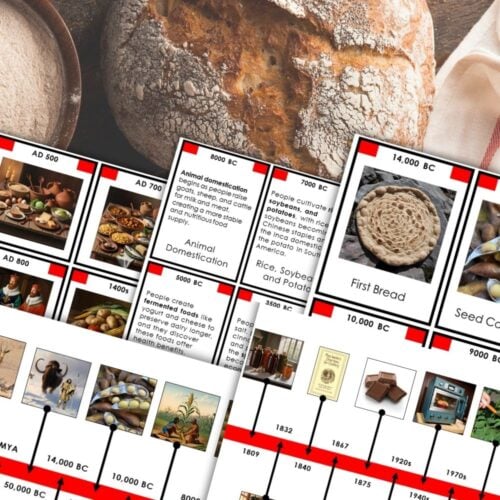
Food History Timeline: 5 Part Cards$7.10
-
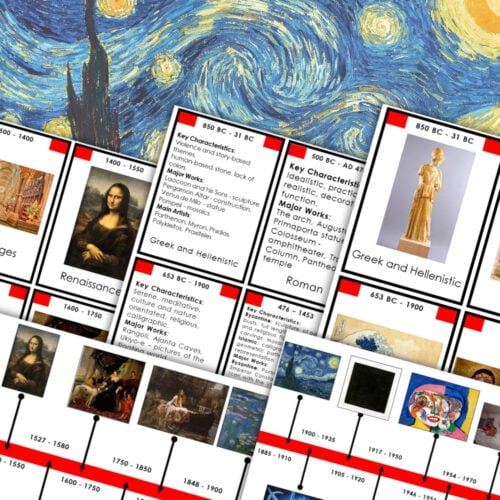
Art History Timeline: 5 Part Cards$6.05
-
Earth History Clock of Eras 3 Part Cards Activities$4.80

About Anastasia | Anastasia is an early childhood teacher with over twenty years of experience in Montessori classrooms and homeschooling. With a Master’s in Information Science, she blends education and information design to create clear, organized, research-backed resources. As founder of Montessori Nature, she develops evidence-based, nature-inspired printables that support holistic child development and foster curiosity, independence, and a love of learning. Explore more in her shop and Teachers Pay Teachers store.