In Montessori education, we talk about Fundamental Human Needs—the basic requirements that all people, across time and culture, have worked to fulfill. We need food and shelter, clothing and transportation. But we also need something else. Something that cannot be measured or weighed.
We need beauty.
We need to create. We need to express. We need to make sense of our world through color, shape, and form. This is what art history is really about. It is not a collection of dusty paintings in museums. It is the story of human spirituality, human culture, and the human imagination.
Art is how we say: I was here. This is what I saw. This is what I felt. This is what I believed.

A Journey Through Time
Let me take you on a journey.
Imagine you are standing in a dark cave, tens of thousands of years ago. You have no electricity, no paper, no paintbrushes. But you have charcoal and ochre, and you have a story to tell. You press your hand against the stone, blow pigment around it, and leave a perfect outline—a declaration of existence. This is Cave Art, and it is the beginning of human expression.
Fast forward to ancient Egypt. You are painting a tomb wall, not for the living, but for the dead. Every figure, every symbol, every color is carefully chosen to guide the soul through the afterlife. Art is not decoration. It is spirituality.
Now step into ancient Greece. You are a sculptor, carving marble into the ideal human form. You believe that the body is sacred, that the human figure is worthy of celebration. Art is perfection.
The Romans take this further. They build vast structures, telling stories of conquest and power. Art is ambition.
Then the world changes. The Byzantine era arrives, and art becomes a window into heaven. Icons of Christ and Mary gaze down from golden backgrounds, reminding the faithful of the divine. Art is prayer.
In the Middle Ages, you are a monk in a scriptorium, illuminating a manuscript with gold leaf and vivid colors. You are copying sacred texts, but you are also creating beauty. Art is devotion.
The Gothic cathedrals rise across Europe. You are a stonemason, carving angels and demons into the stone. You cannot read or write, but you can tell the stories of the Bible with your hands. Art is teaching.
Then comes the Renaissance. Everything changes. You are Leonardo da Vinci, dissecting bodies to understand anatomy, painting the soul through the eyes. You are Michelangelo, stretching on your back for years to tell the story of creation on a ceiling. Art is science, humanism, and genius.
The Baroque era explodes with drama. You are Caravaggio, painting tenebrism—deep shadows and intense light—to capture raw human emotion. Art is feeling.
Neoclassicism arrives, and you are Jacques-Louis David, painting heroic scenes from ancient Rome. You are calling for virtue, sacrifice, and order. Art is morality.
Then Romanticism sweeps in. You are Caspar David Friedrich, standing on a mountain, looking out at a misty landscape. You are Turner, painting storms and sunsets with wild brushstrokes. Art is emotion and the sublime.
Impressionism shocks the world. You are Claude Monet, painting not what you see, but what you feel—the shimmer of light on water, the soft blur of a lily pond. You are Renoir, capturing the joy of everyday life. Art is sensation.
Modernism breaks all the rules. You are Picasso, shattering the human face into fragments. You are Kandinsky, painting music itself. You are Pollock, dancing across a canvas, letting paint fall where it may. Art is innovation and freedom.
Postmodernism arrives, and you are not just an artist anymore—you are a commentator. You are Jeff Koons, turning ordinary objects into monumental sculptures. You are Cindy Sherman, becoming every character in your photographs. You are Jean-Michel Basquiat, covering canvases with graffiti and symbols, speaking a language all your own. Art is irony, play, and self-awareness.
And today, we have Digital Art. You are not using a brush or a chisel—you are using a tablet, a stylus, or software. But the creative spark is still yours. You are Beeple, creating images that sell for millions in virtual galleries. You are Refik Anadol, transforming data into mesmerizing visual sculptures. You are artists who paint with light and code. Art is technology—but it is still, and always, human.
Art history is a story of survival, faith, rebellion, and imagination. It is a story that begins with a handprint on a cave wall and continues with pixels on a screen. It is a story of human beings, reaching out across time and space, saying: I am here. This is what I believe. This is what I see.
Why This Matters for Children
Children are natural artists. They draw before they write. They paint before they read. They sing before they speak.
But somewhere along the way, many children stop creating. They tell themselves they are not “good at art.” They compare their work to others and feel it doesn’t measure up.
Art history can change that.
When children see that cave paintings are not “perfect,” they understand that art is about expression, not precision. When they learn that the Impressionists were considered rebels, they realize that creativity often means breaking the rules. When they see that Digital artists use computers to create, they understand that art belongs to their world too.
Art history gives children permission to create.
How to Use Art History as Inspiration
Here is a step-by-step guide to using art history as a foundation for creative expression in your classroom or homeschool.
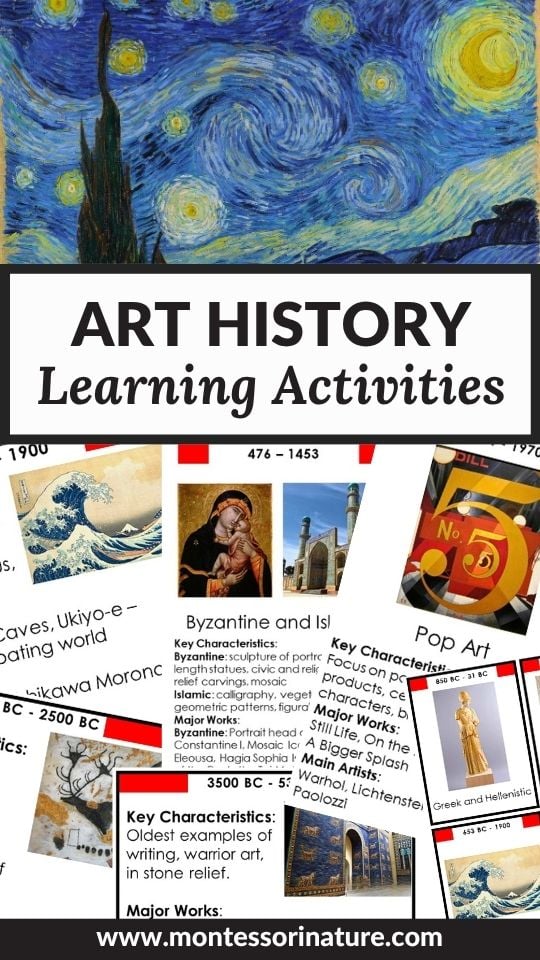
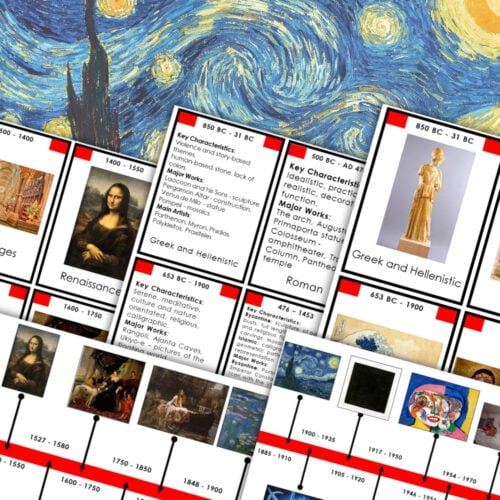
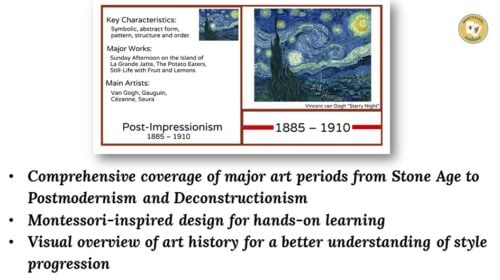
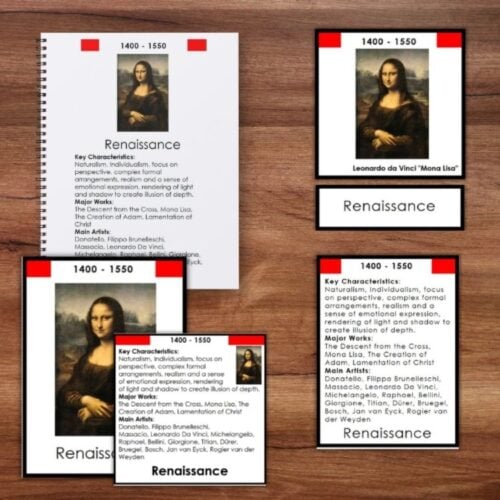
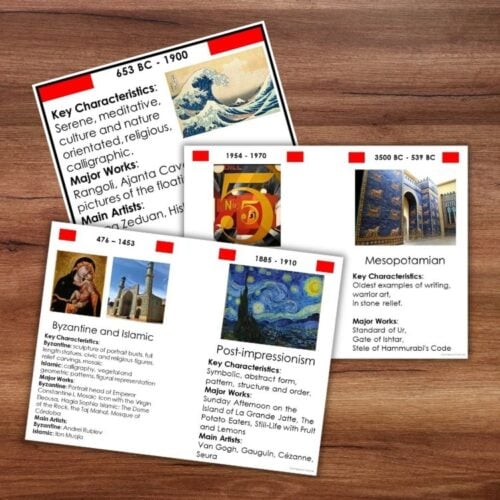
The Art History Timeline Printable includes 4‑part cards for major art movements, a timeline overview, and an easy-to-assemble book. You can use it to introduce each period and provide a visual reference for all your activities.
Step 1: Explore the Timeline Together
Begin by introducing the timeline of art history. Lay out the cards in chronological order—from Cave Art to Digital Art. Talk about the progression of styles and techniques. Discuss how each movement was a response to the one before it.
Ask questions like:
What did people believe in this time?
What materials did they have?
What problems were they trying to solve with their art?
Display the cards on a wall or bulletin board as a visual reference throughout your study.
Step 2: Focus on One Movement at a Time
Choose one art period to explore in depth. Read the definition card together. Look at the representative artwork. Discuss the key characteristics, major works, and main artists.
Hands-On Activities by Age
Ages 3–6 (Early Childhood)
At this age, children learn through sensory exploration and concrete experiences. Keep activities simple, process-oriented, and focused on the joy of creating.
Cave Art
- Crumple brown kraft paper to simulate a stone surface. Let children draw animals or handprints using charcoal sticks or dark brown crayons.
- Make “cave paint” by mixing dirt or cocoa powder with a little water. Paint on rocks or cardboard.
- Trace around their hands on paper and decorate the inside with dots and lines, inspired by ancient handprints.
Ancient Egyptian Art
- Draw a self-portrait with a profile face, a forward-facing eye, and a sideways body—just like Egyptian tomb paintings.
- Use gold and blue markers on sand-colored paper to create a “royal” portrait.
- Make a simple collar necklace from paper plates, painted with bright geometric patterns.
Greek Art
- Roll clay into coils to create a small Greek-style vase. Decorate with simple black patterns.
- Dip sponges in paint and stamp Greek key patterns onto paper.
- Look at statues and try to stand like a Greek sculpture—tall, balanced, and proud.
Byzantine Art
- Cut a cross shape from cardboard. Cover it with gold foil or yellow paint.
- Draw a simple icon on a dark background using bright colors. Emphasize the eyes.
- Make a mosaic using small squares of colored paper to create a glowing, golden background.
Gothic Art
- Build a simple arch using blocks or cardboard. Paint it with bright colors.
- Cut out a rose window shape from black paper and glue small pieces of colored tissue paper behind it.
- Draw tall, pointed windows and fill them with colorful patterns.
Renaissance Art
- Practice drawing circles and ovals to create faces.
- Look in a mirror and draw a simple self-portrait.
- Paint with tempera on wood scraps (or cardboard) like Renaissance panels.
Baroque Art
- Use a flashlight to create dramatic light and shadow. Paint or draw a still life with strong contrasts.
- Try painting with dark paper and white chalk for dramatic effect.
- Act out dramatic scenes with different lighting.
Neoclassicism
- Draw simple columns and arches using rulers.
- Create a frieze (a band of sculpture) with clay, pressing patterns into it.
- Look at classical poses and try drawing people in heroic stances.
Romanticism
- Paint a stormy sky with watercolors.
- Draw a tiny person standing next to a huge mountain or tree.
- Use cotton balls to make clouds and mist on a nature scene.
Impressionism
- Paint outdoors with watercolors and let the colors blend.
- Use cotton swabs instead of brushes to make small dabs of color.
- Paint quickly—set a timer for two minutes and paint what you see outside.
Modernism
- Cut paper into different shapes and arrange them into a collage.
- Paint without using a brush—try sponges, sticks, or fingers.
- Draw the same object in three different ways (realistic, abstract, and crazy).
Postmodernism
- Create a collage from magazine pictures, comics, and your own drawings.
- Use toys or found objects to create a sculpture and display it like an art gallery.
- Draw a self-portrait that mixes two different styles together.
Digital Art
- Use a tablet or smartphone with a simple drawing app. Let children experiment with different digital brushes and colors.
- Take a photo and add digital stickers or drawings on top.
- Create a digital collage using a simple photo editing app.
Ages 6–9 (Lower Elementary)
At this age, children can handle more detail and longer projects. They enjoy research, comparing styles, and creating more polished artworks.
Cave Art
- Research real cave paintings (Lascaux, Altamira). Discuss why early humans painted animals.
- Create a “cave wall” by taping brown paper to a wall or table. Work in groups to create a collaborative mural.
- Make natural pigments by crushing berries, chalk, or charcoal. Paint with sticks or fingers.
Ancient Egyptian Art
- Create a complete tomb painting on a long strip of paper, including hieroglyphics.
- Research the symbolism of Egyptian art (colors, animals, crowns).
- Write your name in hieroglyphics on a cartouche shape.
Greek Art
- Create a clay relief sculpture with a mythological scene.
- Paint a Greek vase in black and orange on a paper template.
- Study the proportions of the human body and draw a figure with correct ratios.
Byzantine Art
- Create an icon on a wood panel or heavy cardboard. Use gold paint and bright colors.
- Make a mosaic using small tiles, beads, or paper squares.
- Research the iconoclasm debate and discuss it.
Gothic Art
- Build a miniature cathedral arch using sugar cubes or cardboard.
- Design a stained glass window with colored tissue paper and black outlines.
- Research the purpose of Gothic cathedrals.
Renaissance Art
- Study perspective: draw a road or hallway that gets narrower as it goes back.
- Create a self-portrait using mirror observation.
- Make a “sfumato” painting by blending colors softly.
Baroque Art
- Paint a still life with dramatic lighting using a lamp or window light.
- Create a tenebrism effect with black paper and white paint.
- Study Caravaggio and discuss how he used ordinary people as models.
Neoclassicism
- Draw a historical scene with clear, clean lines.
- Create a frieze with clay or salt dough.
- Study Jacques-Louis David and discuss the moral messages in his paintings.
Romanticism
- Paint a dramatic landscape with a small human figure to show scale.
- Create a mixed-media piece with watercolors and ink.
- Discuss the concept of the sublime.
Impressionism
- Paint a landscape in the Impressionist style using small, visible brushstrokes.
- Experiment with color theory: paint shadows with purple and blue instead of black.
- Research Monet’s series paintings (haystacks, Rouen Cathedral, water lilies).
Modernism
- Create an abstract painting based on music or emotion.
- Try a Jackson Pollock “action painting” by dripping paint onto paper.
- Create a Cubist portrait by drawing a face from multiple angles.
Postmodernism
- Create a “readymade” sculpture from found objects.
- Make a collage that mixes high art with popular culture.
- Discuss the question: “What is art?” and have a class debate.
Digital Art
- Use a drawing tablet or app to create a digital painting inspired by an Impressionist or Modernist work.
- Create a stop-motion animation using a tablet and a simple app.
- Explore pixel art by creating a grid drawing using an online pixel art maker.
Ages 9–12 (Upper Elementary)
At this age, children are ready for independent research, in-depth analysis, and sophisticated creative projects.
Cave Art
- Research early human migration and how cave art spread across the globe.
- Create a museum exhibit of cave art with labels and descriptions.
- Write a story about a prehistoric artist and their life.
Ancient Egyptian Art
- Research Egyptian burial practices and the Book of the Dead.
- Create a detailed tomb painting on papyrus paper.
- Write a report on Egyptian symbolism and its meaning.
Greek Art
- Research Greek mythology and create a sculpture of a god or goddess.
- Write an essay on the ideals of Greek beauty.
- Study Greek architecture and build a model of a temple.
Byzantine Art
- Research the split between Eastern and Western Christianity.
- Create an icon and write a reflection on its spiritual meaning.
- Compare Byzantine art with Romanesque art.
Gothic Art
- Research the construction of Gothic cathedrals (flying buttresses, ribbed vaults, stained glass).
- Build a scale model of a Gothic structure.
- Write a report on a famous Gothic cathedral.
Renaissance Art
- Research Leonardo da Vinci and create a sketchbook of his inventions.
- Study linear perspective and create a detailed perspective drawing.
- Write a biography of a Renaissance artist.
Baroque Art
- Research the Counter-Reformation and its influence on Baroque art.
- Create a dramatic painting or sculpture with strong chiaroscuro.
- Compare Baroque art with Renaissance art.
Neoclassicism
- Research the French Revolution and Neoclassical art.
- Create a heroic painting or drawing inspired by David.
- Write an essay on the ideals of Neoclassicism.
Romanticism
- Research the Romantic movement in literature, music, and art.
- Create a large-scale landscape painting.
- Write a poem inspired by a Romantic painting.
Impressionism
- Research the Impressionist exhibition of 1874 and its impact.
- Create a series of paintings (like Monet) of the same subject at different times of day.
- Write a report on an Impressionist artist.
Modernism
- Research the Armory Show of 1913 and the introduction of Modernism to America.
- Choose a Modernist artist and create a piece in their style.
- Write a persuasive essay on whether Modernism was a positive or negative development.
Postmodernism
- Research the concept of “deconstruction” and its application to art.
- Create a piece of art that comments on consumer culture or media.
- Write a reflection on the meaning of irony in art.
Digital Art
- Use professional-level digital art software (like Procreate or Photoshop) to create a series of artworks.
- Create a digital portfolio showcasing different styles inspired by art history.
- Research digital artists and write a report on how they use technology to express creativity.
- Experiment with AI-assisted art tools as a creative partner—not as a replacement for human imagination, but as a tool to expand it.
Step 3: Compare and Contrast
Ask children to compare two movements side by side. For example:
- How is Renaissance art different from Byzantine art?
- What makes Modernism different from Postmodernism?
- How is Impressionism different from Baroque?
- How does Digital Art build upon or challenge the traditions that came before it?
Use the 4‑part cards to guide the conversation. The definition cards provide key characteristics, major works, and main artists for each period.
Step 4: Create a Personal Art History
Invite children to create their own art history timeline—but with their own art. Have them create a piece of art in the style of each movement. They can become a Renaissance artist, an Impressionist, a Postmodern creator, or a Digital artist.
This is a powerful way for children to see themselves as part of the story. They are not just observers of art history—they are participants in it.
Connecting to Spirituality and Culture
Art is not just about technique. It is about what people hold sacred.
- Cave paintings were spiritual rituals.
- Byzantine icons were windows into heaven.
- Gothic cathedrals were prayers in stone.
- Renaissance paintings were celebrations of the human spirit.
- Impressionism was a love letter to nature.
- Postmodernism is a reflection on meaning itself.
- Digital Art is the human imagination expressed through new tools.
When children understand this, they begin to see art everywhere—in a sunset, in a building, in a photograph, in the faces of the people they love, and even in the glowing screens they use every day. They understand that art is not separate from life. It is life.
A Call to Create
“Every child is an artist. The problem is how to remain an artist once we grow up.” —Pablo Picasso
Art history shows us that creativity is not a luxury. It is a fundamental human need. It is how we understand ourselves. It is how we connect to others. It is how we leave our mark on the world.
When you share art history with your students, you are doing more than teaching facts. You are giving them a foundation for creative expression. You are showing them that they, too, belong to the great story of human imagination.
And who knows? One day, an art historian might be writing about them.
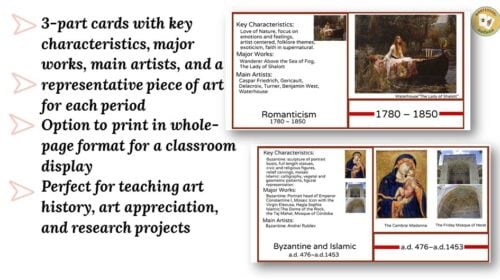
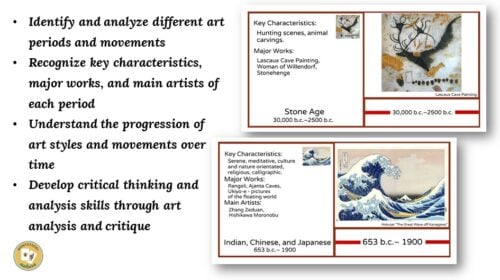
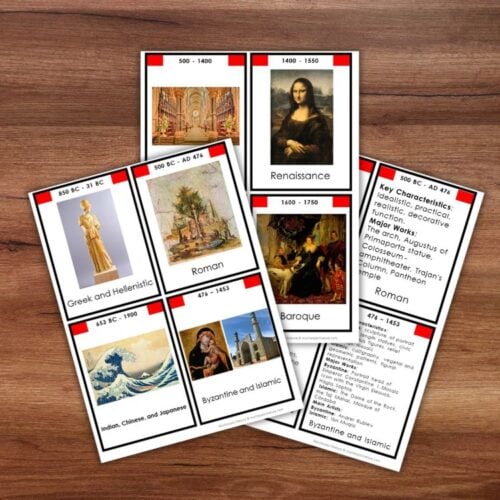
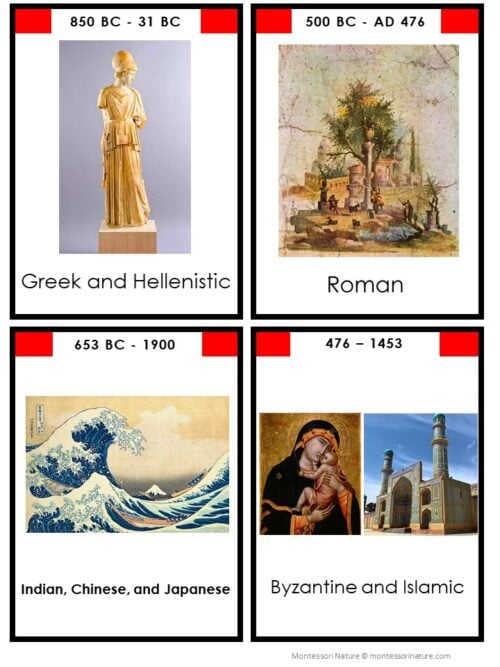
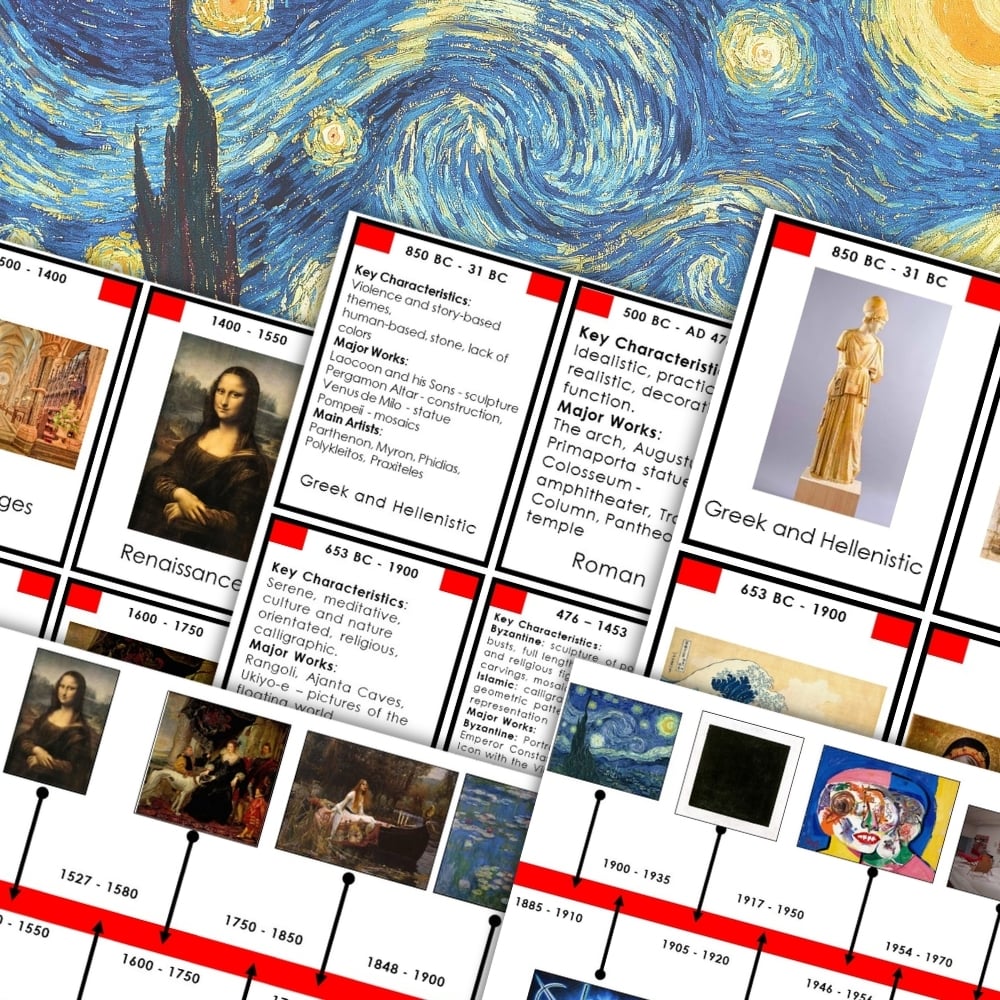


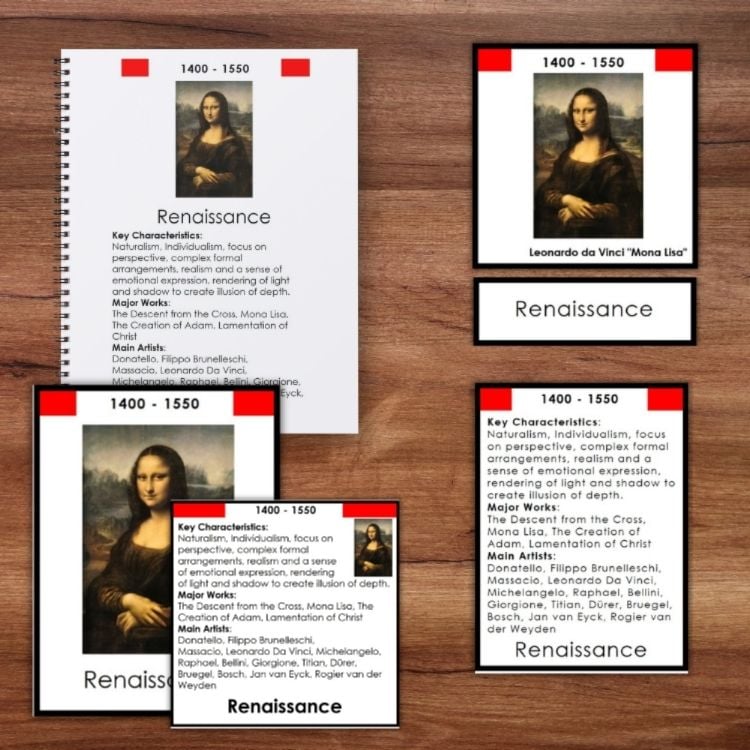
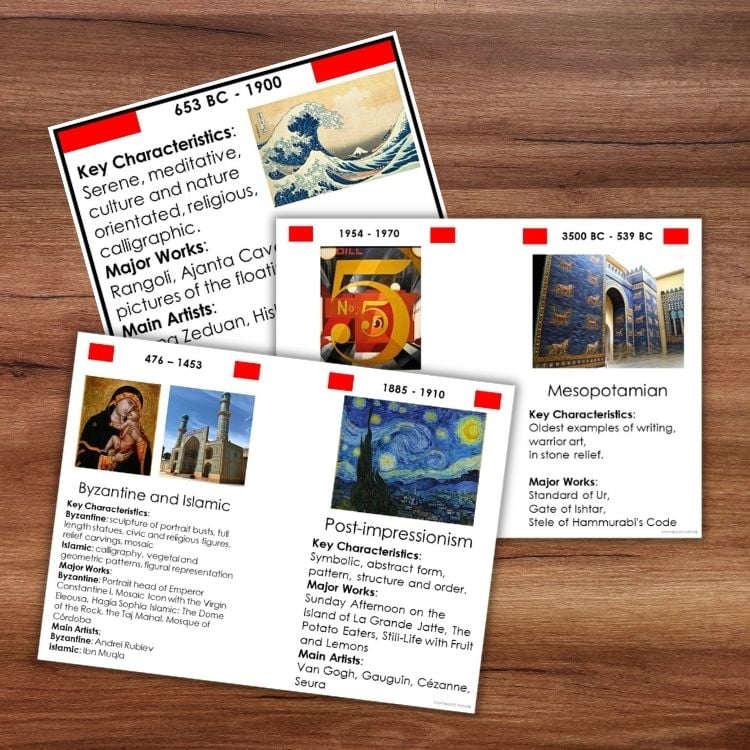
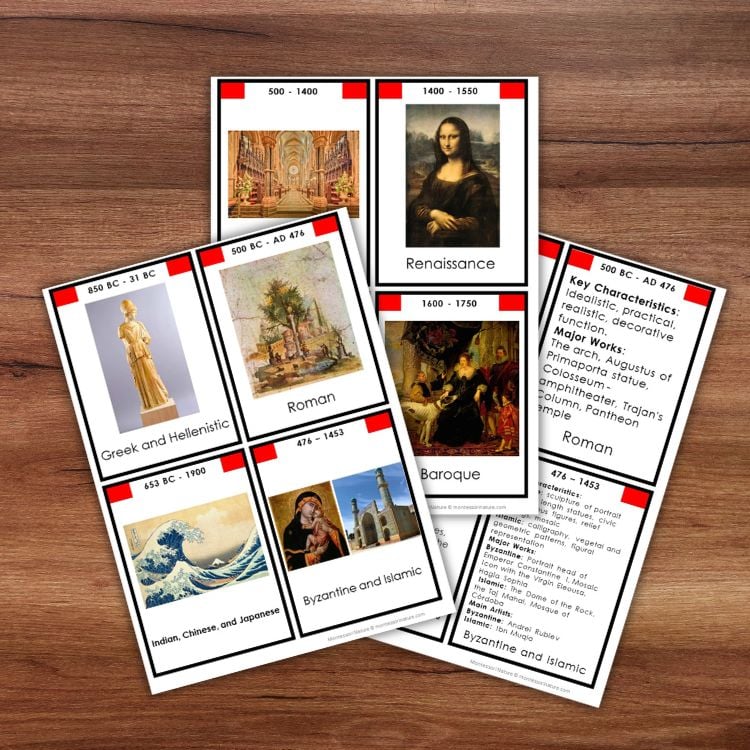

Art History Timeline: 5 Part Cards
Enhance your art history curriculum with this Art History Timeline Montessori-inspired printable, perfect for teaching students about major art periods from the Stone Age to Postmodernism and Deconstructivism and Digital Art. Each card provides key characteristics, major works, main artists, and a representative piece of art for the period.
You Might Also Enjoy
About Anastasia | Anastasia is an early childhood teacher with over twenty years of experience in Montessori classrooms and homeschooling. With a Master’s in Information Science, she blends education and information design to create clear, organized, research-backed resources. As founder of Montessori Nature, she develops evidence-based, nature-inspired printables that support holistic child development and foster curiosity, independence, and a love of learning. Explore more in her shop and Teachers Pay Teachers store.