Have you ever watched a group of children decide the rules for a game? Someone suggests a vote. Another child says, “I should be the leader because I know the rules best.” A third says, “Let everyone have a turn being in charge.”
That small moment is the beginning of understanding forms of government. Every group – whether a playground, a classroom, or a country – needs a system for making decisions.
Today, we’re exploring 14 forms of government – from monarchy and democracy to oligarchy and theocracy. I’ll share practical, close‑to‑life activities for ages 6–9 and 9–12, plus a printable resource that turns civics into a self‑directed Montessori work. And of course, we’ll see how this connects to the Imaginary Island project.
Why Teach Forms of Government to Young Children?


Children naturally understand fairness, power, and rules – even if they don’t have the vocabulary yet. When we teach forms of government, we give them words for what they already experience:
Democracy – when the class votes on which game to play at recess.
Monarchy – when a parent or teacher says, “Because I said so.”
Dictatorship – when one child takes all the toys and makes all the rules.
Oligarchy – when a small group of friends decides who gets to play.
Anarchy – when there are no rules and chaos breaks out.
By connecting abstract systems to real‑life situations, children understand that government is not a general idea – it is how people solve problems together.
How This Connects to the Imaginary Island Project
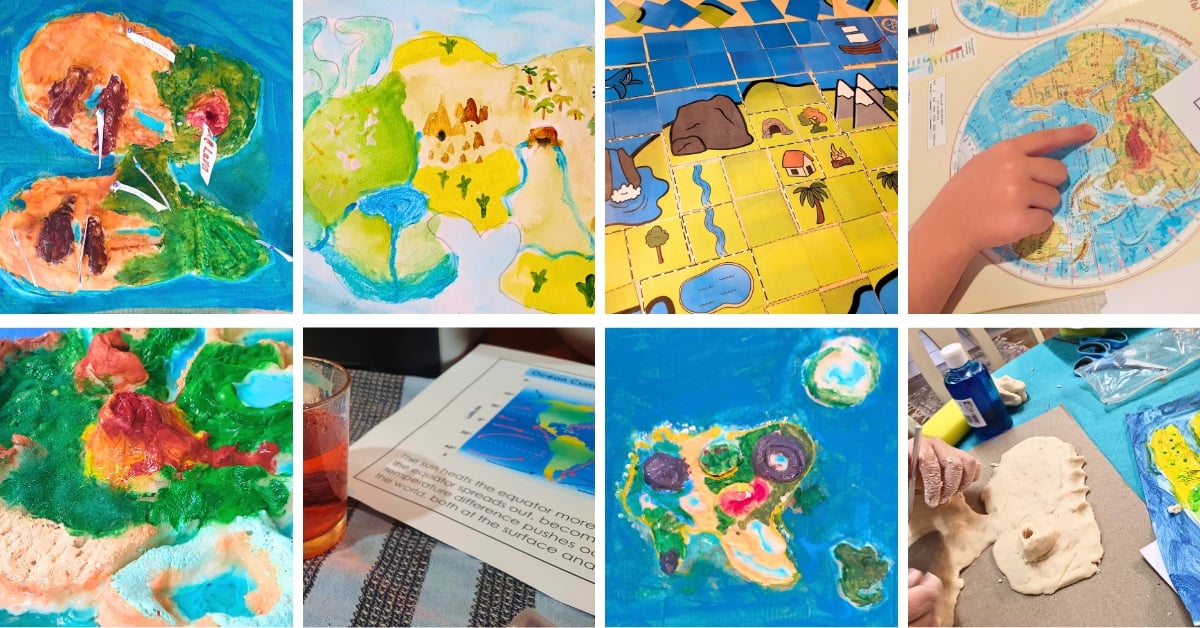
After children build their Imaginary Island with salt dough and decide its physical features, climate zones, and biomes, they face a new question: Who rules this island?
This printable helps them explore the options:
A chiefdom – a respected elder leads the tribe.
A monarchy – a king or queen inherits the crown.
A democracy – everyone votes on important decisions.
A republic – islanders elect representatives.
A theocracy – priests or religious leaders hold power.
A gerontocracy – the oldest and wisest people rule.
An oligarchy – a few wealthy families control everything.
A dictatorship – one person seizes power and commands the army.
Children then declare what form of government their Imaginary Island has – and write a simple constitution explaining why.
Hands‑On, Close‑to‑Life Activities for Ages 6–9
Activity 1: The Class Vote (Democracy in Action)
What you need: A simple question with two or three options (e.g., “What should be our morning song?” or “Which game should we play at the end of the day?”).
What to do: Ask the children to vote by raising their hands or using secret ballots. Count the votes. The option with the most votes wins. Explain: That is democracy – everyone gets a say.
What they learn: In a democracy, citizens vote directly on decisions. The majority rules, but everyone’s voice matters.
Activity 2: King or Queen for a Day (Monarchy)
What you need: A plastic crown or a paper crown.
What to do: Choose one child to be “king” or “queen” for 10 minutes. They get to make one or two small decisions (e.g., which pencil to use, where to sit, what song to hum). Then the crown passes to another child.
What they learn: In a monarchy, the leader inherits power. The ruler’s word is law – at least until the crown moves on!
Activity 3: The “Because I Said So” Game (Dictatorship)
What you need: Nothing.
What to do: For two minutes, you (the teacher) act as a dictator. You make all the rules with no discussion. “Everyone stand on one foot. Now switch feet. No talking.” Then ask: How did that feel? Did you like having no choice?
What they learn: A dictatorship gives one person total power. Citizens have no say and few freedoms. Most people do not enjoy it.
Activity 4: Small Group Rules (Oligarchy)
What you need: Three children as a “ruling group,” the rest as citizens.
What to do: The three rulers make one rule for the whole class (e.g., “Everyone must hop to the door”). The other children must follow it. Then ask: Was it fair that only three people decided?
What they learn: In an oligarchy, a small group holds all the power. Everyone else must obey.
Hands‑On, Close‑to‑Life Activities for Ages 9–12
Activity 5: Design a Classroom Government
What you need: Paper, pencil, a list of government types.
What to do: Ask the class to design a new government for the classroom. They must choose one form of government (democracy, republic, monarchy, oligarchy, etc.) and write three rules. Then they explain why they chose that system.
Discuss: Would a dictatorship work in a classroom? What about anarchy? Why do most schools use a form of democracy or republic?
Activity 6: Research a Real‑World Government
What you need: Access to books or safe websites, a world map.
What to do: Give each child (or pair) a different country. They research the form of government that a country has (e.g., the United States – republic, the United Kingdom – constitutional monarchy, China – one‑party state, Iran – theocracy). They present their findings to the class.
Discuss: Why do different countries choose different governments? How do history, culture, or geography affect government?
Activity 7: The Island Constitution (Imaginary Island Application)
What you need: The drawn map of their Imaginary Island, paper, pencil.
What to do: After children have built their Imaginary Island, they write a short “constitution” – a document explaining how their island is governed. It must include:
The name of their island
The form of government (choose from the 14)
Who holds power
How leaders are chosen (e.g., election, inheritance, appointment)
Three basic laws
Discuss: Why did you choose that form of government? What problem does it solve?
Activity 8: Government Debate – Which Is Best?
What you need: Two forms of government (e.g., democracy vs. oligarchy).
What to do: Divide the class into two teams. Each team argues why their form of government is better for a small island. The debate should focus on fairness, stability, and freedom. After the debate, children vote (democracy!) on which argument was stronger.
Discuss: Is there a perfect government? Why do different people prefer different systems?
How the Printable Resource Brings It All Together
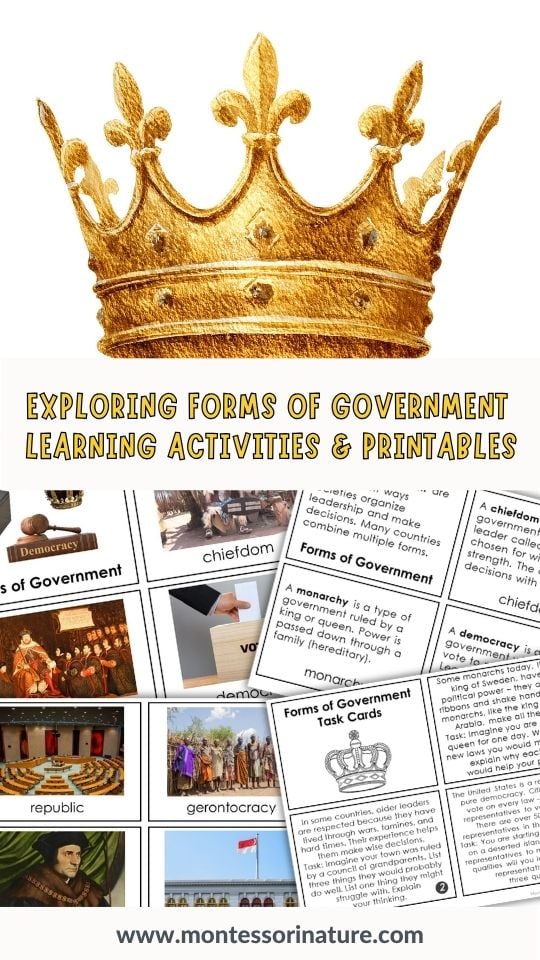
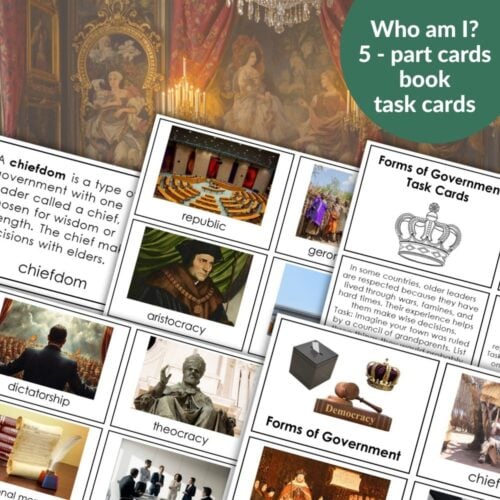
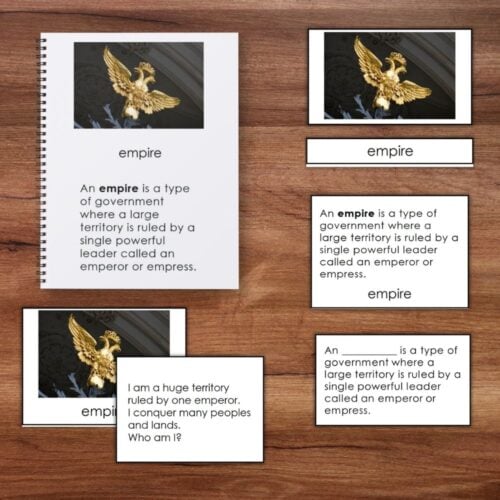
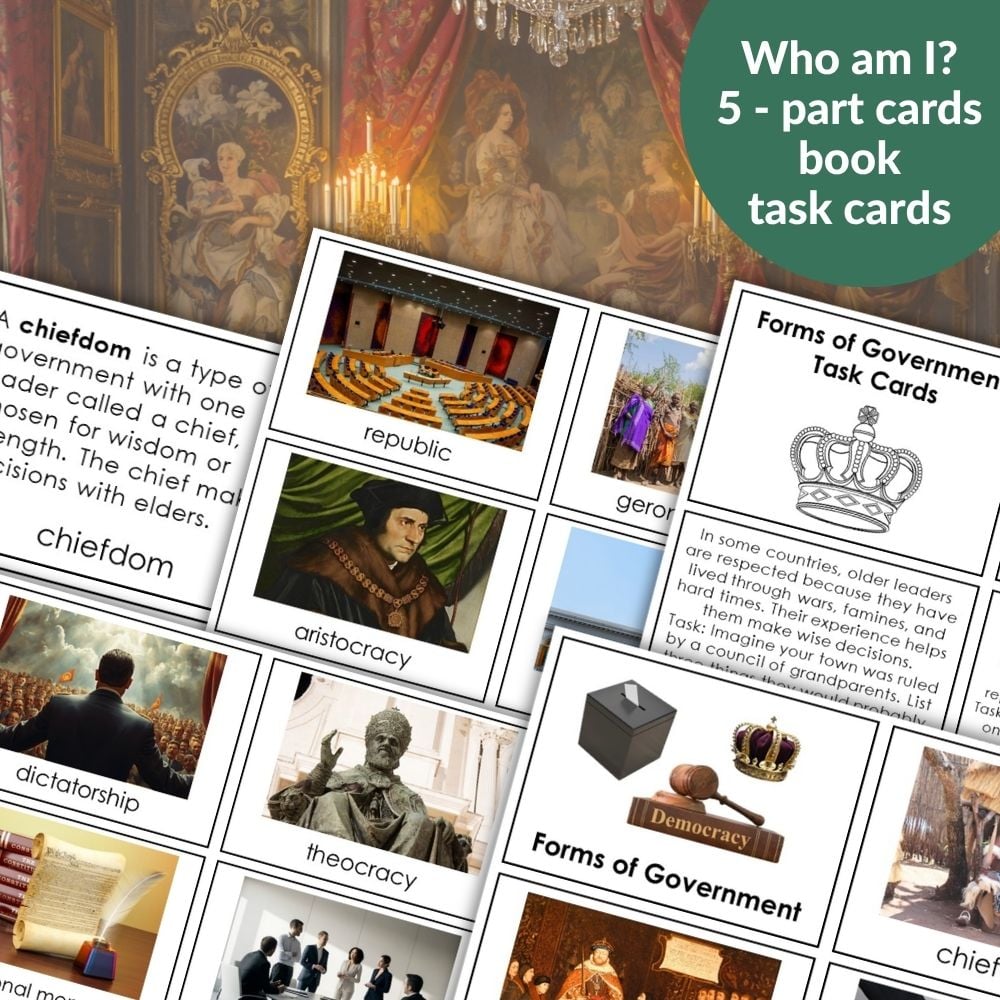
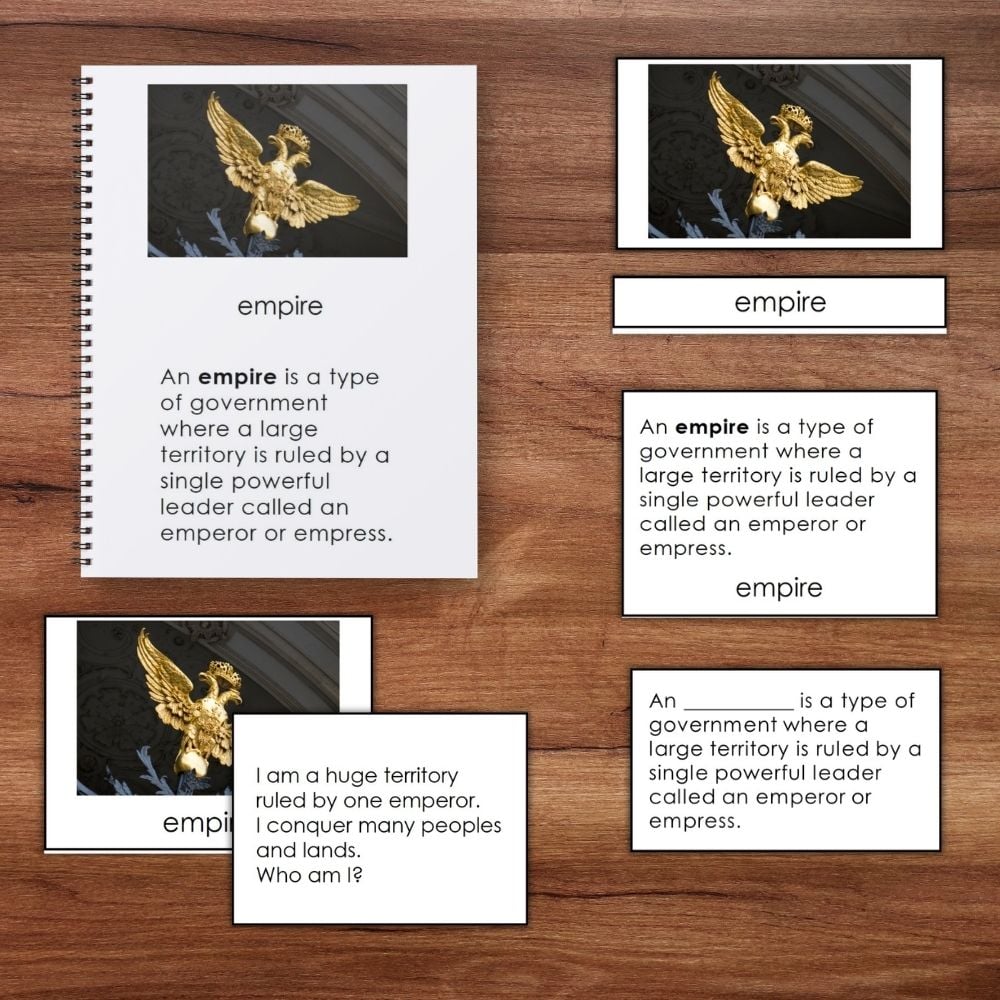
Teaching 14 forms of government could be overwhelming. That is why I created a set of 5‑part cards, task cards, an easy‑to‑assemble book, and “Who Am I?” riddles for each government type.
What’s inside:
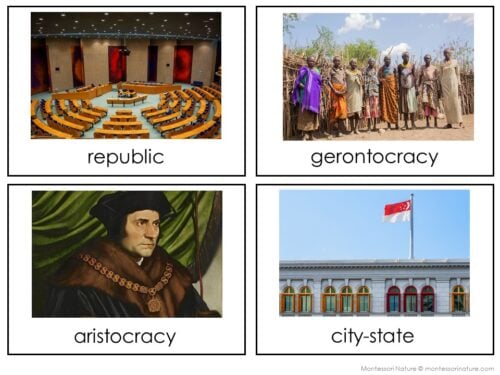
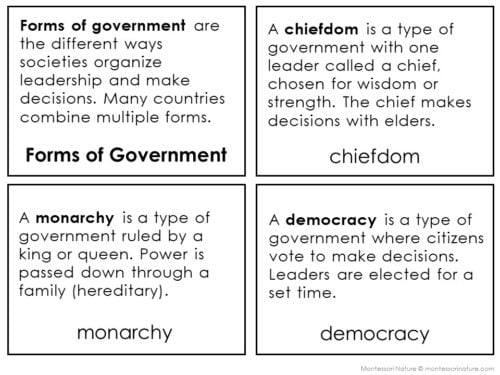
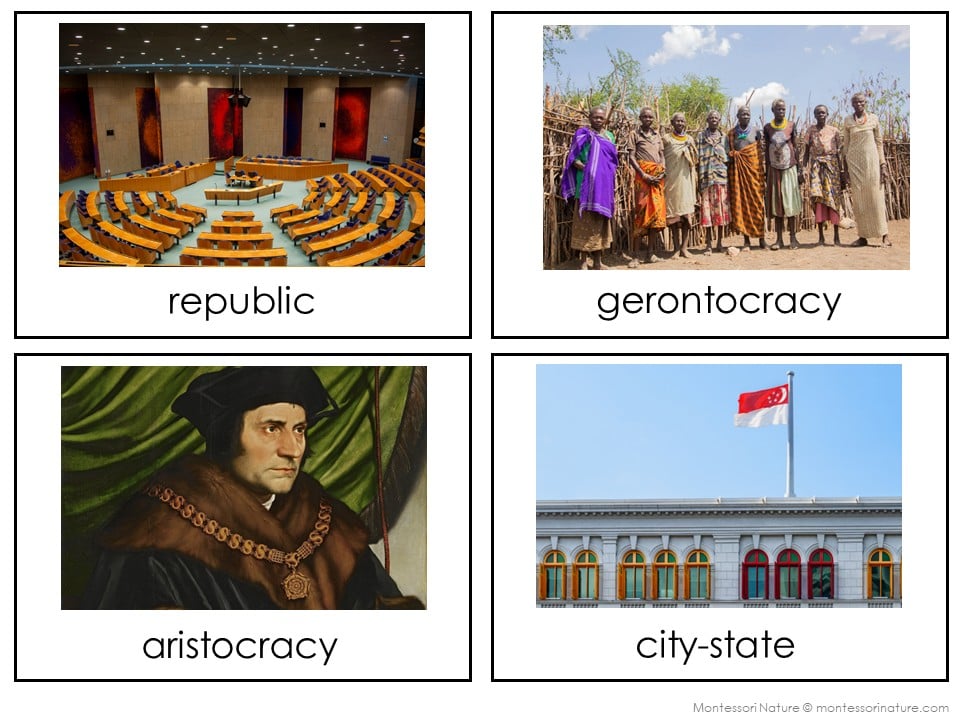
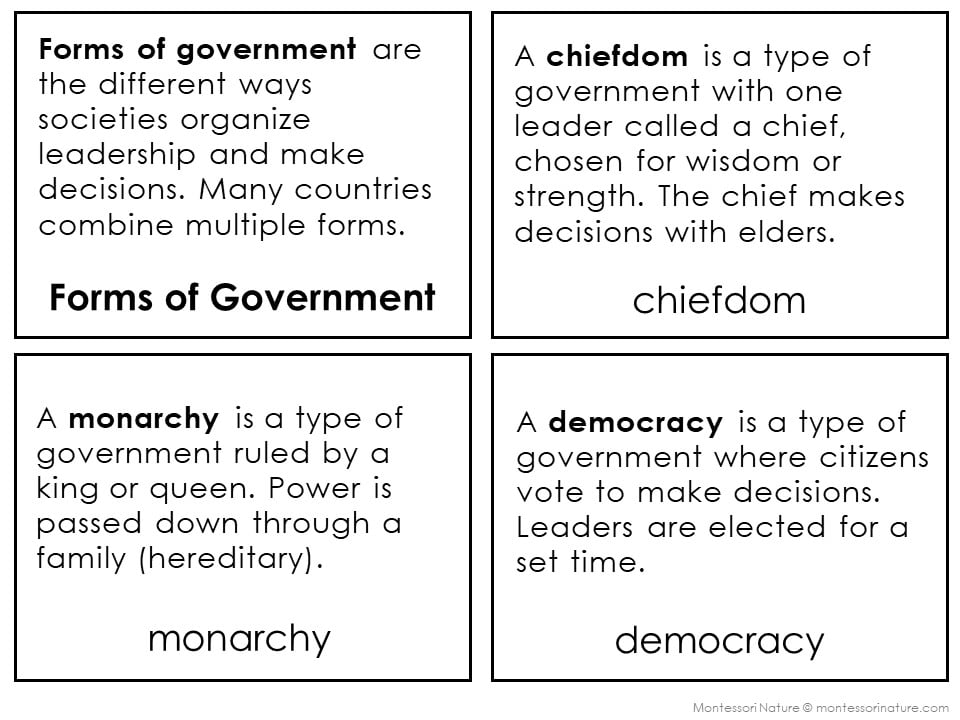
14 forms of government: Chiefdom, Monarchy, Democracy, Republic, Gerontocracy, Dictatorship, Theocracy, Constitutional Monarchy, Oligarchy, Aristocracy, City‑State, Empire, Fascism, Tyranny
For each form: picture card, label card, control card, definition card (15–25 words), cloze card
“Who Am I?” riddles – fun, self‑checking review
Task cards – 16 hands‑on activities (comparison, research, creative writing)
Book – print, fold, staple – no cutting or complex binding
How to use it with different ages:
Ages 6–9: Introduce only 4–6 forms (Chiefdom, Monarchy, Democracy, Dictatorship, Theocracy). Use picture and label matching. Read the book aloud. Play the riddle game as a class. Do simple task cards (e.g., “Draw a king’s crown. Draw a voting box.”).
Ages 9–12: Introduce all 14 forms. Work independently with the 5‑part cards and cloze cards. Use the riddles for review. Complete task cards that require research and comparison. Then design a government for their Imaginary Island.
How it connects to the Imaginary Island project:
After children have built their island and drawn its maps, they use the Forms of Government cards to decide:
Is their island a monarchy ruled by a king or queen?
A democracy where everyone votes on laws?
A theocracy led by religious elders?
A gerontocracy where the oldest, wisest people rule?
They then write a short constitution – their first official document as the leader of their own imaginary country.
“My Imaginary Island is called Misty Peak,” announced Leo. “It is a democratic republic. We vote for a president every four years. Our three laws are: respect the forest, share the fish, and protect the coastline.”
He pulled out the “Republic” card from our Forms of Government book. “See – citizens elect representatives. That’s what we do.”
His partner, Mira, added: “My island is a gerontocracy. The seven oldest people make all the decisions. They have the most experience.”
That moment – when children choose a government for their imaginary world and defend their choice – is why I created this resource.
Government is not just for adults in parliaments. It is how children decide the rules of a game, how a family plans a trip, or how a classroom chooses a morning song. By teaching forms of government through close‑to‑life activities – voting, wearing a crown, debating fairness – we give children the vocabulary to understand the world and the confidence to shape it.
And when they build their Imaginary Island, they become not just geographers, but founders of their own small nations.
Forms of Government
Help your students explore 14 forms of government – Chiefdom, Monarchy, Democracy, Republic, Gerontocracy, Dictatorship, Theocracy, Constitutional Monarchy, Oligarchy, Aristocracy, City‑State, Empire, Fascism, and Tyranny – with this Montessori-inspired printable. Perfect for the Imaginary Island project, these 5‑part cards, easy‑to‑assemble book, task cards, and “Who Am I?” riddles turn civics into a hands‑on, cross‑curricular experience.
This printable is also available on TPT
You Might Also Enjoy

About Anastasia | Anastasia is an early childhood teacher with over twenty years of experience in Montessori classrooms and homeschooling. With a Master’s in Information Science, she blends education and information design to create clear, organized, research-backed resources. As founder of Montessori Nature, she develops evidence-based, nature-inspired printables that support holistic child development and foster curiosity, independence, and a love of learning. Explore more in her shop and Teachers Pay Teachers store.