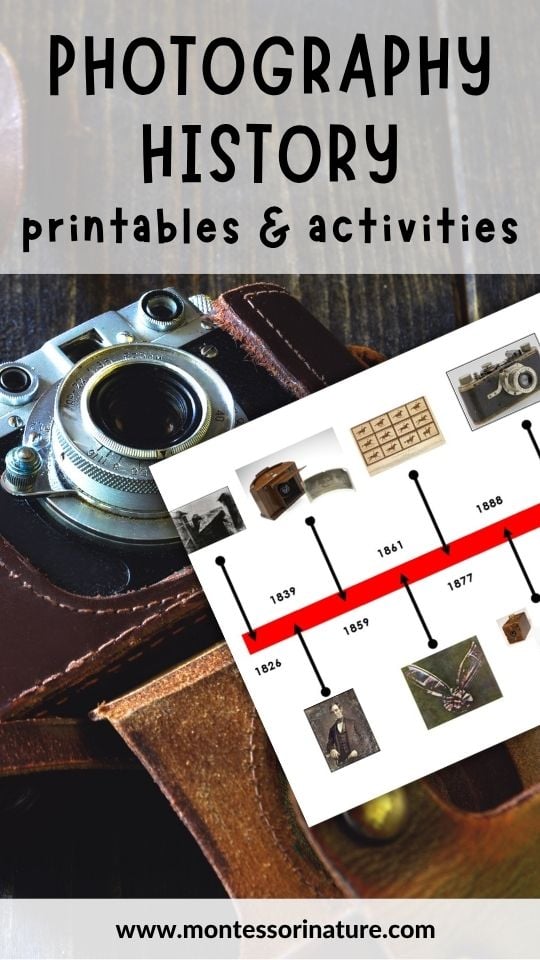
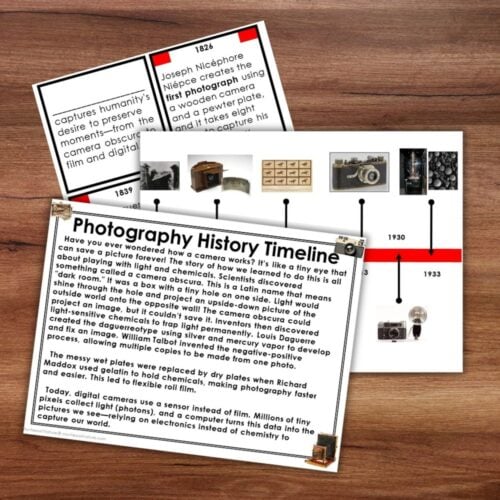
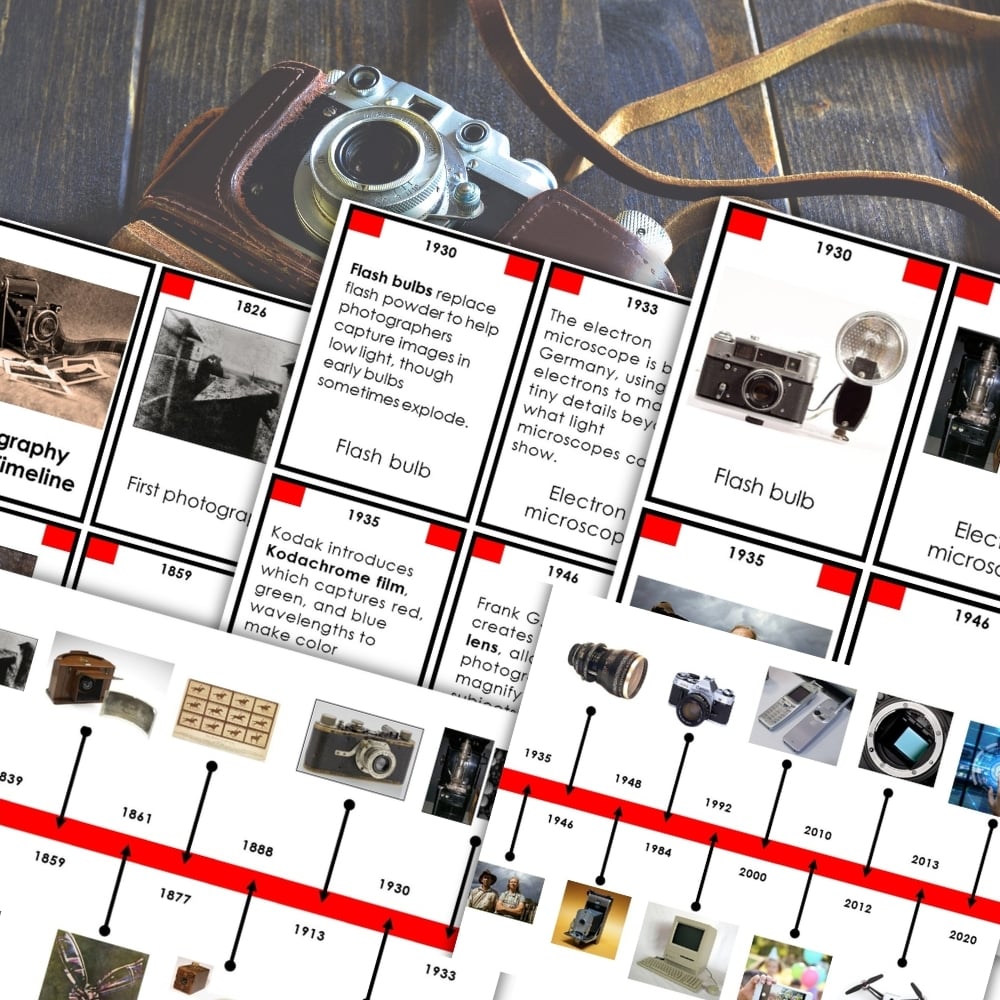
Photography is one of those subjects that naturally sparks curiosity. That is why I created the Photography History Timeline Printable—a complete set of 5‑part cards, timeline overview, and easy‑to‑assemble book that helps children explore key photography milestones from the first photograph to AI and drone photography.
This resource is perfect for Montessori classrooms, homeschoolers, and any educator who wants to bring the story of light and memory to life through hands‑on learning. It builds vocabulary, chronological understanding, and a deep appreciation for how human ingenuity has captured moments and transformed how we see the world. It also connects beautifully to the study of Fundamental Human Needs—specifically the human need for art, beauty, and preserving memories.
But before I tell you more about the printable, let me take you on a journey through the history of photography itself.
The Human Need to Remember
In Montessori education, we talk about Fundamental Human Needs—the basic requirements that all people, across time and culture, have worked to fulfill. We need food and shelter, clothing and beauty. But we also need something else. Something that cannot be held in our hands.


We need to remember.
We need to preserve our stories. We need to see the faces of those we love. We need to capture moments that would otherwise fade away. This is what photography history is really about. It is not a collection of cameras and lenses. It is the story of human memory, human creativity, and human connection.
Photography is how we say: This moment matters. This person matters. This is what I saw, and I want you to see it too.
A Journey Through Light
Let me take you on a journey.
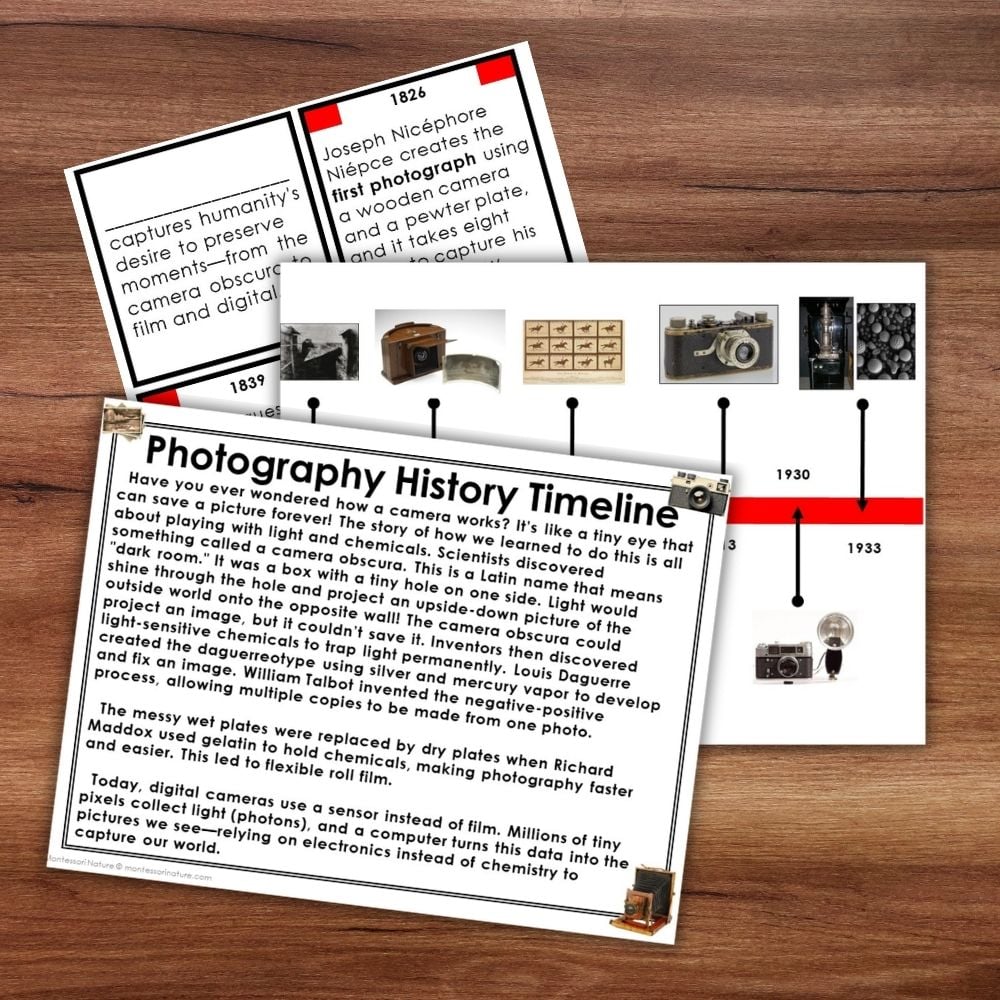
Imagine you are standing in a dark room, centuries ago. You have a wooden box with a tiny hole in one end. Light streams through the hole and projects an upside-down image of the world outside onto the opposite wall. This is the camera obscura—the very first camera. It is not yet a photograph, but it is the beginning of capturing light.
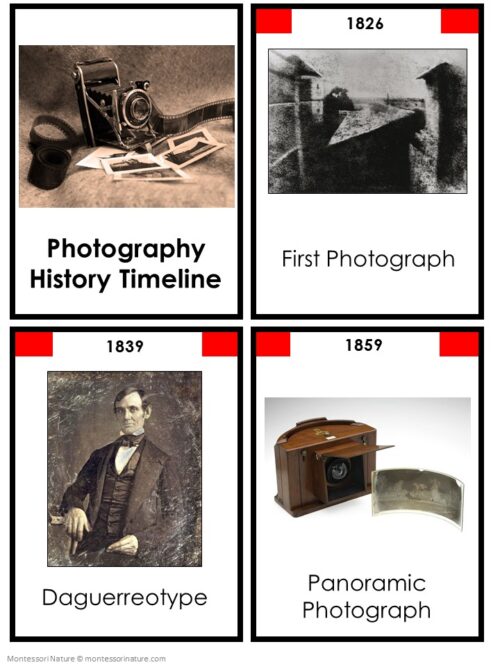
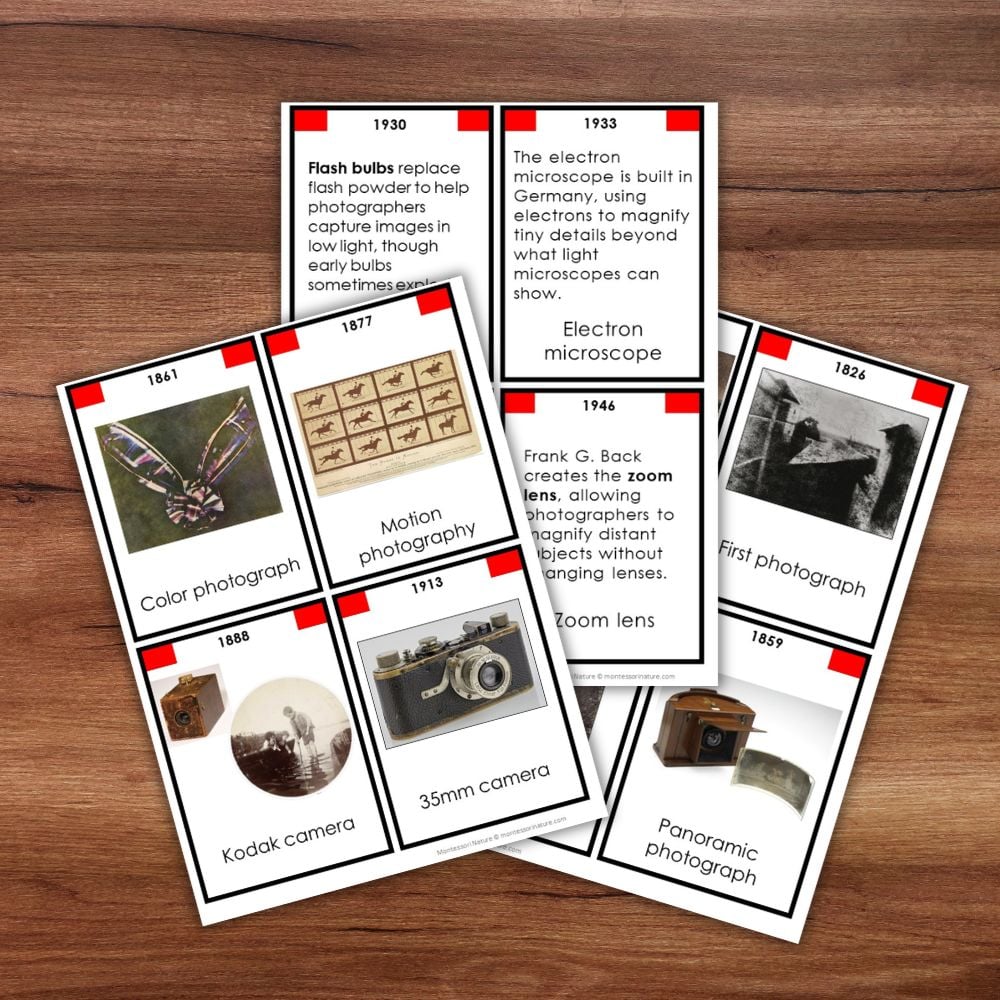
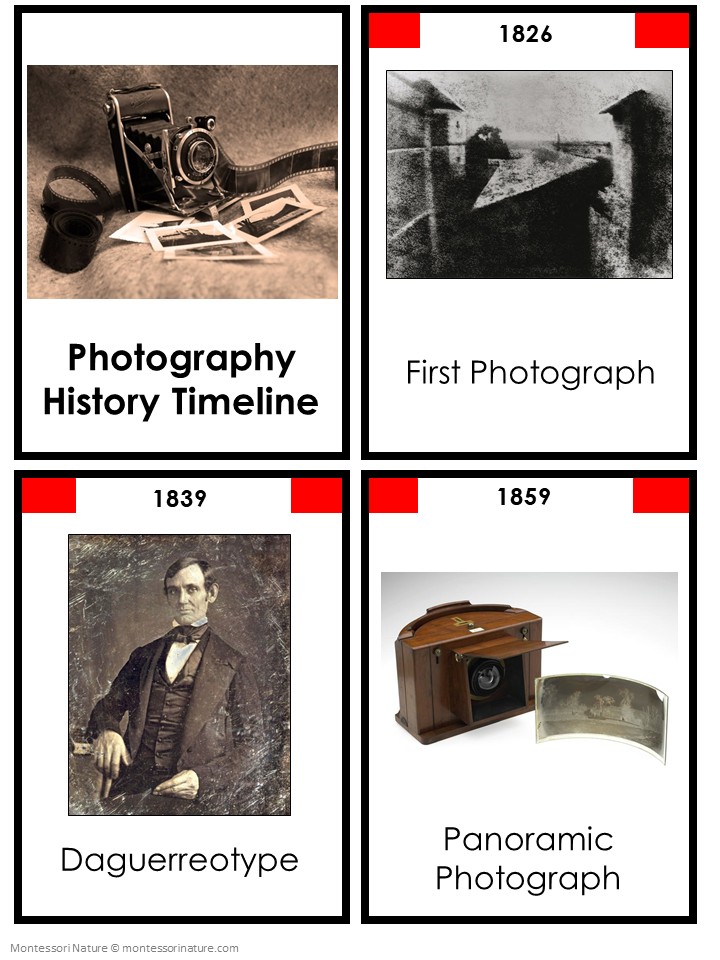
Fast forward to 1826. You are Joseph Nicéphore Niépce, standing in your estate courtyard in France. You have coated a pewter plate with bitumen, placed it in a wooden camera, and pointed it at the view outside. You wait. And wait. And wait. Eight hours later, you have the first photograph ever made. It is grainy, rough, and barely visible—but it is a miracle. For the first time, light has been captured on a surface.
In 1839, Louis-Jacques-Mandé Daguerre refines the process. His daguerreotype produces crisp, detailed images on silver-plated copper. It is the first commercially successful photographic process. People flock to have their portraits taken. For the first time, ordinary people can see their own faces preserved forever. Photography becomes memory.
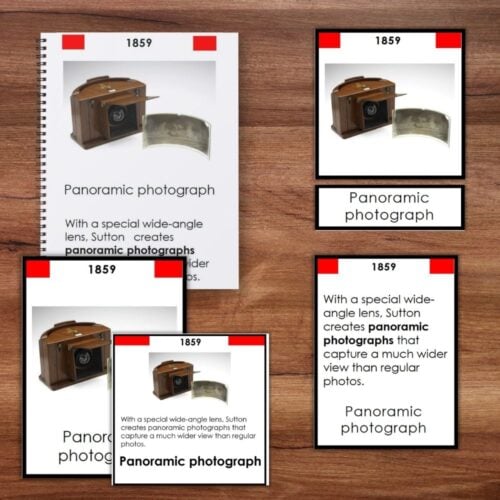
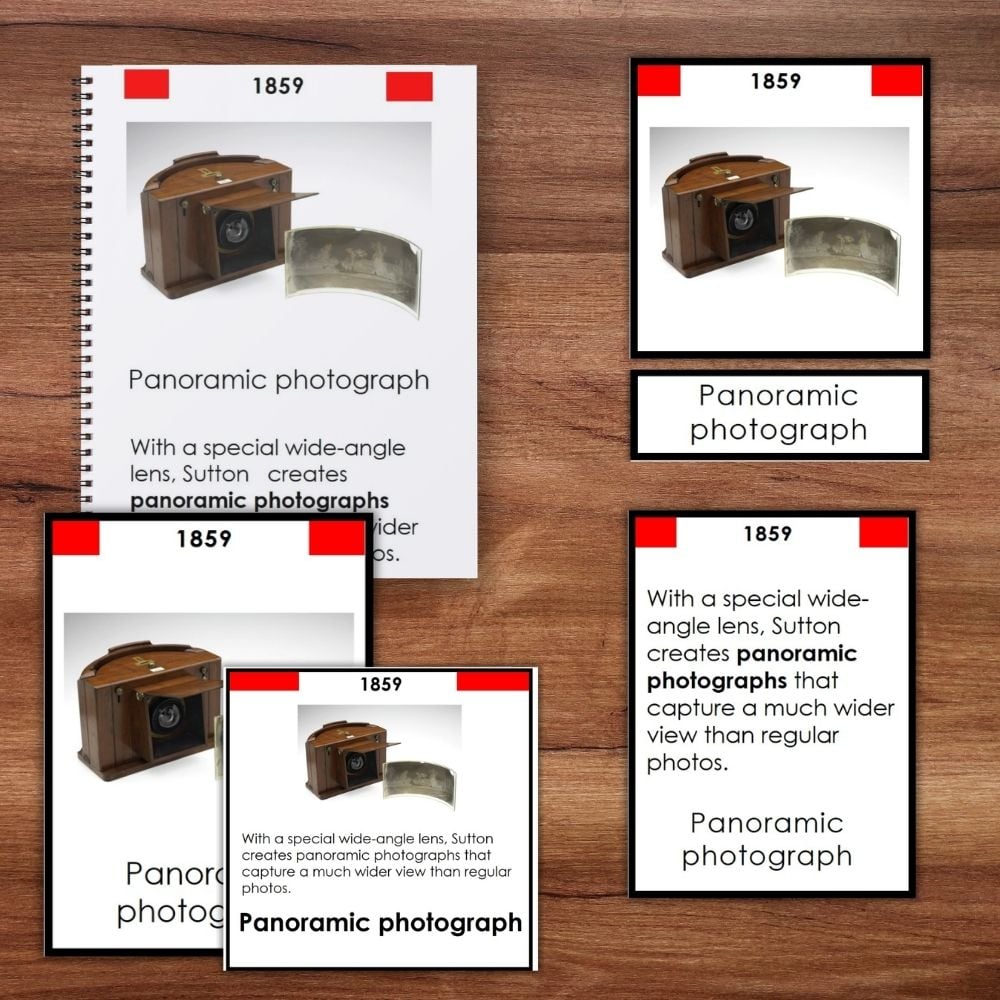
Photographers want more. They want to capture wider views. Thomas Sutton invents a panoramic lens, and suddenly, sweeping landscapes, city skylines, and vast horizons can fit into a single frame. Photography becomes vision.
Then comes color. James Clerk Maxwell suggests a three-color method, and Thomas Sutton takes the first color photograph—a tartan ribbon. The world is no longer black and white. Photography becomes life.
Eadweard Muybridge asks a daring question: Can we capture motion? He sets up multiple cameras along a racetrack. As a horse gallops past, each camera snaps a photo. For the first time, humans can see every stage of a horse’s stride—frozen, frame by frame. Photography becomes science.
George Eastman makes photography available to everyone. He pioneers photographic film and produces the Kodak camera—a simple box anyone can use. His slogan: “You press the button, we do the rest.” Photography becomes accessible.
The 35mm camera arrives. Oskar Barnack creates a compact camera that uses movie film for still photography. It is small, portable, and perfect for capturing everyday life. Photography becomes personal.
Flash bulbs allow photographers to shoot in the dark. No longer limited by sunlight, images can be captured anywhere, anytime. Photography becomes freedom.
Scientists push the boundaries of vision. The electron microscope uses electrons instead of light to magnify tiny details—revealing a world invisible to the naked eye. Photography becomes discovery.
Kodak introduces Kodachrome film, capturing red, green, and blue wavelengths to make color photographs vibrant and rich. Photography becomes art.
The zoom lens arrives. Frank G. Back creates the first commercially successful zoom lens, allowing photographers to magnify distant subjects without changing lenses. Photography becomes exploration.
Edwin Land invents the Polaroid camera, developing photographs instantly inside the camera. No more waiting days for film to be processed. Photography becomes immediate.
Then everything changes. Canon demonstrates the first digital electronic still camera. No film. No chemicals. Just pixels and memory. Photography becomes digital.
The JPEG format compresses image files, making them easy to store, copy, and share. Photography becomes portable.
Sharp manufactures the first camera phone in Japan. Suddenly, everyone carries a camera in their pocket. Photography becomes ubiquitous.
Instagram launches and changes how we share pictures. Millions of people capture and share their lives online. Photography becomes social.
Mirrorless cameras arrive—smaller, lighter, and just as powerful as traditional cameras. Photography becomes creative.
Camera drones take flight, capturing stunning bird’s-eye views from the sky. Photography becomes imagination.
And now, artificial intelligence and editing tools transform how we create and transform images. Photography becomes limitless.
Photography history is a story of light, memory, and human ingenuity. It is a story that begins with a pinhole in a dark room and continues with digital pixels and AI. It is a story of human beings, reaching out across time, saying: I was here. This is what I saw. This is what I remember.
Why This Matters for Children
Children love photographs. They flip through family albums, scroll through phone galleries, and ask endless questions about who, when, and where. They are natural storytellers, drawn to images that capture moments and spark curiosity.
But somewhere along the way, many children stop asking questions. They see photos as disposable—swipe, delete, forget. They forget that every photograph was once a miracle.
Photography history can change that.
When children learn that the first photograph took eight hours to expose, they appreciate the patience of early photographers. When they discover that people once had to wait days for film to develop, they understand the value of instant images. When they see how cameras evolved from wooden boxes to pocket-sized devices, they realize that progress is built on curiosity and creativity.
Photography history gives children a sense of wonder about light and memory.
How to Use Photography History as Inspiration
Here is a step-by-step guide to using photography history as a foundation for exploration in your classroom or homeschool.
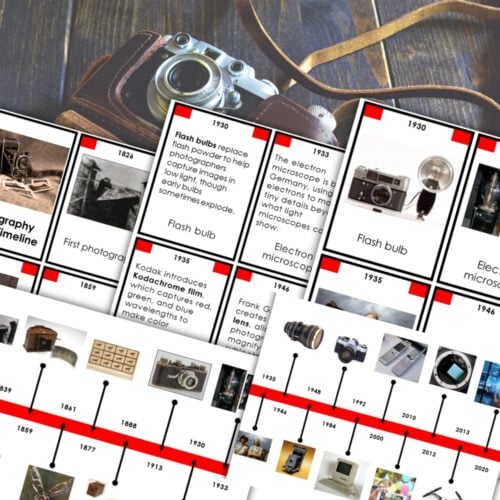
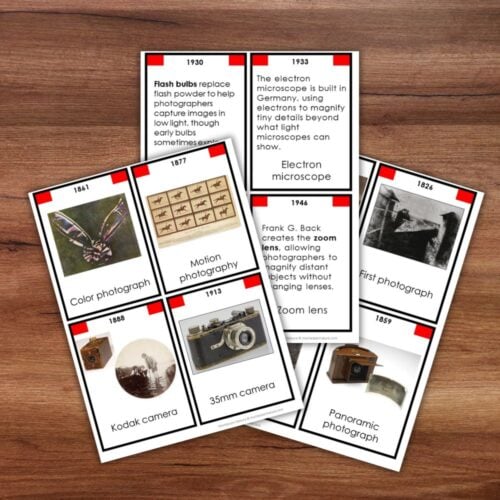
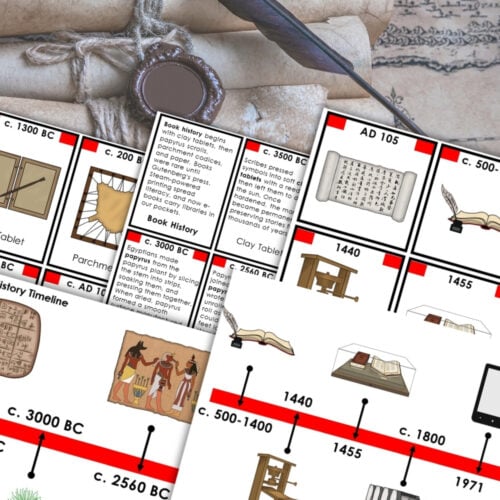
The Photography History Timeline Printable includes 5‑part cards for 19 key photography milestones, a timeline overview, and an easy-to-assemble book. You can use it to introduce each invention and provide a visual reference for all your activities.
Step 1: Explore the Timeline Together
Begin by introducing the timeline of photography. Lay out the cards in chronological order—from the First Photograph to AI Photography. Talk about the progression of technology and how each invention built upon the one before it.
Ask questions like:
- What problem did this invention solve?
- How did this invention change how people saw the world?
- What would life be like without this invention?
Display the cards on a wall or bulletin board as a visual reference throughout your study.
Step 2: Focus on One Milestone at a Time
Choose one photography milestone to explore in depth. Read the definition card together. Look at the representative illustration. Discuss the key characteristics and significance.
Hands-On Activities by Age
Ages 3–6 (Early Childhood)
At this age, children learn through sensory exploration and concrete experiences. Keep activities simple, process-oriented, and focused on the joy of discovering images.
- First Photograph
- Look at pictures of the first photograph. Notice how different it looks from photos today.
- Draw a picture of your house or yard, like Niépce did.
- Use a magnifying glass to look closely at objects, like a camera lens.
Daguerreotype
- Look at old family photos and compare them to modern ones.
- Make a “daguerreotype” craft by drawing on foil or shiny paper.
- Talk about how people used to sit very still for photos.
Panoramic Photography
- Fold a long strip of paper and draw a wide landscape across it.
- Take a “panoramic” walk and look at the wide view around you.
- Use your hands to make a frame and “frame” a wide scene outside.
First Color Photograph
- Look at the first color photograph (tartan ribbon). Notice the colors.
- Sort colored objects by color—red, green, blue—like the three-color method.
- Color a picture using only red, green, and blue crayons.
Motion Photography
- Look at Muybridge’s horse photographs.
- Act out slow motion and fast motion.
- Draw a person or animal in different positions of movement.
Kodak Camera
- Look at pictures of the first Kodak camera.
- Make a “camera” from a cardboard box and pretend to take photos.
- Draw yourself taking a photo of something you love.
35mm Camera
- Compare a big camera to a small one. Which is easier to carry?
- Look through a paper tube to “zoom in” on something.
- Draw a picture of the things you would photograph if you had a tiny camera.
Flash Bulbs
- Turn off the lights and use a flashlight to light up an object.
- Draw a picture using dark and light colors.
- Act out taking a photo with a “flash” (clap or make a sound).
Electron Microscope
- Look at a tiny object with a magnifying glass.
- Draw what you see very big, like a microscope picture.
- Talk about things too small to see with our eyes.
Kodachrome Film
- Look at old color photos and compare them to black and white.
- Color a picture with bright, vibrant colors.
- Sort photos by color—which ones are the brightest?
Zoom Lens
- Use binoculars or a magnifying glass to make things look bigger.
- Draw a scene from far away and then draw it close up.
- Pretend your hands are a zoom lens and “zoom in” on things.
Polaroid Camera
- Look at a Polaroid photo and see how it develops.
- Fold paper to make a “camera” and “develop” a picture.
- Draw a picture of something you love and “give” it to someone instantly.
Digital Camera
- Look at pictures on a phone or tablet.
- Take a photo with a device and see it appear right away.
- Draw yourself taking a digital photo.
JPEG Format
- Talk about how computers store photos.
- Draw a picture and “save” it in a folder.
- Compare a big drawing to a small copy—which one is easier to share?
Camera Phone
- Take a photo with a real camera phone.
- Draw yourself taking a photo with a phone.
- Count how many people have phones that can take photos.
- Look at different photos on a photo-sharing app.
- Draw a picture and “post” it on a class display.
- Talk about how people share photos with friends and family.
Mirrorless Camera
- Compare a small camera to a big one. Which would you rather carry?
- Draw a picture of your dream camera—what would it look like?
- Talk about how technology makes things smaller and lighter.
Drone Photography
- Look at pictures taken from the sky. What can you see from above?
- Draw a bird’s-eye view of your home or school.
- Imagine you have a flying camera—what would you photograph?
AI Photography
- Talk about how computers can help make photos better.
- Draw a picture and then draw a changed or improved version.
- Create a photo collage by cutting and pasting different pictures together.
Ages 6–9 (Lower Elementary)
At this age, children can handle more detail and longer projects. They enjoy research, comparing technologies, and creating projects.
First Photograph
- Research Niépce and the first photograph.
- Create a timeline of early photography.
- Write a diary entry as Niépce waiting eight hours for his photo to develop.
Daguerreotype
- Research the daguerreotype process.
- Compare daguerreotypes to modern photographs.
- Draw a portrait in the style of a daguerreotype.
Panoramic Photography
- Create a panoramic landscape drawing on a long strip of paper.
- Research Sutton’s panoramic lens.
- Photograph a wide scene using a phone in panoramic mode.
First Color Photograph
- Research Maxwell’s three-color method.
- Experiment with mixing colors (red, green, blue light).
- Recreate the tartan ribbon image using colored pencils.
Motion Photography
- Research Muybridge and his motion studies.
- Create a flip book showing motion.
- Photograph a friend in motion and draw their positions.
Kodak Camera
- Research George Eastman and the Kodak camera.
- Build a simple pinhole camera from a cardboard box.
- Write a letter from Eastman to his customers.
35mm Camera
- Research Oskar Barnack and the 35mm camera.
- Compare 35mm film to earlier film formats.
- Design your own compact camera.
Flash Bulbs
- Research the invention of flash bulbs.
- Experiment with light and shadow in the classroom.
- Draw a still life with dramatic lighting.
Electron Microscope
- Research the electron microscope.
- Look at microscope images online and draw what you see.
- Compare light microscopes to electron microscopes.
Kodachrome Film
- Research Kodachrome and its impact on color photography.
- Compare color photos to black-and-white photos.
- Take photos on a device and notice the colors.
Zoom Lens
- Research Frank G. Back and the zoom lens.
- Experiment with zooming in on objects with a phone camera.
- Draw a scene from two different distances.
Polaroid Camera
- Research Edwin Land and the Polaroid camera.
- Make a “developing” paper craft (draw under paper and reveal).
- Write a story about taking an instant photo.
Digital Camera
- Research the first digital camera.
- Compare film and digital photography.
- Take and edit a digital photo.
JPEG Format
- Research the JPEG format.
- Compare file sizes of different images.
- Draw a picture and try different ways to “compress” it.
Camera Phone
- Research the first camera phone.
- Compare camera phones to standalone cameras.
- Write about how camera phones changed photography.
- Research Instagram and its impact.
- Create a class photo display on a wall.
- Write about how people share photos differently today.
Mirrorless Camera
- Research mirrorless cameras.
- Compare mirrorless to DSLR cameras.
- Design your own dream camera.
Drone Photography
- Research drone photography.
- Draw a bird’s-eye view map.
- Write about what you would photograph from the sky.
AI Photography
- Research AI in photography.
- Experiment with photo editing tools.
- Write a persuasive essay on AI’s role in photography.
Ages 9–12 (Upper Elementary)
At this age, children are ready for independent research, in-depth analysis, and sophisticated projects.
First Photograph
- Write a research paper on Niépce.
- Create a detailed timeline of early photography inventions.
- Recreate the first photograph by drawing a view of your estate.
Daguerreotype
- Research the scientific principles behind the daguerreotype.
- Write a report on Daguerre and his invention.
- Compare commercial success of different photographic processes.
Panoramic Photography
- Research Sutton’s achromatic panoramic lens.
- Create a detailed panoramic drawing or painting.
- Write a report on the history of panoramic photography.
First Color Photograph
- Research Maxwell’s three-color method.
- Write a report on the science of color photography.
- Create a three-color print using red, green, and blue filters.
Motion Photography
- Research Muybridge’s contributions to science.
- Write a biography of Muybridge.
- Create a detailed flip book or stop-motion animation.
Kodak Camera
- Research Eastman and Kodak’s impact on photography.
- Write a report on the Kodak camera.
- Build a working pinhole camera from scratch.
35mm Camera
- Research Barnack and Leitz.
- Write a report on the development of 35mm photography.
- Compare different camera formats and their uses.
Flash Bulbs
- Research the chemistry of flash bulbs.
- Write a report on lighting in photography.
- Experiment with different lighting techniques.
Electron Microscope
- Research the electron microscope.
- Write a report on its scientific applications.
- Draw detailed images of objects seen under a microscope.
Kodachrome Film
- Research Kodachrome and its legacy.
- Write a report on color film technology.
- Create a color theory display.
Zoom Lens
- Research the optics of zoom lenses.
- Write a report on the science of magnification.
- Design your own lens system.
Polaroid Camera
- Research Land and Polaroid.
- Write a report on instant photography.
- Create a photo essay using instant photos.
Digital Camera
- Research the evolution of digital cameras.
- Write a report on how digital sensors work.
- Compare film and digital photography in depth.
JPEG Format
- Research image compression algorithms.
- Write a report on digital file formats.
- Experiment with compressing images at different levels.
Camera Phone
- Research the impact of camera phones on society.
- Write a report on mobile photography.
- Compare camera phone quality to standalone cameras.
- Research Instagram and social media.
- Write a report on the cultural impact of photo sharing.
- Create a class photo challenge.
Mirrorless Camera
- Research mirrorless technology.
- Write a report on the future of cameras.
- Compare different camera types in detail.
Drone Photography
- Research drone technology.
- Write a report on aerial photography.
- Plan a drone photography mission on paper.
AI Photography
- Research AI in photography.
- Write a report on the ethics of AI photo editing.
- Experiment with AI editing tools and evaluate their impact.
Step 3: Compare and Contrast
Ask children to compare two photographic milestones side by side. For example:
- How is a daguerreotype different from a digital photo?
- What makes a Polaroid different from a camera phone?
- How did film photography change with Kodachrome?
- How does drone photography compare to panoramic photography?
Use the 5‑part cards to guide the conversation. The definition cards provide key characteristics, major milestones, and significance for each invention.
Step 4: Create a Personal Photography Timeline
Invite children to create their own photography history timeline—but with their own photos. Have them collect or take pictures of themselves at different ages, with different cameras, or in different places. They can also interview grandparents about how photography has changed during their lives.
This is a powerful way for children to see themselves as part of the story. They are not just observers of photography history—they are participants in it.
Connecting to Memory and Culture
Photography is not just about cameras and film. It is about what people value.
The first photograph was patience and persistence.
The daguerreotype was memory and portraiture.
Color photography was life and vibrancy.
Motion photography was science and discovery.
The Kodak camera was accessibility and democracy.
The Polaroid was immediacy and spontaneity.
Digital photography was innovation and progress.
Camera phones were ubiquity and connection.
Instagram was sharing and community.
Drone photography was imagination and perspective.
AI photography is creativity and possibility.
When children understand this, they begin to see photography everywhere—in family albums, in their phones, in the images that fill their world. They understand that photography is not separate from life. It is life.
“The camera is an instrument that teaches people how to see without a camera.” —Dorothea Lange
Photography history shows us that capturing light is not a luxury. It is a fundamental human need. It is how we remember. It is how we connect. It is how we share who we are.
When you share photography history with your students, you are doing more than teaching facts. You are giving them a foundation for curiosity. You are showing them that they, too, belong to the great story of light and memory.
And who knows? One day, they might be the ones capturing the world in a new way.
Photography History Timeline: 5 Part Cards
This Montessori-inspired Timeline of Photography Printable can be a helpful addition to history and science curriculum. This resource is designed to support hands-on, inquiry-based learning for students exploring the evolution of technology and human creativity.
You Might Also Enjoy
This printable is also available on TPT

About Anastasia | Anastasia is an early childhood teacher with over twenty years of experience in Montessori classrooms and homeschooling. With a Master’s in Information Science, she blends education and information design to create clear, organized, research-backed resources. As founder of Montessori Nature, she develops evidence-based, nature-inspired printables that support holistic child development and foster curiosity, independence, and a love of learning. Explore more in her shop and Teachers Pay Teachers store.