Learning to cross the street is one of the most vital life skills we can impart to young children. In a Montessori classroom, we approach this not just as a rule to memorize, but as a practical, sequential process that fosters independence, situational awareness, and responsibility. By breaking down the steps and incorporating hands-on activities, we help children internalize safety protocols in a way that is engaging and empowering.

The Montessori Philosophy and Practical Safety
The Montessori method is rooted in respect for the child and in preparing them for the real world. Practical Life lessons are designed to develop coordination, concentration, and self-confidence. Teaching street safety fits perfectly within this framework. It is a grace and courtesy lesson extended to the community—a way for the child to learn to care for themselves and interact safely with their environment. We move beyond simply saying “don’t run into the street” and instead provide the tools and practice for the child to know exactly what to do.
Key Principles for Street Safety

Before introducing activities, we establish core principles in simple, clear language that children can understand.
- Always Have a Grown-Up: Emphasize that young children must always hold the hand of a trusted adult when near a street or parking lot. This is the most important rule.
- Stop Every Time: The first action is always to come to a complete stop at the curb, the edge of the driveway, or the back of a parked car. This halt creates a crucial moment of assessment.
- Use Your Eyes and Ears: Teach children to look for the “walking person” signal and to listen for the sound of cars, sirens, or horns. We discuss how even if the signal says “walk,” we must still check for cars that might not be stopping.
- Look Left-Right-Left: This is the foundational visual scan. We practice turning our heads all the way to the left, then all the way to the right, and then back to the left again before proceeding.
- Cross Straight and Be Seen: We explain the importance of walking straight across the street, not diagonally, and making eye contact with drivers whenever possible to ensure they see you.
Hands-On Learning Activities for the Classroom
We integrate these principles into the classroom through purposeful activities that refine both gross and fine motor skills while reinforcing the sequence of safe crossing.
- The Masking Tape Road
This simple activity brings the street into the classroom for safe practice.
Setup: Use wide masking tape to create a “road” on the classroom floor. Add smaller parallel lines for a crosswalk.
Activity: Children take turns being pedestrians and “cars” (walking slowly along the road). The pedestrian approaches the tape line, demonstrates a complete stop, and practices the exaggerated head turns of looking left-right-left. They then check for oncoming “cars” before proceeding to cross within the lines of the crosswalk.
Refinement: Introduce a paper “walk” signal on a stick. One child can hold it up, giving the pedestrians the visual cue to begin their safety check and cross.
- The Sensory Bin: Building a Community
This activity focuses on fine motor skills and spatial awareness while discussing safety.
Setup: Fill a shallow bin with kinetic sand. Add small toy cars, wooden people figures, and small blocks to represent buildings and curbs.
Activity: Children can create street scenes, building roads with curves and intersections. They then maneuver the people figures, practicing stopping at the curb and looking both ways before placing the figure in the crosswalk. This small-scale practice helps solidify the cognitive sequence.
- Role-Playing with Props
Dramatic play is a powerful tool for internalizing lessons.
Setup: Create a simple felt “stop sign” and a “traffic light” with red, yellow, and green circles. A small orange cone can mark the curb.
Activity: In a group, children act out a scenario. One child holds the traffic light, changing the colors. Another holds the stop sign. The “pedestrians” must respond appropriately to the signals, still practicing their own left-right-left check before crossing, even when the light is green for them.
Introducing the Sequencing Tool
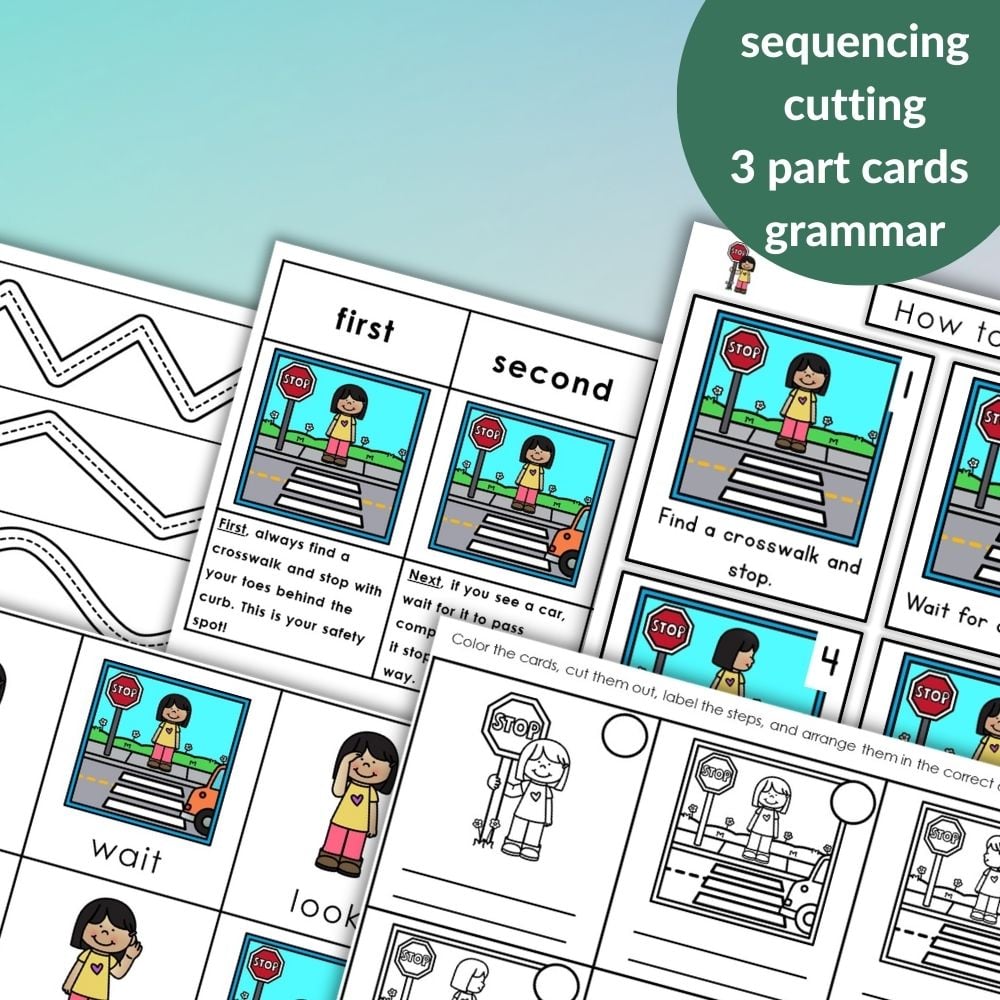
To tie these activities together and provide a concrete reference, we introduce a Sequencing Printable for How to Cross the Street. This resource is more than a poster; it’s a key material in the child’s learning process.
The printable breaks down the complex procedure into manageable, visual steps:
Stop at the curb.
Look left.
Look right.
Look left again.
Listen for cars.
If the road is clear, walk straight across.
This visual guide can be used in multiple ways:
As a Story: During a group lesson, the teacher can use the cards to tell a story about safely crossing the street.
As a Matching Game: Scramble the cards and invite a child to place them in the correct order on a rug.
As a Fine Motor Activity: Children can practice cutting along the lines of the cards and then gluing them in order onto a strip of paper, further reinforcing the sequence through motor skill development.
As a Reference: Laminated and placed near the door, it serves as a gentle reminder before heading outside.
Teaching street safety isn’t a one-time lesson. It’s woven into the culture of the classroom. We might read stories about community helpers like crossing guards, sing songs about safety, and most importantly, model the behavior ourselves during walks or when arriving at school. We verbalize our actions: “I’m stopping at the curb. Now I’m looking left, right, and left again. The road is clear, so we can walk together.”
By providing clear instructions, purposeful practice, and a supportive environment, we give children the confidence and knowledge they need to participate in their own safety. This Montessori-inspired approach respects the child’s intelligence and capability, nurturing a cautious and aware individual who is prepared to navigate the world.
How to Cross the Street Safety Activities
This How to Cross the Street Safely printable is designed for preschool, kindergarten, and first-grade students, offering hands-on activities to teach essential pedestrian safety rules.
This printable is also available on TPT
You Might Enjoy


About Anastasia | Anastasia is an early childhood teacher with over twenty years of experience in Montessori classrooms and homeschooling. With a Master’s in Information Science, she blends education and information design to create clear, organized, research-backed resources. As founder of Montessori Nature, she develops evidence-based, nature-inspired printables that support holistic child development and foster curiosity, independence, and a love of learning. Explore more in her shop and Teachers Pay Teachers store.