Spain is a country rich in geography, culture, history, and tradition, making it a perfect subject for exploring with children. From the ancient Romans who built aqueducts still standing today to the Moorish scholars who introduced advanced mathematics and irrigation, Spain weaves a fascinating story of how humans have met their needs for shelter, food, art, and spirituality across thousands of years. In this post, we will explore Spain’s most interesting facts, its place in world history, and offer hands-on activities—science, cultural, hands-on, and practical life—to bring this vibrant country to life in your Montessori classroom or homeschool.
Learning About Spain
The Iberian Peninsula holds some of Europe’s oldest geological formations. The Picos de Europa mountains and the volcanic landscapes of the Canary Islands tell a story of Earth’s ancient formation. Children can explore how plate tectonics and volcanic activity shaped Spain’s diverse biomes, from snowy peaks to Mediterranean coasts.
Activity Idea: Create a salt dough map of Spain. Add mountains, rivers, and islands, then paint it to show different biomes—green for forests, yellow for deserts, and brown for mountains.

Spain is home to unique animals found nowhere else on Earth. The Iberian lynx is the world’s most endangered wild cat and represents the fragility and resilience of life. The Spanish ibex climbs rocky cliffs with its curved horns, while the Griffon vulture soars high above the mountains. These animals show how living things adapt to their environments.
Activity Idea: Set up 3-part cards featuring native Spanish animals. Children can match pictures, names, and facts while learning about habitats and conservation.
Spain’s human history stretches back over a million years. The Cave of Altamira contains some of the world’s most famous prehistoric paintings, dating back 36,000 years. Later, the Romans arrived and called the land Hispania. They built roads, bridges, and aqueducts that still stand today. In 711 AD, the Moors arrived from North Africa and ruled for over seven centuries. They introduced oranges, rice, paper, and advanced irrigation systems that transformed farming.
Activity Idea: Create a timeline of Spanish history. Include key civilizations such as the Iberians, Romans, Visigoths, Moors, and the Christian kingdoms that unified Spain in 1492.
Spain’s languages offer a fascinating look at how writing developed. Castilian Spanish is the official language, but Spain has three other official languages: Catalan, Galician, and Euskera. Euskera is especially special because it existed before the Romans arrived and is not related to any other known language. Arabic script influenced Spanish writing during Moorish rule, and the first Spanish grammar book was published in 1492.
Activity Idea: Display the Spanish alphabet and teach children a few simple words. Provide sandpaper letters in Spanish script or create vocabulary cards with pronunciation guides.
Spain in World History
Several key moments shaped Spain’s role in world history.
- In 1492, a pivotal year, Christopher Columbus sailed from Spain to the Americas, the Moors were expelled from Granada, and the first Spanish grammar book was published.
- During the 16th and 17th centuries, Spain became a global empire with territories across Europe, the Americas, Africa, and Asia.
- The Spanish Civil War from 1936 to 1939 deeply affected the country and became a precursor to World War II.
- In 1978, Spain adopted its current democratic constitution after decades of dictatorship.
- In 1986, Spain joined the European Union, embracing its role as a modern European nation.
Hands-On Activities for Exploring Spain
Geography & Cultural Activities
Map of Spain
Provide a large outline map of Spain. Children can label regions, major cities such as Madrid, Barcelona, Seville, and Valencia, and neighboring countries including France, Portugal, and Andorra.
Flag Study
Present the Spanish flag with its red and yellow stripes and coat of arms. Children can color their own flags and learn the meaning of the colors—red for bravery and yellow for generosity.
Landmark 3-Part Cards
Use cards featuring the Alhambra, Sagrada Familia, Roman Aqueduct of Segovia, and other iconic sites. Children match pictures, names, and descriptions.
Spanish Language Cards
Introduce common Spanish words such as hola (hello), gracias (thank you), and amigo (friend). Include pronunciation guides to help children practice.
Science Activities
Olive Oil Experiment
Spain produces more olive oil than any other country. Provide small bowls of olive oil alongside other oils such as vegetable or coconut. Children can observe, smell, and compare them while discussing how olives grow and are pressed for oil.
Pine Forest Investigation
The Spanish Moon Moth lives only in pine forests. Provide pine cones, pine needles, and magnifying glasses so children can examine how pine trees grow and support unique wildlife.
Weather and Biomes Study
Spain has snowy mountains, Mediterranean coasts, deserts, and lush forests. Create biome cards and have children match them to regions on a map. Discuss how climate affects food, clothing, and housing.
Practical Life Activities
Making Gazpacho
Children can wash and chop tomatoes, cucumbers, and peppers using child-safe knives, then blend them to create this refreshing cold soup. No heat is required, making it a safe cooking activity.
Olive Tasting
Set up a tasting activity with different varieties of olives such as green, black, and stuffed. Children can practice using small tongs to transfer olives to a dish, building fine motor skills.
Grinding Saffron
Saffron is used in paella and is one of Spain’s most prized spices. Provide a mortar and pestle with saffron threads so children can grind them gently and observe how the color and aroma change.
Fan Folding
The abanico, or hand fan, is a traditional Spanish accessory. Provide paper, paint, and craft sticks so children can create their own fans and practice opening and closing them gracefully.
Preparing Tortilla Española
Under supervision, children can peel potatoes, whisk eggs, and help prepare this classic Spanish omelet. This activity builds fine motor skills and introduces cooking vocabulary.
Art & Music Activities
Flamenco Rhythm
Play flamenco music and provide castanets or simple rhythm sticks. Children can practice clapping patterns, known as palmas, and stomping rhythms, called zapateado.
Gaudí-Inspired Mosaics
Antoni Gaudí used colorful mosaics in his architecture. Provide small tiles, colored paper, or play dough for children to create their own mosaic patterns.
Castanet Craft
Make simple castanets from cardboard or bottle caps. Children can decorate them and practice clicking in rhythm.
Painting the Alhambra
Show images of the Alhambra’s intricate geometric patterns. Provide paper and paint for children to create their own repeating designs inspired by Moorish art.
Interesting Facts About Spain to Share with Children
- Spain has over 8,000 kilometers of coastline. That is longer than the distance from New York to Los Angeles.
- The Iberian lynx was almost extinct but has made a remarkable comeback thanks to conservation efforts.
- Spain produces nearly half of the world’s olive oil.
- The Camino de Santiago pilgrimage route has been walked for over 1,000 years.
- Spain has 48 UNESCO World Heritage Sites, including cities, monuments, and natural parks.
- The Spanish language is spoken by over 500 million people worldwide.
- La Tomatina festival involves throwing over 100 tons of tomatoes in one hour.
- Spain is home to Europe’s only desert, the Tabernas Desert in Almería.
Spain offers a rich and engaging topic for Montessori education, connecting beautifully to the Great Lessons and the study of fundamental human needs. From the ancient Romans to modern Spanish culture, children can explore how humans have adapted to their environment, expressed creativity, and built communities over thousands of years. Through hands-on activities in geography, science, culture, and practical life, children develop a deep appreciation for this vibrant country and its place in world history.
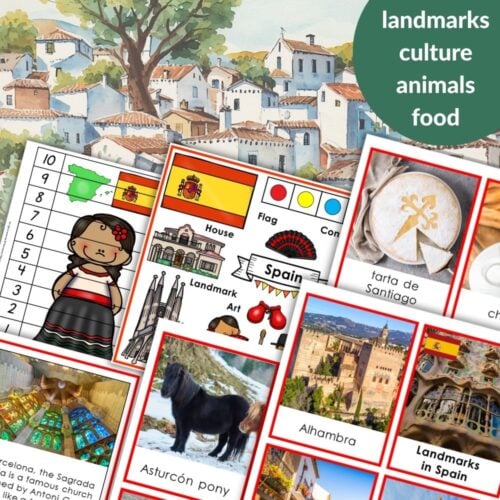
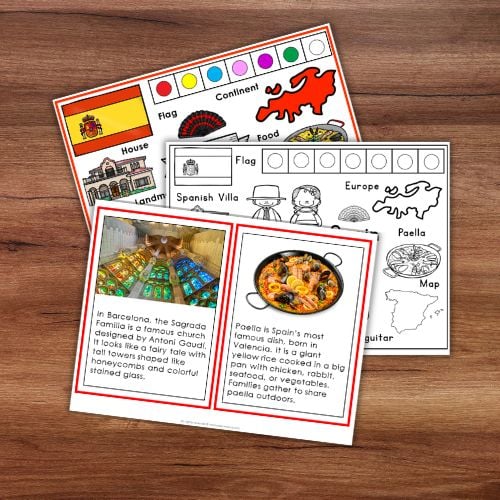
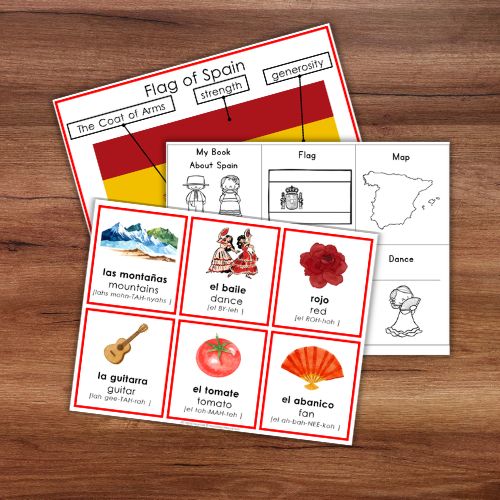
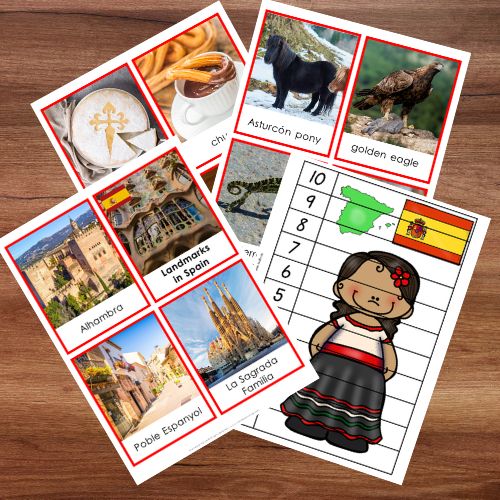
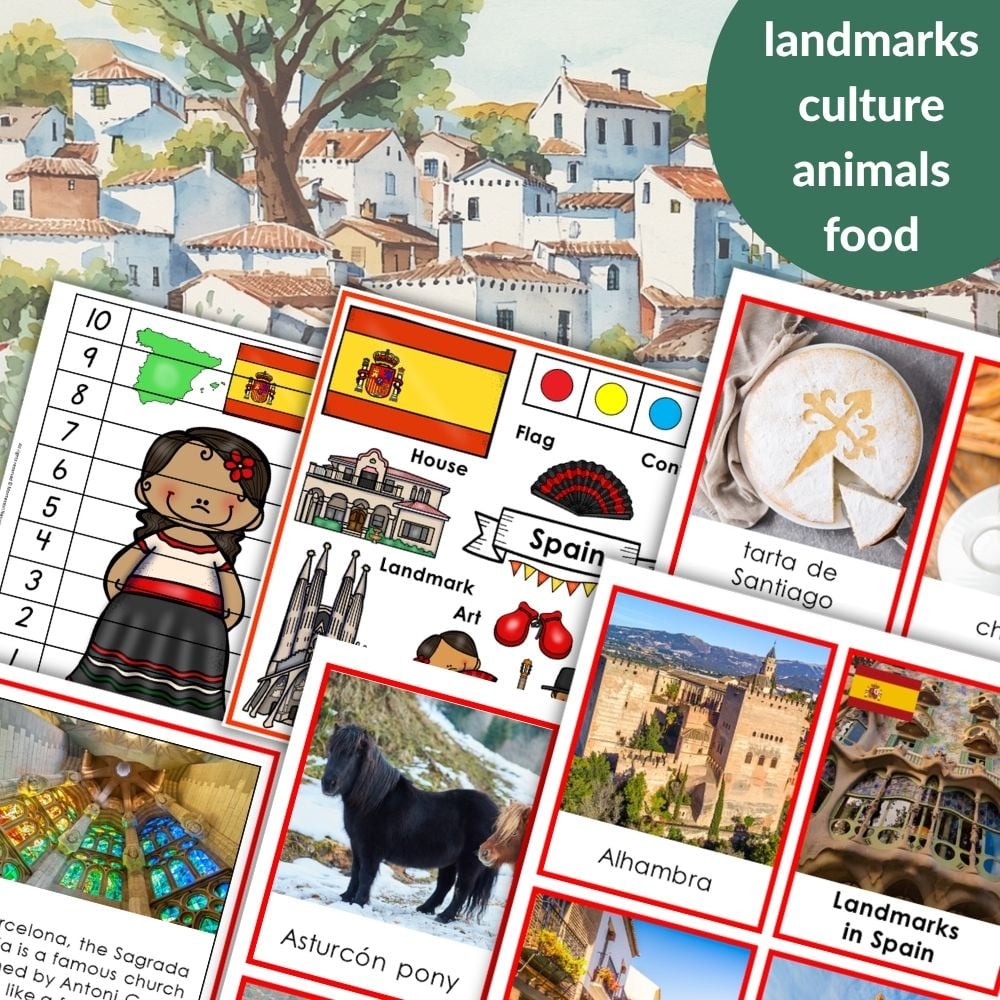
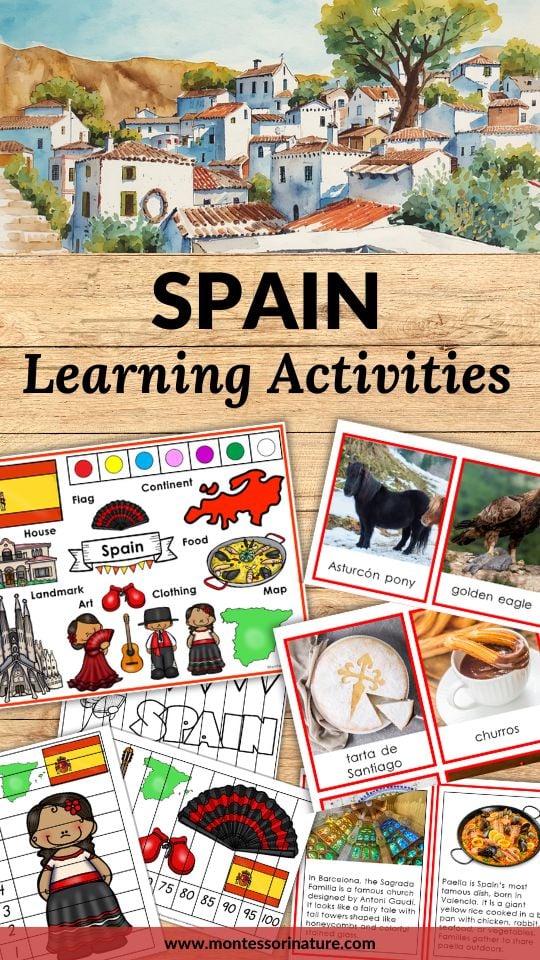
Spain: Map Flag Animals Food Landmarks 3 Part Cards
Discover the beauty and diversity of Spain with this comprehensive Country Pack. Perfect for K-Grade 3 students, this printable resource takes young learners on an engaging journey through Spain’s rich culture, fascinating geography, and unique wildlife. Ideal for supplementing Continent Boxes, Study of Europeans, or exploring global traditions, this pack helps students develop geographical knowledge, cognitive skills, fine motor development, and an appreciation for world cultures.
You Might Also Enjoy


About Anastasia | Anastasia is an early childhood teacher with over twenty years of experience in Montessori classrooms and homeschooling. With a Master’s in Information Science, she blends education and information design to create clear, organized, research-backed resources. As founder of Montessori Nature, she develops evidence-based, nature-inspired printables that support holistic child development and foster curiosity, independence, and a love of learning. Explore more in her shop and Teachers Pay Teachers store.