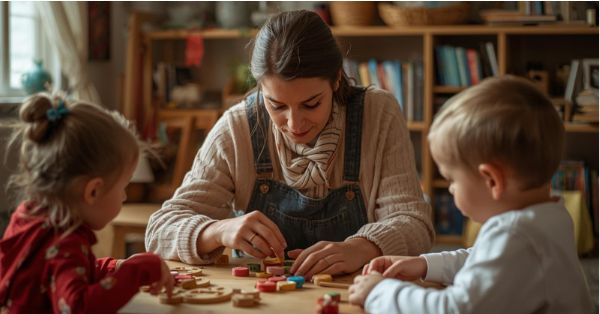
How to honor the mysterious spiritual energy that shapes who we become
There is a passage in The Secret of Childhood that has stopped me in my tracks more times than I can count. It’s a passage that challenges everything we think we know about education, parenting, and who really does the work of becoming human.
Montessori writes:
“It is the child who builds up the man, the child alone. The adult cannot take his place in this work; the exclusion of the adult from the child’s ‘world’ and ‘work’ is still more evident and more absolute than the exclusion of the child from the work producing the social order superimposed on nature in which the adult reigns. The child’s work belongs to another order and has a wholly different force from the work of the adult. Indeed one might say that the one is opposed to the other. The child’s work is done unconsciously, in abandonment to a mysterious spiritual energy, actively engaged in creation.”


Let those words settle.
It is the child who builds up the man, the child alone.
Not the parent. Not the teacher. Not the curriculum or the enrichment classes or the carefully curated childhood we try so hard to construct.
The child. Alone. Engaged in a work so profound, so mysterious, so utterly different from anything we adults do, that Montessori calls it “opposed” to our work.
We labor to produce, to accomplish, to build the world outside ourselves. The child labors to build themselves. From the inside out. Driven by what Montessori calls “a mysterious spiritual energy, actively engaged in creation.”
This is both humbling and freeing. Humbling because it reminds us: we are not the architects of our children. Freeing because it releases us from the impossible burden of trying to be.
So what does this look like in practice? How do we honor this “work of the child” without interfering? How do we step back without abandoning?
Here are some steps I’ve been gathering.
1. Recognize That the Child’s Work Is Not Your Work
Montessori is clear: the child’s work is of a “wholly different force” from adult work. We measure progress in outcomes, achievements, visible results. The child measures progress in inner construction—invisible, internal, unfolding.
Actionable step this week:
When you feel the urge to measure, evaluate, or accelerate your child’s development, pause and remind yourself: This is not my work. The child is building themselves. I am here to protect, not to produce.
Write this somewhere visible: “It is the child who builds up the man, the child alone.” Let it be a daily reminder to trust the process.
2. Step Back—Really Step Back
Montessori speaks of “the exclusion of the adult from the child’s world and work.” This isn’t neglect. It’s reverence. It’s recognizing that our presence, our direction, our constant intervention can be an intrusion into something sacred.
Actionable step this week:
Identify one area where you habitually intervene—dressing, eating, playing, problem-solving—and consciously step back. Let the child struggle a little. Let them figure it out. Let them make mistakes.
Observe from a distance. Breathe through the urge to “help.” Trust that the struggle is part of the work.
3. Protect the Child’s “Mysterious Spiritual Energy”
Montessori describes the child’s work as happening “unconsciously, in abandonment to a mysterious spiritual energy.” This energy is fragile. It needs protection from interruption, distraction, and adult agenda.
Actionable step this week:
Watch for moments when a child seems carried by this energy—deeply absorbed, quietly focused, working with intensity and joy. When you see it, protect it.
- Don’t interrupt.
- Don’t praise (“Good job!” pulls them out of the experience).
- Don’t redirect.
- Don’t ask questions.
- Simply be present. Witness. Protect.
This energy is the engine of self-creation. Our most important job is to get out of its way.
4. Stop Trying to “Teach” Everything
Montessori’s insight is radical: the adult cannot take the child’s place in this work. We can’t teach a child to become themselves. We can’t program development or schedule self-construction.
Actionable step this week:
Identify one thing you’ve been trying to “teach” your child—maybe a skill, a habit—and experiment with letting go. Provide the environment, the materials, the invitation. Then step back.
Trust that when the child is ready, the inner force will draw them to it. Your job is to prepare the soil, not to force the seed to sprout.
5. Create Space for Uninterrupted Time
The child’s work requires long, unhurried stretches of time. It cannot happen in five-minute snippets between adult-directed activities.
Actionable step this week:
Look at your daily rhythm. Where can you carve out longer, uninterrupted blocks of time? A full morning with no scheduled activities. An afternoon where the child leads. A weekend day with no agenda.
During these times, resist the urge to fill, direct, or entertain. Let the child’s work unfold at its own pace.
6. Trust the “Unconscious” Work
Montessori says the child’s work is done “unconsciously.” This is hard for us. We want to see progress. We want to know it’s working. But so much of the child’s construction happens beneath the surface, invisible to our eyes.
Actionable step this week:
When you feel anxious about your child’s development—worried they’re “behind” or not doing enough—remember: you are witnessing only the visible tip of an immense inner process.
Trust that the work is happening, even when you can’t see it. The child is building themselves, layer by layer, in ways that will reveal themselves in their own time.
7. Resist the Urge to “Produce” a Child
Our culture pressures us to produce children with certain skills, achievements, outcomes. Montessori’s words challenge this entire paradigm. The child is not a product we manufacture. The child is a being engaged in their own creation.
Actionable step this week:
Take an honest look at your hopes and expectations for your child. Separate them into two categories:
- What is truly for their flourishing?
- What is for my validation, status, or peace of mind?
Let go of one expectation this week that serves you more than it serves them. It’s hard. It’s freeing.
8. Find Wonder in Witnessing, Not Directing
If the child’s work is their own, then our role shifts from director to witness. And witnessing, it turns out, is its own kind of gift—both to them and to us.
Actionable step this week:
Spend fifteen minutes simply observing your child without any agenda. No teaching. No correcting. No guiding. Just watching.
Notice the intensity. The concentration. The joy. The struggle. The triumph.
Let yourself be filled with wonder at the mysterious energy at work. This is the child building the man. And you get to watch.
A Simple Challenge for This Week
Choose one of these steps—just one—and try it.
- Recognize that the child’s work is not yours.
- Step back from one area of intervention.
- Protect a moment of mysterious energy.
- Stop teaching one thing and trust the process.
- Create an uninterrupted block of time.
- Trust the unconscious work.
- Let go of one expectation.
- Spend time simply witnessing.
Then notice what shifts. In the child. In you.
Montessori’s words about the child’s work aren’t just a theory. They’re an invitation to a different way of being with children.
A way that honors their sovereignty.
A way that trusts their inner wisdom.
A way that steps back enough to let them become who they’re meant to be.
It’s hard. It goes against so much of what we’ve been told about parenting and education. We want to build, to shape, to produce.
But the truth is both humbling and beautiful: the child builds the man. The child alone.
Our work is not to take their place. It’s to create space, to protect the process, and to witness with wonder the mysterious spiritual energy actively engaged in creation.
Right in front of us.
Every single day.
About Anastasia | Anastasia is an early childhood teacher with over twenty years of experience in Montessori classrooms and homeschooling. With a Master’s in Information Science, she blends education and information design to create clear, organized, research-backed resources. As founder of Montessori Nature, she develops evidence-based, nature-inspired printables that support holistic child development and foster curiosity, independence, and a love of learning. Explore more in her shop and Teachers Pay Teachers store.