I have noticed that generally, children get interested in clocks early on – before they are old enough to be able to read the analog clock all on their own. For children to be able to tell time with analog clocks they need to :
- be able to recognize numbers 0-60
- be familiar with fractions
- be familiar with the definition of past and present, a.m, pm., afternoon, noon

Generally speaking, preschool children do not know these math concepts. However, schedules and time are something that often becomes an essential part of a child’s everyday life at this age. They are curious to know what time daddy comes home, when their favorite show starts and how long it takes to get to the park. I found that the best way to introduce the concept of time, telling time and different clocks is to do it gradually, starting with simple tasks:
- Wearing a watch – my daughter got her first watch ( by request ) for her 4th Christmas. At this age, she learned that the small hand on the clock is the hour hand. She was very proud to be able to tell what o’clock it was. We got an analog watch just because this is the most commonly used type of clock at homes and in public areas – in waiting rooms, libraries, schools, etc.
- telling o’clock with a play clock – we have a great wooden clock that we use for telling time. With the help of this play clock, I showed introductory lessons on types of hands – minute and hour. We talked that there are 24 hours in a day, 12 o’clock on the clock face, and 60 minutes in one hour, the direction in which hands move.


- matching digital time display with a play clock
- a step-by-step guide to learning about clock face – we did that by constructing our play clock using Montessori math beads, which was inspired by Montessori Soul’s idea, and using Lego. As you know, Lego is an incredibly versatile material and great for developing problem-solving skills. Blossom was very excited to create her play clock together with me. The hands-on aspect of putting this together helped her: better remember parts of the clock and introduce 5-minute intervals for a minute count (counting in 5s), practice one-to-one correspondence. We used task cards I made to move hands to match the digital clock display. You can download this set here – free printables page.
I hope you were inspired to have fun creating hands-on learning experiences for your child.
-

Time Telling Activities
$0.00

you might enjoy our math resources
-
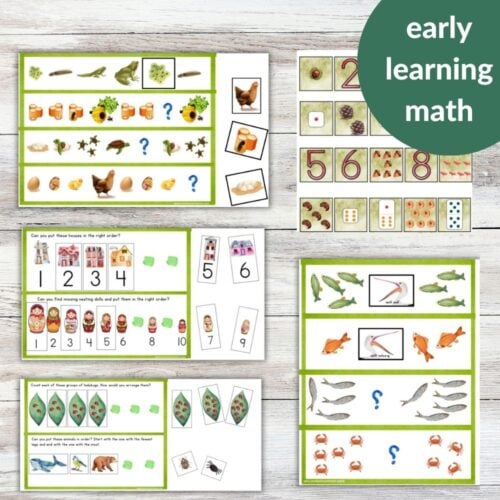
Math Preschool Kindergarten Hands-on Activities$5.50
-
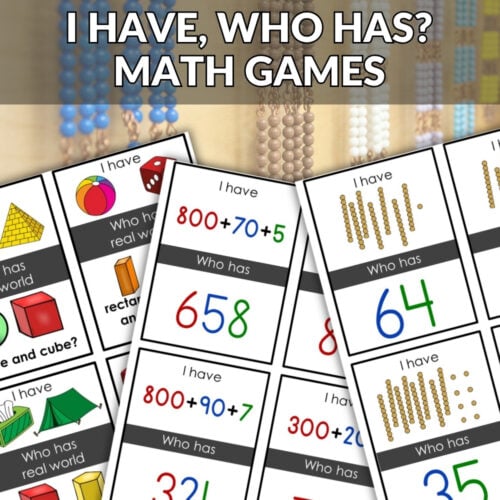
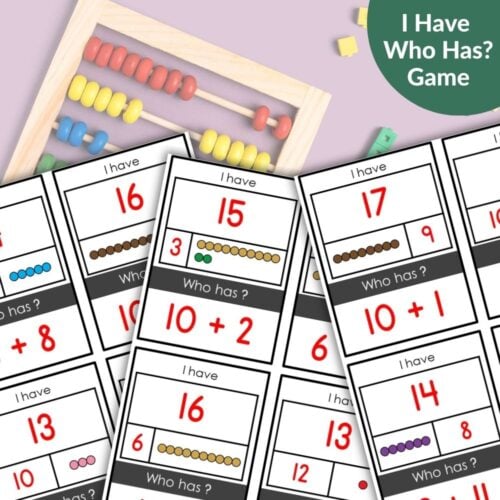
I Have Who Has Math Games Bundle
-
Knobless Cylinder Sensorial Extension Cards: Spring Patterns$4.10
-
Knobless Cylinder Extension Cards: Winter Patterns$4.10
-
Place Value Math Bundle: Addition Subtraction Division Multiplication Operation Cards
-
Knobless Cylinder Extension Cards: Summer Patterns$4.10
-
Knobless Cylinder Extension Cards: Fall Patterns$3.60
-
Fact Families Division: I Have Who Has Math Game$3.10
-
Number Bonds Up to Twenty: I Have Who Has Math Game$2.60

About Anastasia | Anastasia is an early childhood teacher with over twenty years of experience in Montessori classrooms and homeschooling. With a Master’s in Information Science, she blends education and information design to create clear, organized, research-backed resources. As founder of Montessori Nature, she develops evidence-based, nature-inspired printables that support holistic child development and foster curiosity, independence, and a love of learning. Explore more in her shop and Teachers Pay Teachers store.