For educators and parents building math fluency in young children, the goal is to move beyond rote counting toward immediate number recognition. This free “Roll the Snowman” printable game targets that exact skill through a playful, self-directed activity. It is a designed math work, not just a busy-time craft.
The Material: What’s Included
The printable is a single-page game board featuring an outline of a simple snowman. The snowman is divided into parts, each marked with a number: 1-6.
The only other materials required from your environment:
- A single standard die
- A pencil, or small dry-erase marker if the sheet is laminated

The Work: The Procedure is the Game
The child’s task is to “build” their snowman by rolling the die and drawing the corresponding part.
- Roll the die.
- Subitize: Recognize the number of dots instantly, without counting.
- Match & Draw: Find the snowman section labeled with that number and draw the designated part.
- Continue rolling until all parts are drawn. The game is complete when the snowman is fully built.
The Purpose: Isolating a Skill
This is a focused math game with clear aims:
- Direct Aim: To reinforce subitizing (instant number recognition of 1-6) and numeral identification.
- Indirect Aims: To practice one-to-one correspondence, turn-taking (if played with a partner), and fine motor control (drawing small shapes). It also introduces early probability—the child experiences that some numbers (like 3) will be rolled more often to complete the snowman.
Why This Format is Effective for Independent Learning
- Control of Error: The game provides inherent feedback. The child cannot complete the snowman until they roll the required numbers. They immediately see if their number recognition was correct by checking the section label.
- Clear Cycle of Activity: The work has a definite beginning (blank snowman), process (rolling and drawing), and end (complete snowman). This satisfies the child’s need for order and completion.
- Minimal Prep, Maximum Engagement: It is a “print-and-play” activity that requires no additional pieces to cut or manage. The engagement comes from the action of the game itself.
Presentation & Integration
- Prepare: Print on cardstock. For repeated use, laminate and provide a dry-erase marker.
- Present: On a tray, place the game sheet, a single die, and a pencil. Briefly demonstrate: roll the die, silently recognize the number, point to the matching snowman section, and draw one corresponding part. Invite the child to begin.
- Extension/Variation: For a more challenging version, use two dice. The child adds the dots together (practicing facts up to 12) and draws a part for the sum.
-

Roll the Snowman
$0.00

You Might Also Enjoy
-
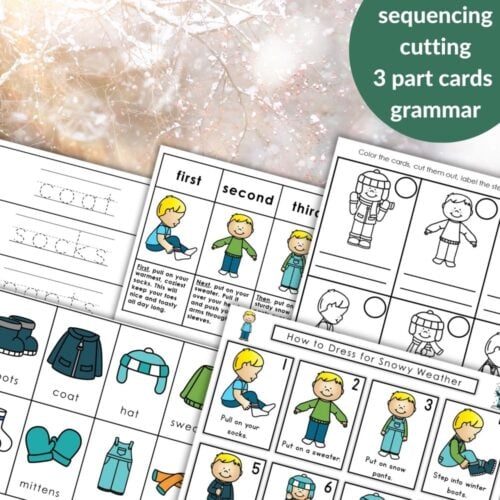
How to Dress for Snowy Weather Practical Life Winter Sequencing Cards Blackline Master$3.10
-
Knobless Cylinder Extension Cards: Winter Patterns$4.10
-
How to Build a Snowman: Sequencing Grammar Fine Motor Activities$3.10
-
Winter Hands On Preschool Activity Pack$6.10
-
Count to 10: Math Fine Motor Number Winter Cards Bilingual English Spanish$3.30
-
Winter Kindergarten Hands On Activity Pack$9.10


About Anastasia | Anastasia is an early childhood teacher with over twenty years of experience in Montessori classrooms and homeschooling. With a Master’s in Information Science, she blends education and information design to create clear, organized, research-backed resources. As founder of Montessori Nature, she develops evidence-based, nature-inspired printables that support holistic child development and foster curiosity, independence, and a love of learning. Explore more in her shop and Teachers Pay Teachers store.