As Montessori educators, we are always on the hunt for meaningful, hands-on printable resources that bring ancient civilizations to life in our elementary classrooms. The search for materials that go beyond dates and names to reveal the fundamental human needs of a culture—and do so in a way that integrate variety of activities—can be a challenge. That’s the very gap this comprehensive Indus Valley Civilization printable and unit study is designed to fill.

A World in Bronze: The Indus Valley’s Place in History
Around 5,000 years ago, a revolution in human technology sparked the dawn of a new era: the Bronze Age. From the banks of the Tigris and Euphrates to the Nile Delta, societies learned to combine copper and tin, creating a stronger metal that transformed toolmaking, art, and warfare. In this world of emerging empires, a unique civilization quietly rose along the fertile floodplain of the Indus River.
This was the Indus Valley Civilization (c. 3300–1300 BCE), a contemporary of ancient Egypt and Mesopotamia. Yet, the Harappans carved a distinct path. While others built towering pyramids and ziggurats for gods and kings, the Harappans invested in civic genius. Their legacy is one of stunning urban planning: cities like Mohenjo-Daro and Harappa were laid out on precise grids, featuring the world’s first sophisticated sewage systems, standardized bricks, and monumental public baths. They were a society of master planners, skilled artisans, and far-reaching traders, leaving behind a puzzle that captivates us to this day—a detailed written script we have yet to fully decipher.

The Foundation: Storytelling & Introducing Key Concepts
Begin by setting the scene. Use a large timeline to place the Indus Valley alongside Egypt and Mesopotamia, visually establishing it as a major peer civilization of the Bronze Age. This is where the 3-Part Cards become an essential tool. Present control cards featuring key artifacts like the Great Bath, intricate stone seals, and terracotta pottery. Read the descriptions together, inviting children to become observers of history. “What does this object tell us about the people who made it?” This initial exploration with the printable cards builds a foundational vocabulary and sparks curiosity.
Hands-On Science: Engineering and Innovation
Children learn by doing. These activities let them test the principles behind Harappan achievements.
- The Strength of Standardization (Physics/Math): Provide clay and a simple wooden mold in a standardized ratio (e.g., 4:2:1). As children make their own uniform bricks, they grapple with a core Harappan innovation. Why is consistency vital for large-scale construction? This leads to measuring, comparing, and understanding a key engineering concept.
- Hydraulic Engineers (Physics/Engineering): Challenge small groups to design a model drainage system using gutters, tubing, and clay on a slanted board. Can they channel “wastewater” from model houses to a main drain without leaks? This messy, engaging activity makes the brilliance of Harappan urban planning tangible.
- Metallurgy in Miniature (Chemistry): Simulate the magic of the Bronze Age with a safe, low-temperature alloy (like bismuth and tin). Using a hot plate and a tin can as a crucible, let children witness the creation of a new, harder metal from two softer ones, demystifying a transformative technological leap.
Practical Life: The Artisan’s Workshop
Connect fine motor skill development to the daily lives of the Harappan people.
- Seal Carving (Visual Arts/Fine Motor): Using soft soapstone or thick styrofoam and dull clay tools, children can carve their own personal seal with a geometric pattern or animal motif. Pressing it into clay to create an impression ties directly to the Indus Valley Seal cards and highlights their use in trade and ownership.
- Bead Making & Weaving (Fine Motor/Geometry): The Harappans were famed for their exquisite carnelian and gold bead jewelry. Stringing tiny beads into complex patterns or practicing simple weaving on a cardboard loom builds patience and dexterity, linking the child’s concentrated effort to that of an ancient craftsperson.
- Coil Pottery (Sensorial/Geometry): Building pots using the coil method with air-dry clay connects children to the ubiquitous Indus Valley Terracotta Pot. They can feel the clay’s resistance and see the form emerge from their hands, later reinforcing this experience by completing the corresponding Vocabulary & Illustration worksheet, where they paste the definition and draw their creation.
Language & Literacy: Decoding the Ancient World
The undeciphered Harappan script is an open invitation to explore the purpose and power of written communication.
- Create Your Own Symbols (Linguistics/Creative Writing): What did the Harappans need to record? Harvest counts? Trader agreements? Have children invent 5-10 simple pictographic symbols and use them to write a short message on “clay” (modeling foam). This activity builds deep respect for the invention of writing as a system.
- Exploring Interconnectedness (Reading Comprehension/Social Studies): The Word Bank activity is a cornerstone of this unit. It moves beyond simple recall. Sentences like “The _______ grew wheat so the _______ could bake bread” require children to think critically about the network of farmers, bakers, potters, and traders. This is language work that builds a profound understanding of economic and social interconnectedness, a core Montessori principle.
- Artifact Research & Description (Writing/Exposition): Using the Informational Description Cards as exemplars, children can choose an artifact (from the cards or one they crafted) and write their own museum-style description card. This formalizes observation into structured expository writing.
A Scaffolded Learning Journey with the Printable Resource
This Indus Valley printable is designed as a complete system to support differentiated learning, as detailed in the Teacher’s Guide.
- Knowledge Acquisition: Introduce concepts with the full 3-Part Cards and Informational Cards. These are the primary “artifacts” for study.
- Recall & Application: Use the Fill-in-the-Blank Activity Cards. Can children insert “standardized bricks” or “granary” from memory? This checks for understanding.
- Synthesis & Connection: This is the heart of deep learning. The Interconnectedness Word Bank forces synthesis of roles within society. Concurrently, the Vocabulary & Illustration worksheets allow children to synthesize knowledge by defining a term like “city planner” and visually representing it.
- Ownership & Expression: Finally, the Blackline Masters / Coloring Booklets empower children to create their own personal record of the civilization. They can color, label, and assemble their booklets, adding sketches of their own clay seal or model cart alongside the printed image of the Dancing Girl. The resource guides them from receiving knowledge to creating their own.
The Enduring Legacy: More Than a History Lesson
Studying the Indus Valley Civilization offers a vital narrative for today’s children. In a world often focused on conquests and monarchs, the Harappans present a story of community planning, technological harmony, and cooperative prosperity. Their silent cities challenge us to look for evidence of a society’s greatness not only in its monuments but in the welfare of its people.
By engaging with this unit—through carving, building, writing, and puzzling over the same challenges the Harappans faced—children do more than learn history. They practice the timeless skills of innovation, problem-solving, and collaboration. They see that the past is not a distant land but a continuum of human ingenuity to which they, too, belong.
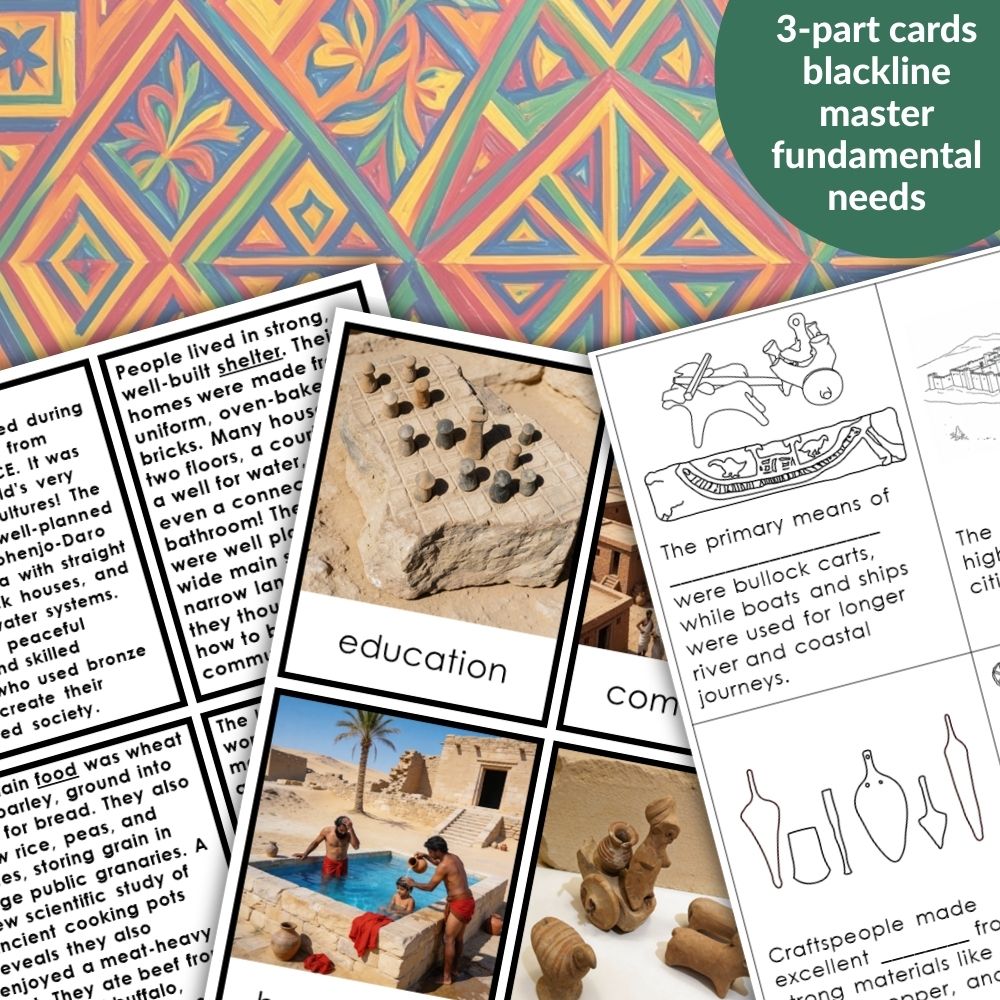
Indus Valley: Fundamental Needs 5 Part Cards
Engage your elementary students with the fascinating puzzle of the Indus Valley Civilization! This printable Montessori resource is a ready-to-use toolkit for teaching about ancient civilizations through the lens of fundamental human needs. Designed for hands-on learning, this unit helps children ages 6-12 explore how the Harappan people of the Bronze Age met their needs for shelter, food, clothing, and community through remarkable innovation and planning.
This printable is also available on TPT
You Might Also Enjoy

About Anastasia | Anastasia is an early childhood teacher with over twenty years of experience in Montessori classrooms and homeschooling. With a Master’s in Information Science, she blends education and information design to create clear, organized, research-backed resources. As founder of Montessori Nature, she develops evidence-based, nature-inspired printables that support holistic child development and foster curiosity, independence, and a love of learning. Explore more in her shop and Teachers Pay Teachers store.