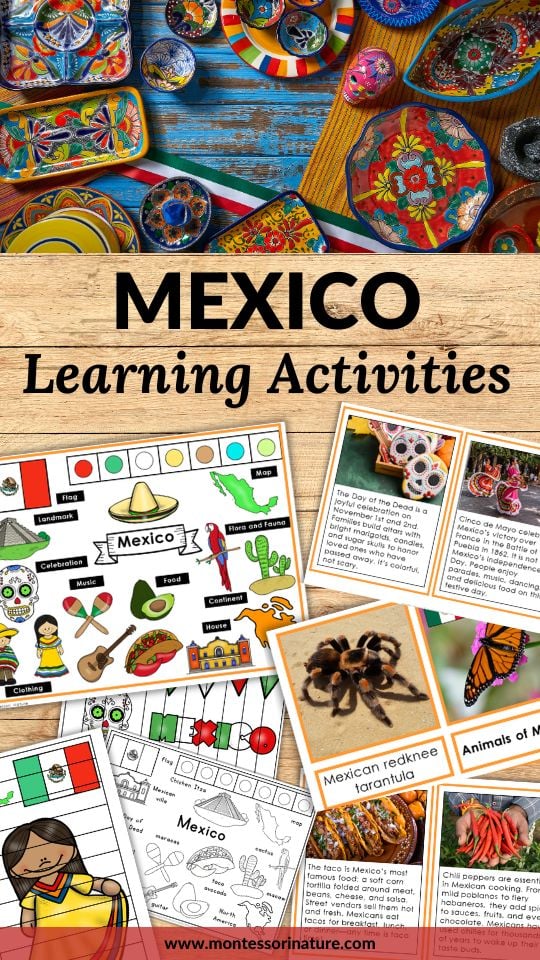
Have you ever watched a child’s eyes light up when they taste a tortilla they made with their own hands? If you teach Pre-K, kindergarten, or first grade, you already know that young children learn best when they can touch, see, and do. That is why I created this collection of printable activities about Mexico. No long prep. No complicated lessons. Just simple, hands-on learning that builds cultural awareness naturally. In this post, I will share Mexico’s geography, culture, history, and traditions through stories and activities your students will love. You will find science experiments, cultural lessons, practical life tasks, and printable resources ready to use in your centers or homeschool.
Mexico is home to dramatic geological formations that tell the story of Earth’s ancient past. The Copper Canyon in Chihuahua is larger and deeper than the Grand Canyon. The Parícutin volcano, which emerged from a cornfield in 1943, gives children a firsthand example of how new land is formed. Mexico also sits on the Pacific Ring of Fire, making it one of the most seismically active regions on Earth.
Activity Idea: Create a baking soda and vinegar volcano to demonstrate how volcanic eruptions shape the land. Discuss how Mexico’s mountains and fertile soil come from ancient volcanic activity.
Mexico is one of the world’s most biodiverse countries. It is home to the monarch butterfly, which migrates thousands of miles from Canada and the United States to the forests of Michoacán each winter. The axolotl, a salamander that never grows up and can regenerate its body parts, lives only in Lake Xochimilco near Mexico City. Other unique animals include the jaguar, the Mexican gray wolf, and the coatimundi.

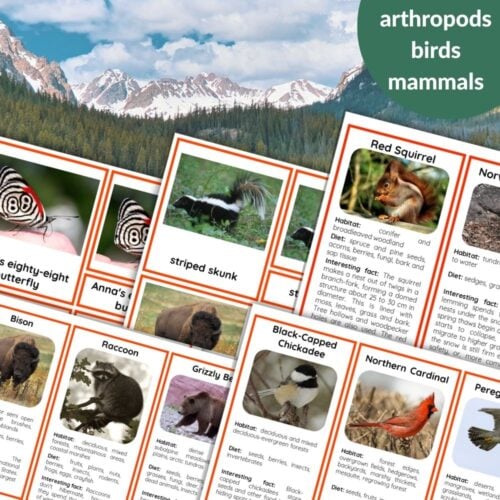
Activity Idea: Set up 3-part cards featuring native Mexican animals. Children can match pictures, names, and facts while learning about habitats and conservation.
Mexico’s human history stretches back over 10,000 years. The Olmecs, known as the “mother culture” of Mesoamerica, carved colossal stone heads. The Mayans built pyramid cities like Chichén Itzá and developed a written language and a precise calendar. The Aztecs founded their capital Tenochtitlán on an island in Lake Texcoco, which is now Mexico City. In 1521, Spanish conquistadors led by Hernán Cortés defeated the Aztec Empire, beginning three centuries of Spanish rule. Mexico finally gained independence in 1821.
Activity Idea: Create a timeline of Mexican history with key civilizations—Olmecs, Mayans, Aztecs, Spanish colonization, independence, and modern Mexico.
The Mayans developed one of the world’s earliest writing systems, called hieroglyphs. They also invented the concept of zero independently from other civilizations and created a highly accurate calendar based on advanced mathematics. After the Spanish arrived, the Latin alphabet replaced indigenous writing systems, and Spanish became the dominant language. Today, Mexico recognizes 68 indigenous languages, including Nahuatl (the language of the Aztecs), Mayan, and Mixtec.
Activity Idea: Display the Spanish alphabet and teach children a few simple words in Spanish and Nahuatl, such as chocolate (from Nahuatl xocolātl) and tomato (from Nahuatl tomatl). Provide sandpaper letters or vocabulary cards.
Fundamental Human Needs in Mexico
Shelter: Traditional Mexican homes include adobe brick houses with flat roofs and inner courtyards. The Mayans and Aztecs built stone pyramids and palaces that still stand today.
Food: Mexican cuisine is a UNESCO Intangible Cultural Heritage. Staples include corn, beans, squash, tomatoes, avocados, and chili peppers. Dishes include tacos, tamales, enchiladas, pozole, and mole.
Clothing: Traditional clothing includes the colorful embroidered huipil (tunic), the rebozo (shawl), the sarape (blanket-like cloak), and the sombrero (wide-brimmed hat). Charro suits are worn by horsemen and mariachi musicians.
Transportation: The Aztecs built canals and used canoes. The Spanish introduced horses and wagons. Today, Mexico has extensive bus networks and a modern subway system in Mexico City.
Art and Music: Mariachi music features violins, trumpets, and guitars. Folk art includes pottery, weaving, and the colorful alebrijes (fantastical wooden creatures). Famous artists include Frida Kahlo and Diego Rivera.
Spirituality: Most Mexicans are Catholic, a legacy of Spanish colonization. Indigenous traditions blend with Catholicism in celebrations like Día de los Muertos (Day of the Dead), which honors deceased ancestors.
Defense: The Aztecs built fortified city-states. Spanish colonial forts protected ports and trade routes. The Mexican military played a key role in the country’s independence and revolution.
Hands-On Activities for Exploring Mexico
Geography and Cultural Activities
Map of Mexico
Provide a large outline map of Mexico. Children can make a salt map and label regions, major cities (Mexico City, Guadalajara, Monterrey), neighboring countries (United States, Guatemala, Belize), and bodies of water (Pacific Ocean, Gulf of Mexico).
Flag Study
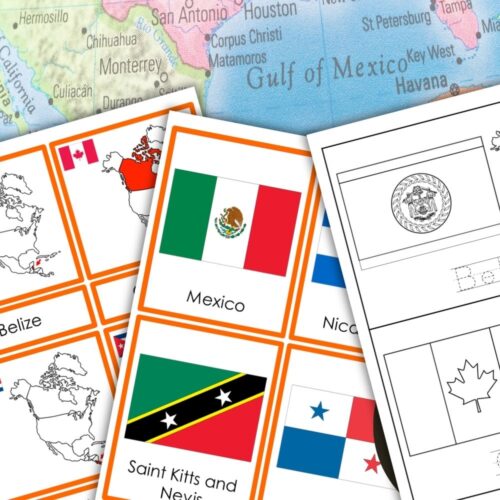
Present the Mexican flag with its green, white, and red vertical stripes and central coat of arms. Children can color their own flags and learn the meanings: green for hope, white for unity, and red for the blood of national heroes.
Landmark 3-Part Cards
Use cards featuring Chichén Itzá, Teotihuacán, Palenque, Copper Canyon, and other iconic sites. Children match pictures, names, and descriptions. Encourage children to build a maquette of landmarks of their choice using contstuction bricks.
Spanish Language 3-Part Cards
Introduce common Spanish words such as hola (hello), gracias (thank you), amigo (friend), and familia (family). Include pronunciation guides. Also introduce Nahuatl words like chocolate, tomate, aguacate (avocado), and chile (chili).
Science Activities
Corn Kernel Observation
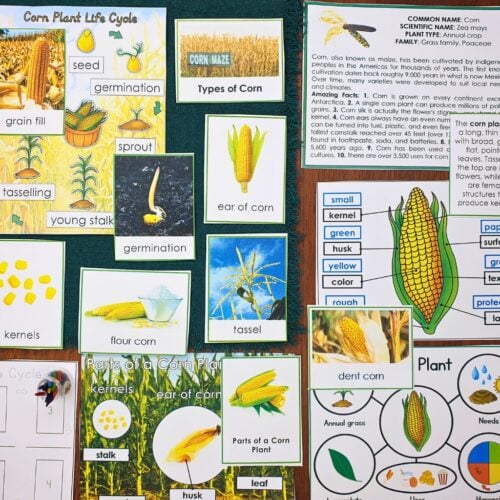
Corn (maize) was first domesticated in Mexico over 9,000 years ago. Provide dried corn kernels, fresh corn on the cob, and popped popcorn. Children can observe, touch, and compare different forms of corn. Discuss how corn became a global food.
Monarch Butterfly Migration
The monarch butterfly migrates up to 3,000 miles to Mexico each winter. Provide pictures, a simple map of the migration route, and magnifying glasses. Children can learn how butterflies navigate and why their Mexican forest habitat is protected.
Volcano in a Cup
Mexico has over 3,000 volcanoes. Create a small volcano using baking soda, vinegar, and red food coloring in a cup. Children observe the chemical reaction and discuss how volcanoes create new land and fertile soil.
Axolotl Study
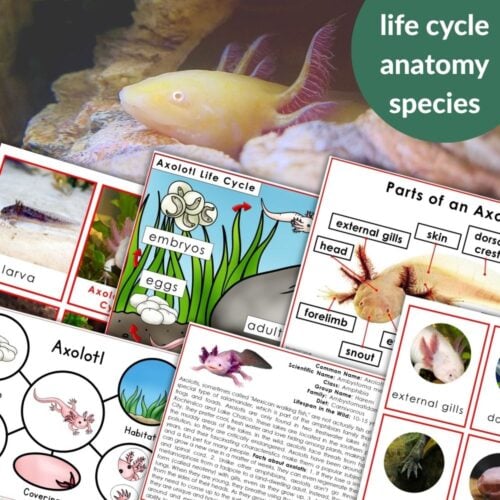
The axolotl is a salamander that lives only in Mexico and can regenerate its limbs. Provide pictures, a simple diagram, and a discussion of why this animal is important for scientific research.
Practical Life Activities
Making Guacamole
Children can wash, peel, and mash avocados using child-safe tools. Add lime juice, salt, and cilantro. Serve with tortilla chips. This activity builds fine motor skills and introduces basic food preparation.
Tortilla Pressing
Provide masa dough (corn flour mixed with water) and a tortilla press. Children can flatten dough balls into round tortillas. Cook on a griddle (with supervision). Discuss how tortillas are a daily food in Mexico.
Grinding Chocolate
The Aztecs and Mayans used chocolate as currency and as a drink. Provide cacao nibs and a mortar and pestle. Children can grind the nibs and observe how the texture and aroma change. Mix with warm milk for a traditional drink.
Weaving a Placemat
Mexican weaving is an ancient craft. Provide a small cardboard loom and colorful yarn. Children can practice simple over-under weaving to create a small placemat or bookmark.
Pinata Preparation
Children can help decorate a simple paper bag pinata with colorful tissue paper strips. Discuss how pinatas are used for celebrations in Mexico. (Leave filling and breaking for a separate supervised activity.)
Art and Music Activities
Mariachi Rhythm
Play mariachi music and provide simple rhythm instruments such as maracas, guiros, or rhythm sticks. Children can practice keeping time and learn about the instruments used in mariachi: violin, trumpet, guitar, and vihuela.
Alebrije Sculpting
Alebrijes are fantastical wooden creatures painted in bright patterns. Provide air-dry clay or modeling dough. Children can sculpt their own imaginary creature and paint it with bright colors and patterns.
Frida Kahlo Self-Portrait
Show children examples of Frida Kahlo’s self-portraits. Provide paper, mirrors, and drawing materials. Children can draw their own self-portraits, adding elements that represent their personality and interests.
Huichol Yarn Painting
The Huichol people of Mexico create yarn paintings on wooden boards coated with beeswax. Provide cardboard, white glue, and colorful yarn. Children can press yarn into glue to create their own designs.
Day of the Dead Mask
Provide paper plates, markers, paint, and glitter. Children can create calavera (skull) masks inspired by Día de los Muertos. Discuss how the holiday celebrates and remembers ancestors.
Interesting Facts About Mexico to Share with Children
- Mexico is the 14th largest country in the world by land area.
- The official name of Mexico is the United Mexican States (Estados Unidos Mexicanos).
- Mexico has 68 official indigenous languages, plus Spanish.
- The Chihuahua dog breed is named after the Mexican state of Chihuahua.
- Chocolate, vanilla, chili peppers, corn, and avocados all originated in Mexico.
- The Great Pyramid of Cholula is the largest pyramid in the world by volume, even larger than the Great Pyramid of Giza in Egypt.
- Mexico City is built on top of the Aztec capital Tenochtitlán, which was built on a lake.
- The oldest university in North America is the National Autonomous University of Mexico (UNAM), founded in 1551.
- The Mexican flag’s coat of arms shows an eagle eating a snake on a cactus, which fulfilled an Aztec prophecy for the location of their capital.
- The Day of the Dead (Día de los Muertos) is a UNESCO Intangible Cultural Heritage.
Mexico offers a rich and engaging topic. From the ancient pyramids of the Mayans and Aztecs to the vibrant traditions of Día de los Muertos and mariachi music, children can explore how humans have adapted to their environment, expressed creativity, and built communities over thousands of years. Through hands-on activities in geography, science, culture, and practical life, children develop a deep appreciation for this vibrant country and its place in world history.

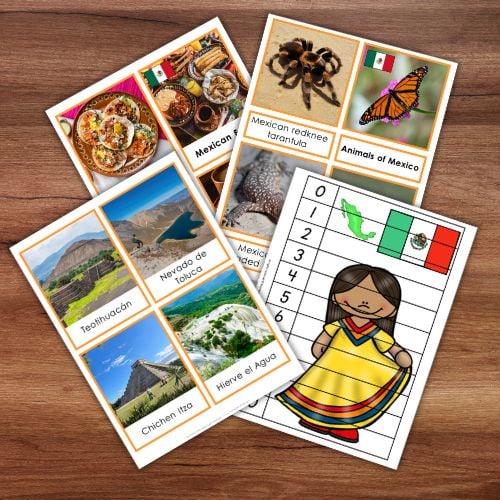
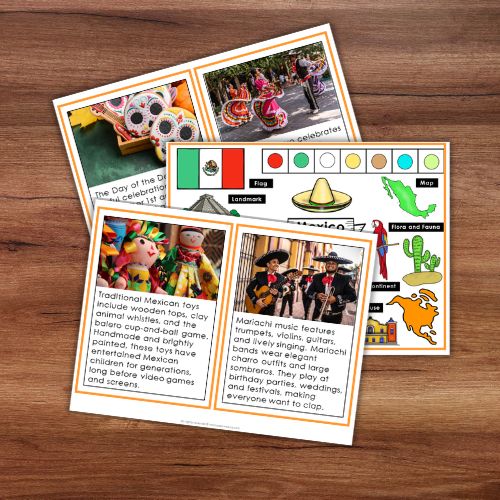
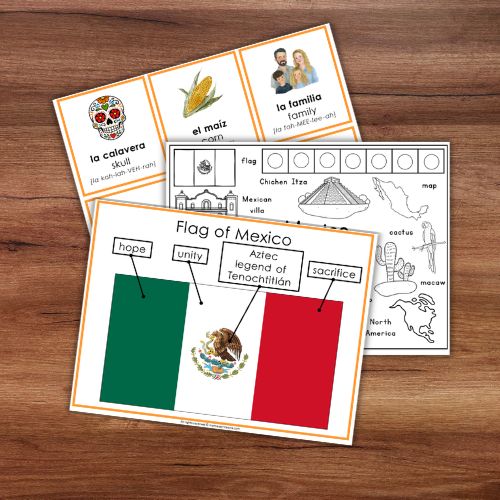
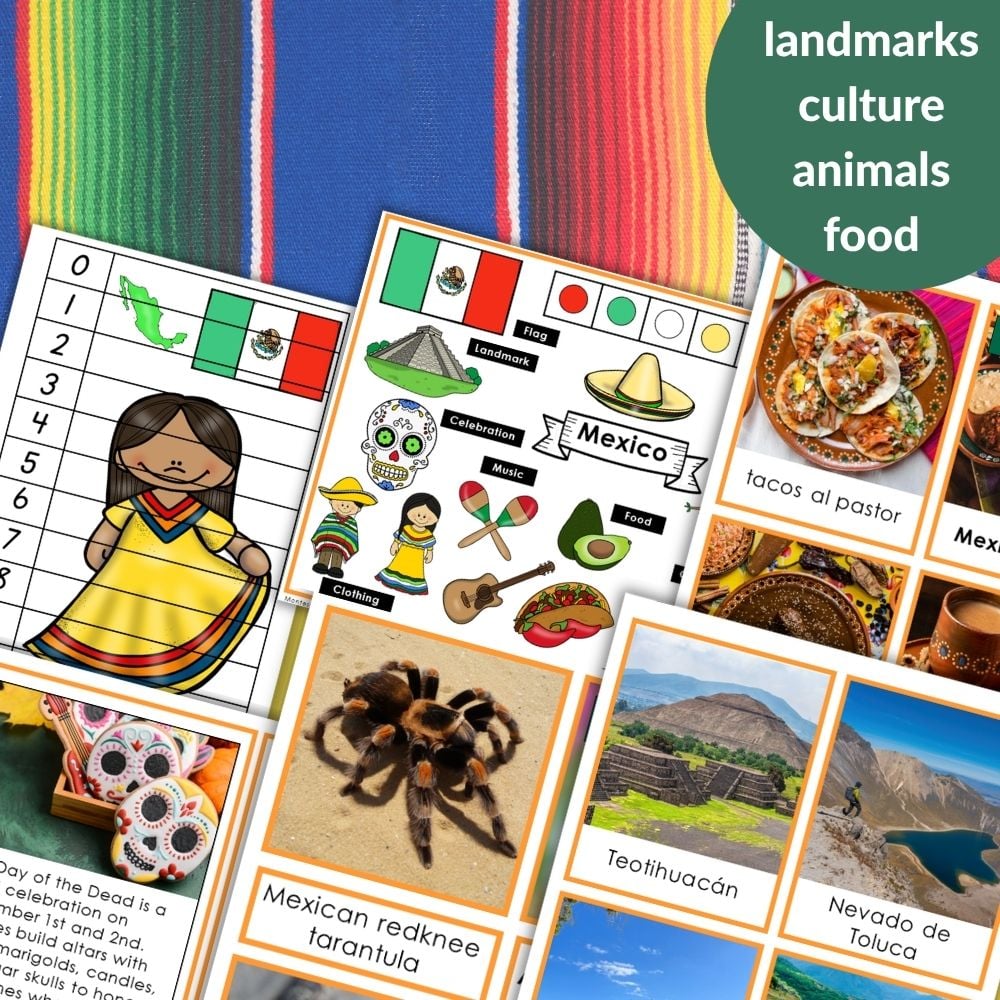
Mexico: Map Flag Animals Food Landmarks 3 Part Cards
Take your PreK – Grade 2 students on an exciting adventure to Mexico with this Country Pack! This engaging and interactive resource provides a wealth of information about Mexico’s culture, people, animals, food, landmarks, and flag. Perfect for developing geographical knowledge, cognitive skills, fine motor skills, and mastering early math concepts. This pack is also a great supplementary resource for Cinco de Mayo or The Day of the Dead (Día de los Muertos) celebrations and cultural units.
This printable is also available on TPT
You Might Also Enjoy

About Anastasia | Anastasia is an early childhood teacher with over twenty years of experience in Montessori classrooms and homeschooling. With a Master’s in Information Science, she blends education and information design to create clear, organized, research-backed resources. As founder of Montessori Nature, she develops evidence-based, nature-inspired printables that support holistic child development and foster curiosity, independence, and a love of learning. Explore more in her shop and Teachers Pay Teachers store.