There’s a certain magic in watching a child’s hands at work. It’s in those moments of quiet concentration, as they carefully place one block atop another or line up a row of pebbles from largest to smallest, that profound learning is happening. In my time working with young children, both in classrooms and at home, I’ve come to see these moments not just as play, but as the essential work of building a mind.

One of the great examples of this is a Montessori material called the Knobless Cylinders. If you’ve ever seen a set, you know they’re simply four boxes of solid wood cylinders in red, yellow, green, and blue. They have no knobs, just smooth, inviting surfaces. But within their simplicity lies a deep purpose. When a child works with them, they are embarking on a silent conversation about size, order, and relationship.
The red cylinders, for instance, are all the same height but vary minutely in width. The child’s task is to line them up from the widest to the most slender. This is far more than a stacking game. It is a masterclass in visual discrimination. The child’s eyes and hands are learning to perceive differences in diameter that are so subtle, an adult might overlook them. This refinement of the senses is the bedrock for mathematical thinking. The child is internalizing concepts of seriation, order, and gradation long before they ever learn the words for them.
And it’s not just about seeing. It’s about doing. The absence of a knob means a child must use a delicate pincer grasp to lift each cylinder, strengthening the very muscles needed for holding a pencil. Building a tall, precarious tower requires a steady hand and a patient heart, lessons in coordination and perseverance that last a lifetime.

You might be thinking that these are specialized classroom materials, and you’re right. But the concepts they teach are all around us. You don’t need a perfectly equipped Montessori classroom to foster this same kind of learning. In fact, some of the best materials are waiting just outside your door.
Nature provides the most wonderful and varied loose parts for this very work. The next time you’re on a walk with your preschooler or kindergartener, try one of these simple, soul-nourishing activities.
First, look for a Gradation Walk. Instead of just collecting treasures, give the hunt a focus. Can we find five stones and line them up from the very smallest to the largest? Can we gather a series of twigs and order them from shortest to longest? This turns a simple stroll into a purposeful mission, training the eye to compare and sequence.
Next, create a Pattern Mandala. Find a flat patch of ground or a stump to use as a canvas. Collect an assortment of natural items—pinecones, acorns, yellow leaves, dark stones, feathers. Start a pattern for your child to continue. Perhaps a simple ABAB pattern: pinecone, acorn, pinecone, acorn. Or maybe an ABC pattern: leaf, stone, feather, leaf, stone, feather. There is something deeply satisfying about creating these temporary circles of order and beauty from the chaos of the forest floor.
Finally, build a Loose Parts Tower. This is nature’s answer to the Pink Tower. Challenge your child to build the tallest, most stable structure they can using only what they find. They will quickly learn that the widest, flattest stone must be the base, and the lighter, smaller sticks can go on top. They are experimenting with gravity, balance, and geometry, all through the tips of their fingers.
This leads us to the crucial skill of pattern recognition. When we help children see and create patterns, we are doing much more than keeping them occupied. We are introducing them to the fundamental order of the universe. Patterns are the language of mathematics, from the times tables to complex coding algorithms. They are the rhythm in music and poetry. They are the cycle of the seasons.
Recognizing patterns is a primary cognitive function. It is how our brains make sense of the world, by finding connections and predicting what comes next. A child who is skilled in seeing patterns is building a mind that is wired for logical reasoning, problem-solving, and critical thinking. They begin to see the world not as a series of disconnected events, but as a tapestry of interrelated sequences.
Of course, there is a time for nature’s beautiful chaos and a time for more structured exploration. This is where a simple resource can breathe new life into a classic material. I wanted to create a way to connect the precise learning of the Knobless Cylinders with the changing world a child observes outside the window. So, I made a set of winter extension cards.
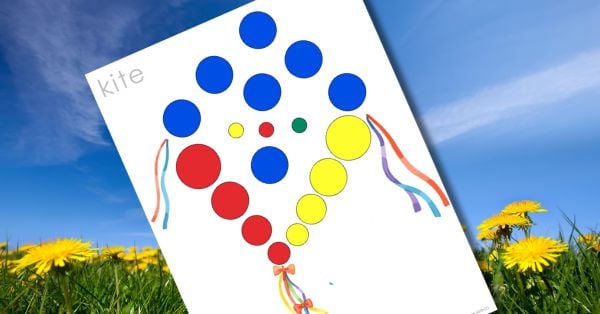
The idea is simple but powerful. On each image are circles of varying diameters. The child’s task is to find the exact Knobless Cylinder that matches each circle, completing the picture.
What I love about this activity is how it bridges a concrete sensorial material with a seasonal narrative. The child is no longer just sorting cylinders by size; they are helping to build a snowman or a tree. It reframes the activity, making that essential repetition for skill mastery feel like a new and engaging game. It reinforces that careful eye for dimension and that controlled, gentle hand, all within a context that feels fresh and joyful, especially on a cold day when a bit of winter can be brought inside.
Whether you are using a crafted material like the Knobless Cylinders, arranging pinecones on the forest floor, or completing a winter matching card, the goal is the same. We are guiding our children to look closely, to think logically, and to find joy in creating order. We are helping them build, not just towers and patterns, but the very architecture of their own minds. And that is a beautiful thing to watch unfold.

Knobless Cylinder Extension Cards: Winter Patterns
This seasonal printable features winter extension cards designed for use with knobless cylinders. This is a Montessori-inspired resource that helps preschool and kindergarten students refine their visual discrimination skills, particularly in perceiving differences in diameter.
This printable is also available on TPT
You Might Also Enjoy
-
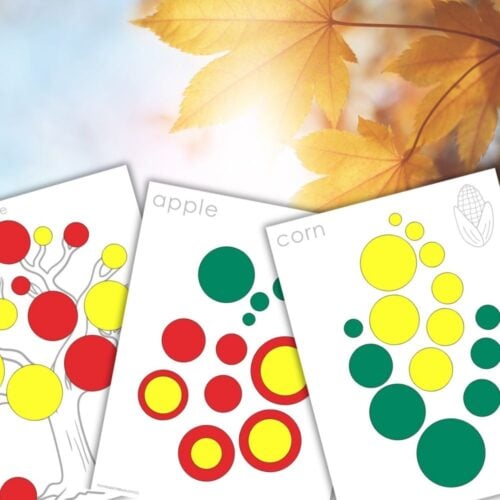
 Knobless Cylinder Extension Cards: Fall Patterns$3.60
 -
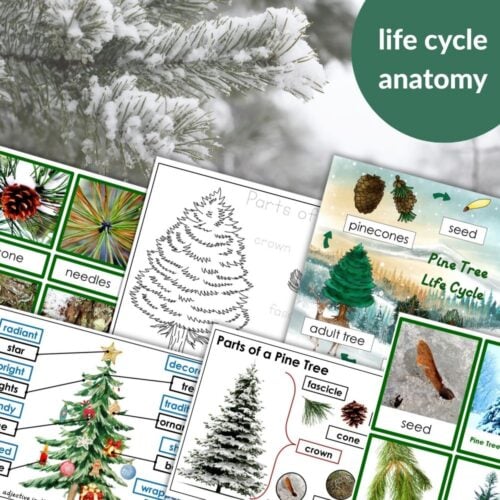
Parts of a Pine Tree Life Cycle Activities$7.10
-
How to Build a Snowman: Sequencing Grammar Fine Motor Activities$3.10
-
Winter Hands On Preschool Activity Pack$6.10
-
Count to 10: Math Fine Motor Number Winter Cards Bilingual English Spanish$3.30
-
Winter Kindergarten Hands On Activity Pack$9.10



About Anastasia | Anastasia is an early childhood teacher with over twenty years of experience in Montessori classrooms and homeschooling. With a Master’s in Information Science, she blends education and information design to create clear, organized, research-backed resources. As founder of Montessori Nature, she develops evidence-based, nature-inspired printables that support holistic child development and foster curiosity, independence, and a love of learning. Explore more in her shop and Teachers Pay Teachers store.