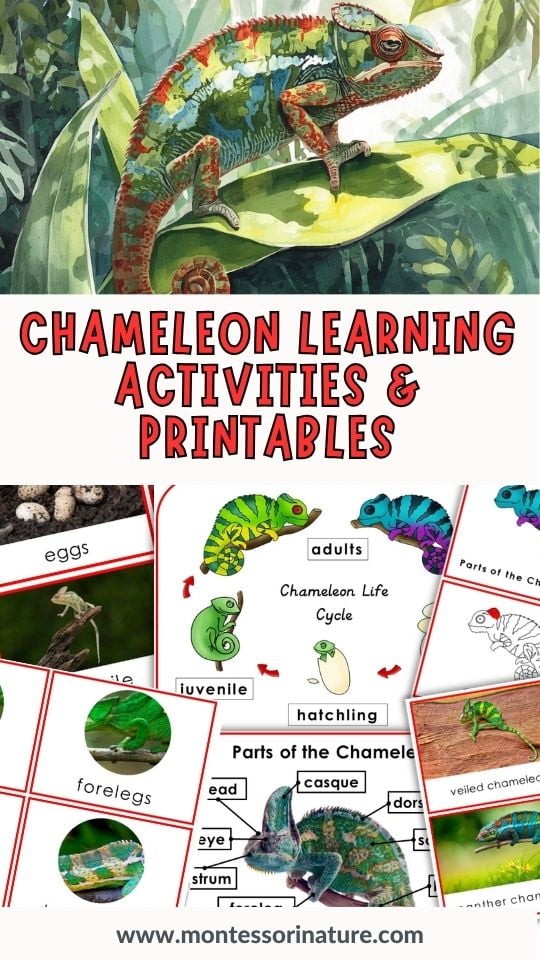
There is something about chameleons that stops children in their tracks. Maybe it’s their slow-motion walk, their curling tails, or the way their eyes move in two directions at once. If you are building a rainforest unit, teaching about animal adaptations, or exploring the wildlife of Africa, these colorful reptiles offer endless opportunities for discovery. This resource brings the wonder of chameleons into your classroom with hands-on, Montessori-inspired materials that children will love to explore.
What Makes Chameleons So Amazing?
Their Tongue is a Super Weapon
A chameleon’s tongue can be longer than its own body. It shoots out at incredible speed—faster than the human eye can follow—to catch insects. The tip is super sticky, like a built-in suction cup.
They Can See in Two Directions at Once
Chameleon eyes move independently. One eye can look forward while the other looks backward, giving them nearly a 360-degree view. When they spot prey, both eyes lock on for perfect focus.


Their Color is Like a Mood Ring
Chameleons don’t just change color to hide. They use color to talk! Bright colors mean “I’m happy and healthy.” Dark colors mean “I’m scared or angry.” You can read a chameleon’s mood by its colors.
They Have a Prehensile Tail
Most chameleons have a tail that can wrap around branches like a fifth hand. It provides extra grip and balance while climbing and can even hold their full weight.
Their Bones Glow in the Dark
Chameleon bones glow bright blue or green under UV light! They can see this glow because their eyes detect UV light. They likely use this secret code to find each other in the dark forest.
Chameleon Anatomy: A Body Built for the Trees
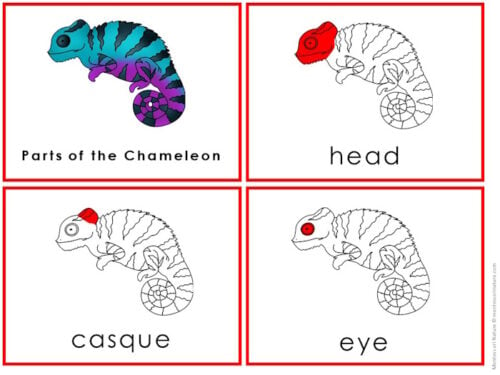
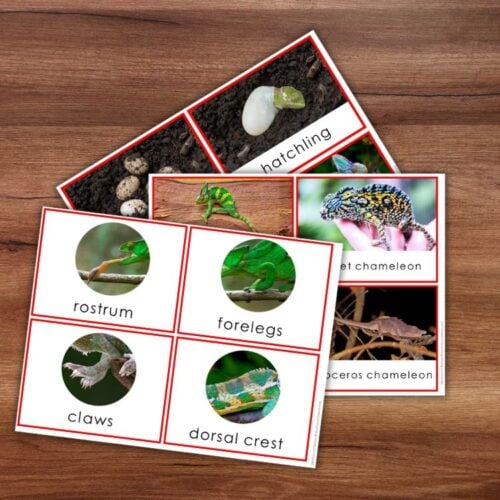
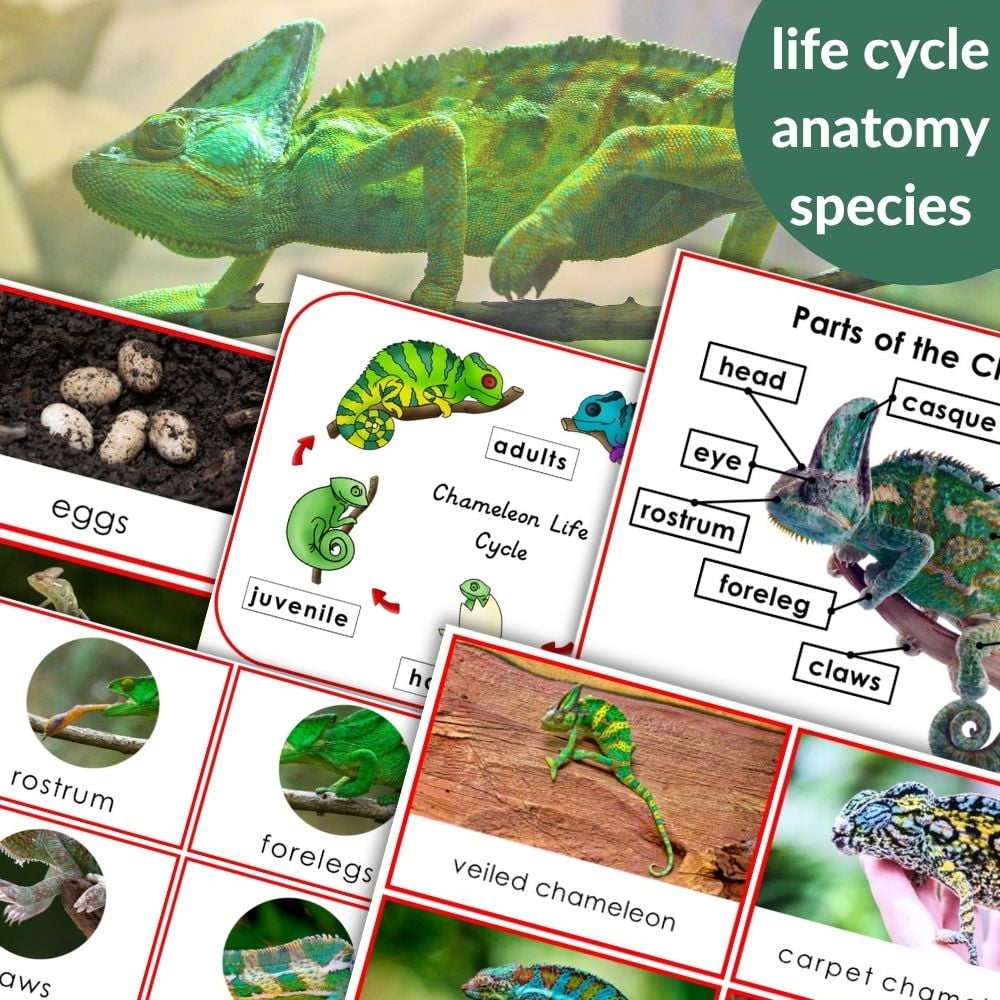
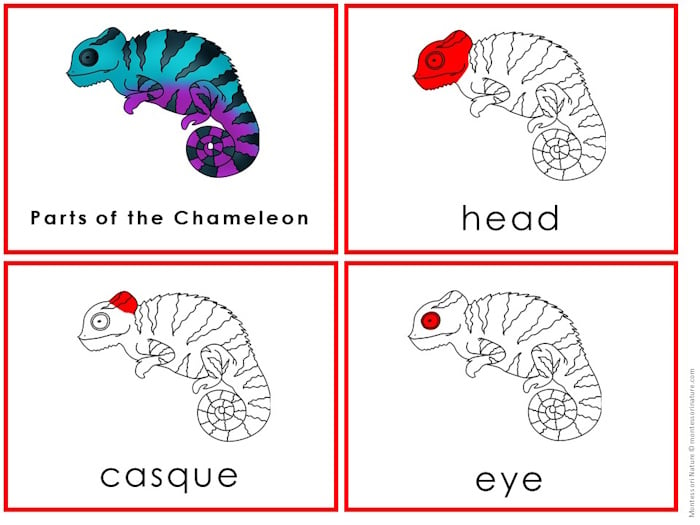
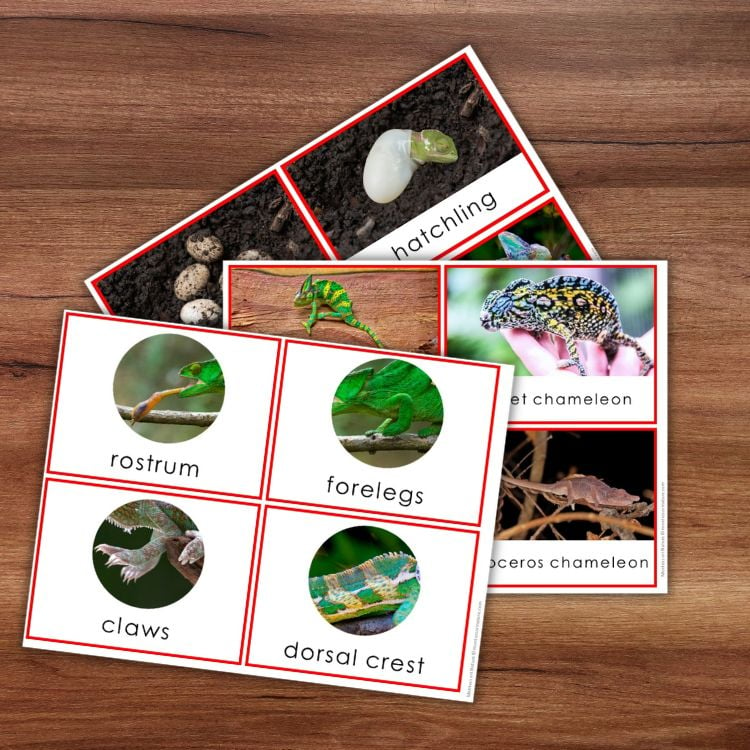
Every part of a chameleon’s body is specially designed for life in the trees. Their prehensile tail wraps around branches like a fifth hand, providing extra grip and balance. Their grasping feet have toes split into two groups, forming a “V” shape that grips branches securely. Their independently moving eyes give them nearly a 360-degree view of their surroundings. Their lightning-fast tongue shoots out to catch insects from a distance. Their color-changing skin communicates mood and regulates temperature. Their casque, a helmet-like crest on some species, collects rainwater and channels it to their mouth.
Each part works together to make the chameleon a perfect tree-dwelling hunter. Children can learn these parts through labeling activities, 3-part cards, and student booklets.
The Chameleon Life Cycle: From Egg to Adult
The chameleon’s life cycle is a story of transformation and survival.
Eggs
Female chameleons lay eggs in a hole dug in the ground, up to 80 at a time. Eggs take months to hatch. Some species can hold sperm for later use. Incubation can last from four months to over a year.
Hatchling
Hatchlings are tiny and fully independent. They can hunt and change color right away. They are vulnerable to predators and grow slowly, shedding their skin as they get bigger.
Juvenile
Juveniles grow quickly. Their colors are duller than those of adults. They eat often and shed their skin several times. Some take over a year to reach full adult size and color.
Adult
Adult chameleons are ready to reproduce and use color to attract mates. Males are often brighter. Their tongues shoot out faster than your eye can see. Some species live over ten years.
Bringing Chameleons into Your Classroom: Hands-On Activities
The best way to learn about chameleons is through observation and hands-on exploration. Here are simple, Montessori-friendly activities that invite children to discover chameleons through science, practical life, and art.
Practical Life Activity: Tongue-Target Tweezer Work
What you need: Tweezers, small pom-poms or beads (insects), a cup (the chameleon’s mouth), and a target card.
What to do:
Invite the child to use tweezers to pick up a “bug” and place it into the cup. To make it more challenging, set up targets at different distances. Explain that the chameleon’s tongue acts like these tweezers, shooting out to grab food.
What they learn: Fine motor control, concentration, and how a chameleon catches prey.
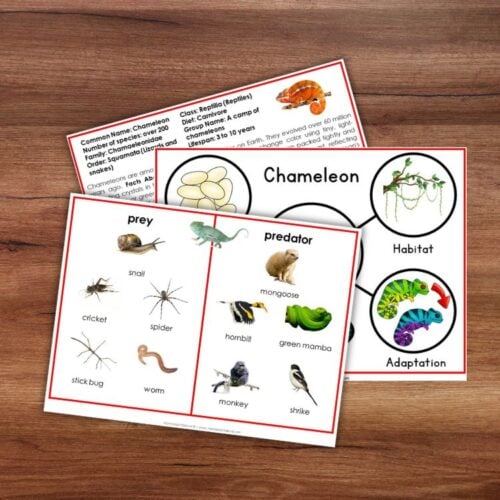
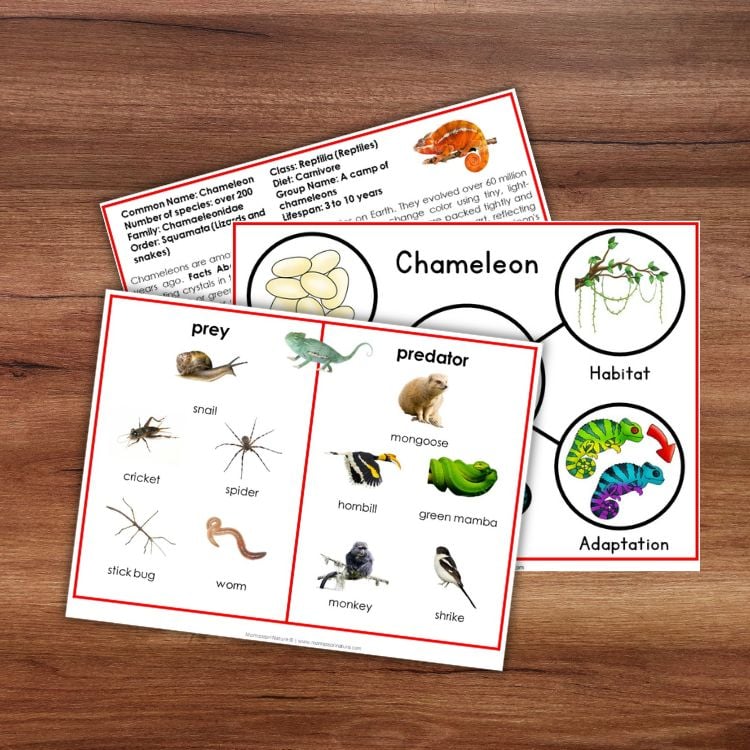
Science Sorting: Chameleon Diet vs. Predators
What you need: Two sorting mats labeled “Chameleon Food” and “Chameleon Predators,” plus picture cards of various items (crickets, birds, snakes, etc.).
What to do:
Children sort the cards into what chameleons eat and what eats chameleons. Then discuss: Why do chameleons have so many predators? How do they protect themselves?
What they learn: The chameleon’s place in the food chain and ecological relationships.
Sensory Activity: Color Change Discovery
What you need: Color swatches or paint samples in various shades (green, brown, yellow, orange, red), and images of chameleons in different colors.
What to do:
Lay out the color swatches. Show children images of chameleons in different colors. Discuss what each color might mean (calm, excited, angry). Then invite children to match the chameleon images to the closest color swatch.
What they learn: How chameleons use color to communicate.
Language Activity: “Who Am I?” Riddle Cards
What you need: Riddle cards and picture cards of different chameleon species.
What to do:
Read a riddle aloud. Children guess which chameleon it describes and match it to the correct picture card. For example: “I am the smallest chameleon. I can fit on a match head. Who am I?” (Brookesia micra)
What they learn: Species identification and listening comprehension.
Art Activity: Draw a Chameleon in Its Habitat
What you need: Paper, pencils, crayons, and reference images of chameleons.
What to do:
Invite children to draw a chameleon perched on a branch, with its tongue extended to catch a fly. Encourage them to add details like the curled tail, grasping feet, and color patterns. Discuss how chameleons use their color-changing ability to communicate.
What they learn: Observation skills and artistic expression.
Outdoor Activity: Lizard Watcher’s Journal
What you need: A small notebook, pencil, and a magnifying glass.
What to do:
Take children outside to find lizards or insects. Sit quietly and observe. What are they doing? How do they move? Children draw what they see and write one or two sentences. Discuss how chameleons are different from other lizards.
What they learn: Patience, observation skills, and real scientific inquiry.
Bringing It All Together with the Chameleon Learning Pack
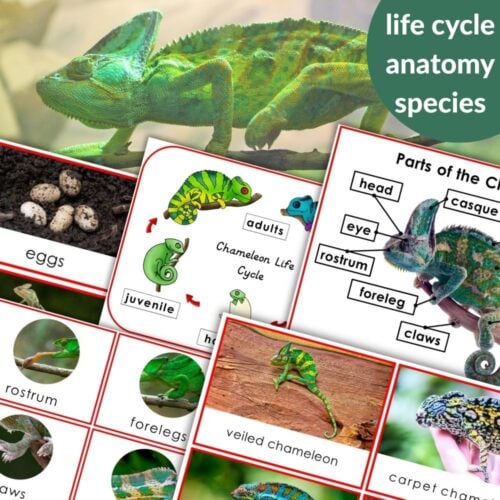
To help you organize these lessons and give children beautiful, accurate materials to work with independently, the Chameleon Learning Pack is a complete resource. It includes everything you need for a thorough study of chameleons.
Inside, you will find:
Parts of a Chameleon – Diagrams, 3-part cards, information cards, and student booklets
Chameleon Life Cycle – Diagrams, 3-part cards, information cards, and cut-and-paste worksheets
Types of Chameleons – 3-part cards and information cards for fascinating species from around the world
Characteristics and General Information – Color posters, blackline masters, and a student reader
Extended Activities – “Who Am I?” riddle cards, peg fine motor matching activity and an adjective labeling activity
The materials are designed for children ages 3 to 9. Younger children can match picture cards and trace labels. Older children can read information cards, complete fill-in-the-blank activities, and write their own booklets. Every activity is self-paced and child-led, perfect for Montessori shelf work, learning centers, or homeschool study.
Chameleons are extraordinary creatures. They have adapted to their environment in ways that seem almost magical. With their independently moving eyes, grasping feet, curling tails, lightning-fast tongues, and color-changing skin, they remind us that nature is full of wonder.
Children naturally slow down when they watch a chameleon. They notice the colors. They follow the tongue. They ask, “How does it do that?” and “Why does it change color?” These are the beginnings of scientific thinking.
This printable is also available on TPT
You Might Also Enjoy


About Anastasia | Anastasia is an early childhood teacher with over twenty years of experience in Montessori classrooms and homeschooling. With a Master’s in Information Science, she blends education and information design to create clear, organized, research-backed resources. As founder of Montessori Nature, she develops evidence-based, nature-inspired printables that support holistic child development and foster curiosity, independence, and a love of learning. Explore more in her shop and Teachers Pay Teachers store.