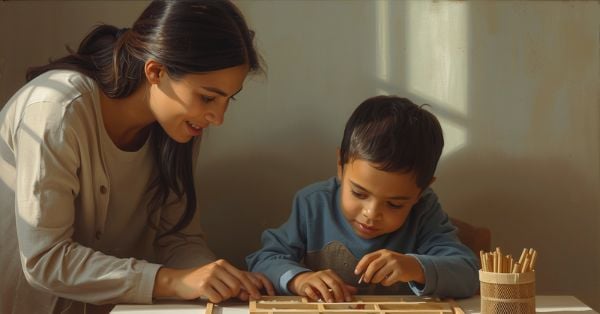
Why concentration—not punishment—is the doorway to true self-mastery
There’s a moment every guide waits for. A moment that feels almost sacred.
Montessori describes it like this:
“The first dawning of real discipline comes through work. At a given moment it happens that a child becomes keenly interested in a piece of work showing it by the expression of his face, by his intense attention, by his perseverance in the same exercise. That child has set foot upon the road leading to discipline. Whatever be his undertaking – an exercise for the senses, an exercise in buttoning up or lacing together, or washing dishes – it is all one and the same.”
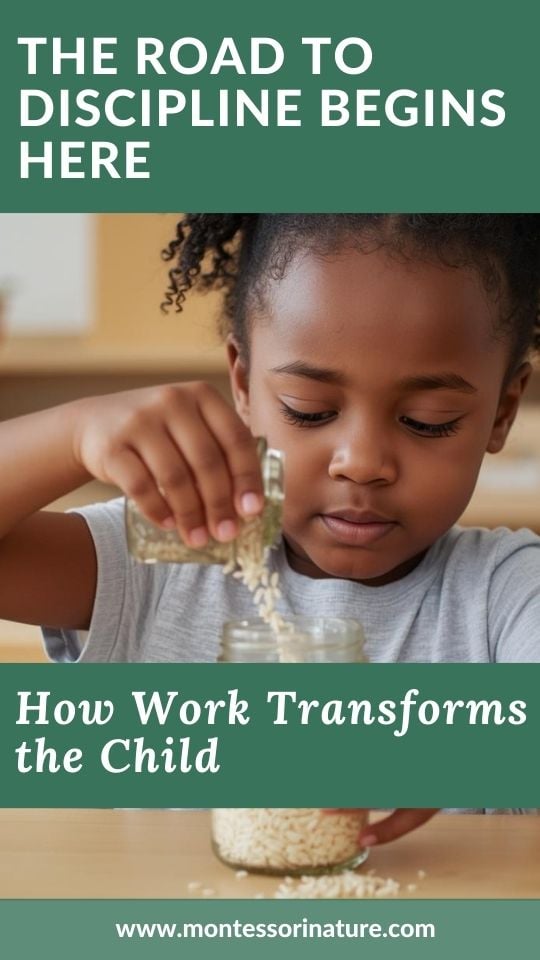


A child who moments before seemed scattered, restless, everywhere at once—suddenly still. Focused. Absorbed. Their whole being poured into the work of their hands.
And in that moment, something shifts. Not just in what they’re doing, but in who they are becoming.
Montessori calls this “the first dawning of real discipline.” Not discipline imposed from outside—rewards, punishments, threats, praise. But discipline that grows from within. Self-mastery. The ability to choose concentration over distraction. To persevere. To complete.
And here’s the beautiful part: it doesn’t matter what the work is. Buttoning. Washing. Pouring. Matching sounds. It’s all the same. The work itself—freely chosen, deeply engaging—is the doorway.
So how do we create conditions for this moment to happen? How do we invite children onto this road?
Here are some steps I’ve been gathering.
1. Trust That Work—Not Words—Builds Discipline
Montessori is clear: discipline doesn’t come from lectures, rewards, or punishments. It comes from work. Real, meaningful, absorbing work that calls forth the child’s whole attention.
Actionable step this week:
Notice where you’re relying on words to manage behavior. Are you reminding, nagging, praising, threatening? This week, experiment with trusting the work instead.
When a child seems unsettled, instead of saying “settle down,” quietly invite them to a piece of work they love. Lead them to the shelf. Roll out a mat. Sit beside them and begin something yourself.
Let the work do the talking.
2. Watch for the Signs—Then Protect What You See
Montessori describes the signs clearly: the expression on the face, intense attention, perseverance in the same exercise. These are not random. They’re clues that something important is happening.
Actionable step this week:
Become an observer of these moments. Sit back and simply watch. Notice:
- When does a child’s face become still and focused?
- How long do they stay with one activity?
- What draws them back, again and again?
When you see these signs, protect them. Don’t interrupt. Don’t praise. Don’t ask questions. Just let it be. This is sacred time.
3. Prepare the Environment for Deep Engagement
Children can’t become deeply engaged in work if the environment doesn’t support it. Cluttered shelves, broken materials, too many choices, constant interruptions—all of these work against the “intense attention” Montessori describes.
Actionable step this week:
Take a hard look at your environment—classroom or home. Ask:
- Are materials complete and in good repair?
- Is everything accessible and orderly?
- Is there a calm, uncluttered feeling, or does it feel busy and overwhelming?
- Are there opportunities for both active movement and quiet concentration?
Choose one area to refresh this week. Simplify. Repair. Beautify. The environment is your co-teacher.
4. Offer Work That Invites Repetition
Montessori notes that the child shows “perseverance in the same exercise.” Repetition isn’t a sign of boredom—it’s a sign of deep learning. The child repeats not because they haven’t mastered it, but because they’re mastering themselves through it.
Actionable step this week:
Notice which activities children return to again and again. Honor this. Don’t rush them to “new” work. Don’t suggest they try something else. Repetition is the work of integration.
If you’re not seeing much repetition, ask: Are the activities meaningful? Do they have a satisfying cycle—beginning, middle, end? Do they meet a real developmental need?
Adjust accordingly.
5. Respect That It Doesn’t Matter What the Work Is
Montessori explicitly says: “Whatever be his undertaking—an exercise for the senses, buttoning, lacing, washing dishes—it is all one and the same.”
This is freeing. We don’t have to curate only “academic” work. Washing a table is just as valuable as tracing sandpaper letters. Sweeping is just as important as the pink tower.
Actionable step this week:
Let go of any hierarchy you hold about what work “counts.” When a child chooses practical life over math, trust that they know what they need. When they wash dishes for the twentieth time, trust the process.
The work is the vehicle. The destination is self-discipline.
6. Give Time—Uninterrupted Time
Intense attention and perseverance don’t happen in five-minute snippets. They require long, unhurried blocks of time. Montessori called this the “work cycle,” and it’s essential.
Actionable step this week:
Look at your daily rhythm. Are there long, uninterrupted blocks—at least two to three hours—where children can choose work, engage deeply, repeat, and complete cycles?
If not, what can you protect? What interruptions can you eliminate? What can wait until later?
The road to discipline is paved with unhurried mornings.
7. Resist the Urge to Interrupt or “Help”
How many times have we watched a child deeply focused, only to break the spell with a well-meaning comment? “Good job!” “Look how careful you are!” “Do you need help with that?”
Montessori warned that praise can be as disruptive as correction. Both pull the child out of their internal experience and make them externally focused.
Actionable step this week:
Practice the art of silent observation. When a child is working, simply be present. No words. No praise. No intervention unless absolutely necessary.
If you must communicate, let it be with your presence—a quiet nod, a soft smile, simply being nearby.
The child’s focus is fragile. Protect it with your silence.
8. Trust the Child’s Inner Guide
At the heart of this quote is a deep trust: the child wants to become disciplined. They want to concentrate, to persevere, to master themselves. Our job isn’t to make this happen. It’s to remove obstacles and get out of the way.
Actionable step this week:
When you feel the urge to control, correct, or direct, pause and ask: Am I interfering with the child’s inner guide right now?
Then step back. Breathe. Trust.
The road to discipline is already within them. We just help clear the path.
A Simple Challenge for This Week
Choose one of these steps—just one—and try it.
- Trust the work instead of your words.
- Watch for the signs and protect them.
- Refresh one part of your environment.
- Honor repetition without rushing to “new.”
- Let go of hierarchies about what work matters.
- Protect an uninterrupted work cycle.
- Practice silent observation.
- Trust the child’s inner guide.
Then notice what shifts.
Montessori’s insight about discipline and work isn’t just a classroom strategy. It’s a truth about human beings.
We all long to be absorbed in something meaningful. To lose ourselves in worthy work. To persevere, master, become.
When we create conditions for children to experience this, we’re not just managing behavior. We’re inviting them onto the road that leads to self-mastery. To real discipline. To becoming fully themselves.
And that road begins with a single moment: a child, a piece of work, and the quiet miracle of attention.
About Anastasia | Anastasia is an early childhood teacher with over twenty years of experience in Montessori classrooms and homeschooling. With a Master’s in Information Science, she blends education and information design to create clear, organized, research-backed resources. As founder of Montessori Nature, she develops evidence-based, nature-inspired printables that support holistic child development and foster curiosity, independence, and a love of learning. Explore more in her shop and Teachers Pay Teachers store.