How we can bring dignity, beauty, and possibility to every child—starting right where we are
There’s a passage in Montessori’s writings that doesn’t get quoted as often as the others. Maybe because it’s harder. Maybe because it asks more of us.
She wrote:
“It may be that the life lived by the very poor is a thing which some of you here today have never actually looked upon in all its degradation. … The soul of the people is being set free from the torpor of vice, from the shadows of ignorance. The little children too have a ‘House’ of their own. The new generation goes forward to meet the new era, the time when misery shall no longer be deplored but destroyed. They go to meet the time when the dark dens of vice and wretchedness shall have become things of the past, and when no trace of them shall be found among the living.”


And then she adds this striking image:
“What a change of emotions we should experience and how we should hasten here, as the wise men guided by a dream and star hastened to Bethlehem!”
Montessori wasn’t naive. She had seen the Casa dei Bambini rise in the slums of San Lorenzo, Rome. She had looked upon the faces of children born into poverty, neglect, and darkness. She knew that misery was real—not abstract, not distant, not someone else’s problem.
But she also believed something radical: that education could destroy misery. Not just temporarily relieve it. Not just make it more bearable. But actually, over time, erase its traces from the living.
And she compares those who work for this vision to the wise men—guided by a dream and a star, hastening toward hope.
It’s a breathtaking call. And it leaves me asking: What does this look like for us, today, in our own small corners of the world?
We may not be in the slums of Rome. But we each have a sphere—a classroom, a home, a community. And within that sphere, there are children who need to be seen, lifted, and freed.
Here are some practical steps I’ve been gathering—ways we can carry this vision forward, starting exactly where we are.
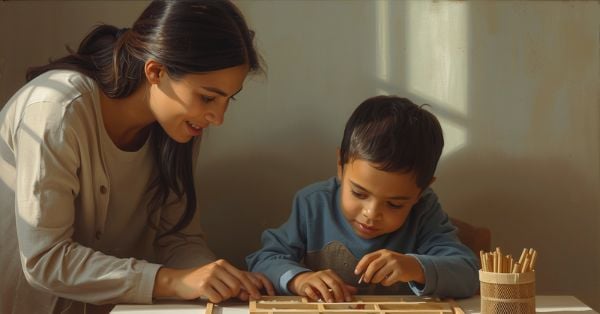
- Look—really look—at the children in front of you
Montessori begins by acknowledging that many of us have never actually looked upon the kind of degradation she witnessed. But looking is where it starts.
Not glancing. Not assuming. Not labeling.
Looking.
Actionable step this week:
Choose one child in your life—your own, or one in your care—and simply watch them for ten uninterrupted minutes. Not teaching. Not correcting. Just watching. Notice:
What draws their attention?
When do they seem most at peace?
Where do they struggle?
What might be hidden beneath the surface?
This is the first act of liberation: seeing clearly.
- Create a space of dignity, no matter how small
Montessori’s first “Children’s House” was in a tenement building. The children came from poverty. But the space itself? It was beautiful. Ordered. Peaceful. Worthy of them.
She understood something profound: the environment speaks. To a child who has known chaos, a calm and beautiful space says: You matter. You deserve this.
Actionable step this week:
Look at your environment—whether classroom or home—through fresh eyes. Ask:
Does this space feel dignified?
Is there beauty here, even in small things?
Does it say to a child, “You are worthy of care”?
If something feels off, change one small thing. A plant. A cleared shelf. A piece of art at eye level. A basket of natural materials. These small acts are quiet revolutions.
- See every child as capable of rising
Montessori didn’t see the children of San Lorenzo as broken vessels to be fixed. She saw them as souls waiting to be set free. She trusted the “inner force” long before it had a chance to show itself.
Actionable step this week:
Identify one child you find challenging—one who tries your patience, who seems behind, who makes you work harder. This week, practice seeing them differently. Every time frustration rises, pause and silently say to yourself:
“You are capable of freedom. I am here to help you find it.”
This doesn’t mean lowering expectations. It means holding them with expectation, rooted in deep belief.
- Bring light into dark places—literally and figuratively
Montessori spoke of misery being “destroyed,” not just deplored. She was practical. She knew that change required action, not just pity.
Actionable step this week:
Ask yourself: Where is there darkness in my small corner of the world? Not abstract darkness—real, tangible lack.
A child who comes to school hungry?
A family struggling with warmth or clothing?
A parent who needs support but doesn’t know how to ask?
Then ask: What is one concrete thing I can do to bring light?
Maybe it’s keeping extra snacks in your bag. Maybe it’s a quiet word to a colleague who seems overwhelmed. Maybe it’s connecting a family with a resource. Small lights, consistently offered, slowly destroy darkness.
- Hasten toward hope—like the wise men
Montessori’s image of the wise men is striking. They didn’t drag their feet. They didn’t wait for perfect conditions. They followed a dream and a star, and they hastened.
Actionable step this week:
Name one dream you have for the children in your life. Something you’ve pushed aside as impractical or too difficult. Something that feels like a star on the horizon.
Now ask: What is one small step I can take toward it this week?
Not the whole journey. Just a step.
Hope becomes real when it moves.
- Remember: you are part of the “new generation”
Montessori wrote about “the new generation going forward to meet the new era.” She wasn’t just talking about the children. She was talking about us—the adults willing to do the work, to see differently, to build something better.
Actionable step this week:
Find one other person who shares this vision. A colleague. A parent. A friend. Share this quote with them. Ask: What does this stir in you?
We weren’t meant to do this alone. The wise men traveled together.
A Simple Challenge for This Week
Choose one of these steps—just one—and take it.
- Look.
- Create dignity.
- See capacity.
- Bring light.
- Hasten toward hope.
- Find a companion.
- Then notice what shifts. In the child. In you.
Because here’s what I’m coming to believe: Montessori’s vision wasn’t just for Rome in 1907. It was for every child, everywhere, in every era. The “dark dens of vice and wretchedness” take different forms now. But the call is the same.
We are invited to see.
We are invited to hope.
We are invited to act.
And when we do, we become like the wise men—guided by a dream and a star, hastening toward the light.

[click here to sign up and download this printable]
About Anastasia | Anastasia is an early childhood teacher with over twenty years of experience in Montessori classrooms and homeschooling. With a Master’s in Information Science, she blends education and information design to create clear, organized, research-backed resources. As founder of Montessori Nature, she develops evidence-based, nature-inspired printables that support holistic child development and foster curiosity, independence, and a love of learning. Explore more in her shop and Teachers Pay Teachers store.