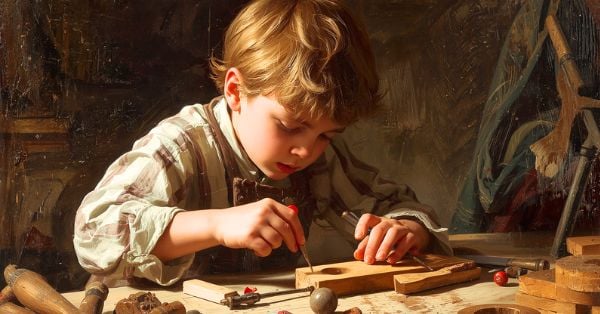
How to honor the moments of agitation, the search for satisfaction, and the joy of completion
There is a passage in The Advanced Montessori Method that I return to again and again. It describes something I’ve witnessed countless times in children, but never had words for until Montessori gave them to me.
She writes:
“The apparent fatigue of the child between the first and second period of work is interesting; at that moment the aspect of the child is not calm and happy as at the end of the curve; indeed, he shows signs of agitation, moves about, and walks, but does not disturb the others. It may be said that he is in search of the maximum satisfaction for his interest, and is preparing for his ‘great work’. But, on the other hand, when the cycle is completed, the child detaches himself from his internal concentration; refreshed and satisfied, he experiences the higher social impulses, such as desiring to make confidences and to hold intimate communion with other souls.”
I love this quote because it’s so honest about what the work cycle actually looks like. Not a smooth, uninterrupted arc of perfect concentration. But a rhythm. A curve. A process with its own phases—including restlessness, agitation, searching.


Montessori describes children between periods of work as not calm and happy. They’re agitated. They move around. They’re clearly looking for something—the “maximum satisfaction of their interest.” They’re preparing for their “great work.”
And then, when the cycle is complete, something beautiful happens. The child emerges from concentration refreshed and satisfied and turns toward others with warmth, openness, and a desire for connection.
This rhythm is natural. It’s essential. And understanding it changes everything about how we see children.
So what does this look like in practice? How do we honor both the searching and the satisfaction, the agitation and the intimacy?
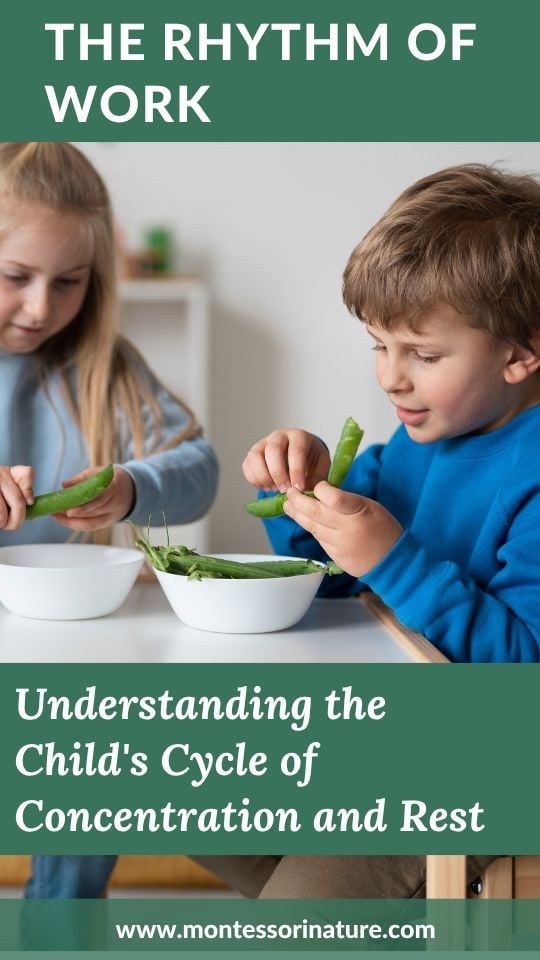
1. Understand the Curve: There’s a Natural Rhythm
Montessori describes a “curve” of work—a rise and fall of concentration. Not a flat line. Children move through phases: engagement, deep concentration, fatigue, searching, and finally, satisfaction and social connection.
Actionable step this week:
- Observe children with this rhythm in mind. Notice:
- When does concentration begin to deepen?
- When does it peak?
- What does the child look like when they’re between periods of work?
- How do they emerge from concentration?
- Stop expecting constant, steady focus. Start expecting a rhythm. It’s more natural—and more sustainable.
2. Don’t Interrupt the Searching Phase
Montessori describes children between work cycles as agitated, moving about, and searching. This is not misbehavior. This is preparation. The child is actively seeking the work that will satisfy their deepest interest.
Actionable step this week:
When you see a child moving restlessly, pausing at shelves, wandering without obvious purpose, resist the urge to direct or correct. Don’t say, “Sit down,” “Choose something,” or “What are you doing?”
Instead, trust. They are in the searching phase. They are preparing for great work. Your intervention is more likely to disrupt than to help.
3. Protect the “Great Work” When It Emerges
When the searching leads to engagement, and engagement deepens into concentration, the child is doing “great work.” Not great in the adult sense—impressive or important—but great in the sense of fully absorbing, fully alive.
Actionable step this week:
When a child becomes deeply engaged, protect it with everything you have:
No interruptions.
No questions.
No praise (“Good job!” pulls them out).
No redirecting.
No time limits.
This is the heart of the work cycle. Your silence is its protection.
4. Trust the Agitation—It’s Not a Problem
Montessori is clear: the child between work cycles is agitated, moves about, but does not disturb the others. This is important. The child is not causing trouble. They’re simply in transition.
Actionable step this week:
When you see a child in this agitated, searching state, check your own response. Are you feeling anxious? Do you want to “fix” it? Do you interpret it as a lack of focus?
Reframe: This is part of the rhythm. They’re preparing for something. Trust the process.
Give them space. Let them move. Let them search. Your calm trust is the gift they need.
5. Notice the Shift: From Concentration to Connection
Montessori describes the end of the work cycle beautifully: the child detaches from concentration, refreshed and satisfied, and turns toward others with warmth. They want to share confidences, connect intimately.
Actionable step this week:
Pay attention to the moments when a child emerges from deep work. Notice the quality of their presence. Are they softer? More open? More social?
This is a window—a moment when the child is ready for connection. Honor it. Be available. Let them share what they want to share. Don’t rush to the next activity. Let the intimacy unfold.
6. Protect the Whole Cycle, Not Just the Product
We tend to value the product of work—what the child made, learned, accomplished. But Montessori invites us to value the whole cycle: the searching, the agitation, the concentration, the completion, the connection.
Actionable step this week:
Reflect on where you might be undervaluing parts of the cycle. Do you get impatient with the searching phase? Do you push for productivity too soon? Do you rush the social connection phase because “it’s time for the next thing”?
Try this week to protect the whole cycle. Give time for searching. Allow agitation. Honor concentration. Savor connection.
7. Be Present, Not Directive, During the Transition
When a child is between periods of work, they don’t need you to direct them. They need you to be a calm, attentive, non-interfering presence.
Actionable step this week:
Practice being present without directing. Sit quietly nearby. Be available but not intrusive. Let the child find their way back to work without your help.
If they approach you, be warm and open. If they wander, let them wander. If they settle into something, let it be their choice.
8. Trust That Satisfaction Leads to Social Connection
Montessori observes that when the work cycle is complete, the child experiences “higher social impulses”—a desire to connect, share, and be intimate with others. This is profound. Deep work doesn’t isolate children; it prepares them for genuine community.
Actionable step this week:
When a child emerges from concentration, look for signs of this social openness:
- Do they approach you or others?
- Do they want to share something?
- Do they seem more affectionate or warm?
Don’t dismiss this as a distraction from work. It’s the fruit of work—the natural movement from inner satisfaction to outer connection.
A Simple Challenge for This Week
Choose one of these steps—just one—and try it.
- Observe the rhythm of concentration, not just its presence.
- Let a child search without directing.
- Protect a moment of deep engagement.
- Reframe agitation as preparation, not a problem.
- Savor the shift from concentration to connection.
- Value the whole cycle, not just the product.
- Be present without directing during transitions.
- Notice how satisfaction leads to social connection.
- Then notice what shifts. In the children. In you.
Montessori’s description of the work cycle isn’t just an observation of children. It’s a model for a well-lived life.
We all have rhythms. Times of searching. Times of agitation. Times of deep engagement. Times of satisfaction and connection.
When we honor these rhythms in children, we teach them to honor them in themselves. We teach them that searching is part of the process. That restlessness can be preparation. That concentration has its season, and so does community.
And we learn, too, to honor our own rhythms.
So here’s to the searching. Here’s to the great work. Here’s to the satisfaction that opens us to connection.
And here’s to trusting the whole beautiful curve.
You Might Enjoy





About Anastasia | Anastasia is an early childhood teacher with over twenty years of experience in Montessori classrooms and homeschooling. With a Master’s in Information Science, she blends education and information design to create clear, organized, research-backed resources. As founder of Montessori Nature, she develops evidence-based, nature-inspired printables that support holistic child development and foster curiosity, independence, and a love of learning. Explore more in her shop and Teachers Pay Teachers store.