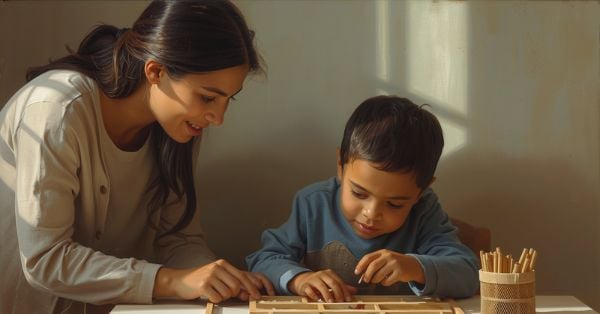
How to see the small changes, celebrate them, and trust the harmony of development
There are two passages from Montessori’s 1946 London Lectures that belong together. They speak to something I’ve felt but never quite articulated: that raising and educating children is both a science and an art—a study of nature’s plan and a practice of shared joy.
The first is about the great web of life:
“We must study the correlation between life and the environment. In nature all is correlated. This is the purpose of nature. Nature is not concerned just with the conservation of individual life or with the betterment of itself. It is a harmony, a plan of construction. Everything fits into the plan: rocks, earth, water, plants, man, etc.”
The second is about the quiet, daily work of the adult who cares for children:

“Those whom nature has fitted to care for children see a change in them every day, almost every hour. They see these small changes as admirable. This is an art which cannot be acquired without effort. To encourage is to rejoice, so that the child sees that you are rejoicing.”
Read together, these passages tell a story. The child is part of a vast, correlated plan—nature’s harmony, unfolding according to its own inner laws. And we, the adults who care for them, are privileged to witness this unfolding. Day by day. Hour by hour.
But not just witnessing. Rejoicing. Seeing the small changes as admirable. Letting the child see that we are rejoicing.
This is the art Montessori speaks of—an art that takes effort to acquire. It requires attention, patience, and a willingness to see what is often invisible: the tiny shifts, the subtle growth, the quiet miracles.
So how do we practice this art? How do we study the correlation between life and environment? How do we learn to rejoice in the small changes?

Here are some steps.
1. See the Child as Part of Nature’s Plan
Montessori insists that “in nature all is correlated.” Everything fits into the plan. The child is not an exception. They are part of this harmony, unfolding according to laws we didn’t invent and cannot control.
Actionable step this week:
When you feel anxious about a child’s development—worried they’re behind, or not following the expected path—pause and remember: They are part of nature’s plan. Their unfolding is not mine to force.
Write this somewhere visible: “Nature is a harmony, a plan of construction.” Let it remind you to trust the process, even when you can’t see the pattern.
2. Study the Correlation Between Life and Environment
Montessori doesn’t just tell us to appreciate nature. She tells us to study the correlation between life and environment. This is active work. Observation. Reflection. Understanding how the child and their world shape each other.
Actionable step this week:
Become a student of your child’s environment. Ask:
- How does the space affect their mood, their behavior, their focus?
- What elements of the environment draw them in? What repels them?
- Are there correlations between what they see, hear, touch, and how they grow?
This week, try moving one thing in the environment—a shelf, a piece of furniture, a plant—and observe what changes. Notice the correlation.
3. Look for Small Changes—Every Day, Every Hour
Montessori says that those fitted to care for children “see a change in them every day, almost every hour.” Not just big milestones. Small changes. The kind we often miss because we’re focused on the next thing.
Actionable step this week:
Set aside five minutes at the end of each day to reflect on the small changes you noticed. Not the big achievements. The tiny shifts:
- A new word, a new gesture.
- A slightly longer period of concentration.
- A moment of kindness to someone else.
- A new way of solving a problem.
- A subtle shift in mood or confidence.
Write them down. Over time, you’ll see a pattern of growth you might otherwise have missed.
4. See the Changes as Admirable
Montessori says, “They see these small changes as admirable.” Not just noticeable. Admirable. Worthy of admiration. This is a stance—a way of viewing the child’s growth as genuinely remarkable.
Actionable step this week:
When you notice a small change, practice admiring it. Not with exaggerated praise (“Good job!”), but with quiet, internal reverence. Let yourself feel admiration for the work of growth you’re witnessing.
Then, if the moment is right, let it show on your face. Let your eyes light up. Let the child see that you see them.
5. Let the Child See That You Are Rejoicing
This is the heart of the second quote: “To encourage is to rejoice, so that the child sees that you are rejoicing.” Encouragement isn’t about words. It’s about joy. Real, visible, shared joy in the child’s growth.
Actionable step this week:
Practice visible rejoicing. Not performance. Not empty praise. Genuine joy.
- When a child accomplishes something—even something small—let your face show your delight.
- When you notice a new skill or understanding, let your voice soften with wonder.
- When you see them trying, struggling, persisting—let them see that you are with them, cheering them on from the inside.
The child should see your joy. Not for their performance, but for them.
6. Accept That This Is an Art—and It Takes Effort
Montessori is honest: “This is an art which cannot be acquired without effort.” It’s not automatic. It requires practice, attention, and intention. We won’t do it perfectly every day.
Actionable step this week:
Acknowledge the effort this takes. You’re not just “parenting” or “teaching.” You’re practicing an art. That means:
- You will have off days.
- You will miss small changes sometimes.
- You will forget to rejoice.
- You will try again.
Forgive yourself when you fall short. Then return to the practice.
7. Trust That Everything Fits Into the Plan
Montessori’s vision of nature as a correlated harmony is radical. It suggests that even the things that don’t make sense to us—the struggles, the delays, the detours—are part of a plan we can’t fully see.
Actionable step this week:
When you encounter something difficult—a regression, a challenge, a phase that feels endless—try reframing it through this lens: Everything fits into the plan. Even this.
You don’t have to understand it. You don’t have to like it. But you can trust that it’s part of a larger harmony, unfolding in its own time.
8. Practice Wonder—Even When You’re Tired
The art of rejoicing requires energy. It’s hard to see small changes when you’re exhausted, overwhelmed, or just trying to get through the day. But Montessori reminds us that this is the work—and it’s worthy of our effort.
Actionable step this week:
On the tired days, practice one small act of wonder. Just one. A single moment where you stop, look at your child, and let yourself be amazed.
- “Look at you. You’re growing.”
- “I see you. I see how hard you’re trying.”
- “You are becoming someone. I get to watch.”
Let wonder be your fuel.
A Simple Challenge for This Week
Choose one of these steps—just one—and try it.
- Trust that the child is part of nature’s plan.
- Study the correlation between environment and growth.
- Notice one small change each day.
- Practice admiring what you see.
- Let the child see your joy.
- Acknowledge that this is an art—and be gentle with yourself.
- Trust that everything fits into the plan.
- Practice one small act of wonder, even when tired.
Then notice what shifts. In the child. In you.
Montessori’s vision isn’t just about education. It’s about a way of seeing the whole world—a world where everything is correlated, where the child is part of a vast harmony, where the work of the adult is to notice, to admire, and to rejoice.
This is the art. This is the work. Not to control the unfolding, but to witness it with joy. Not to force the changes, but to see them—every day, almost every hour—and to let the child know that we see.
And in that seeing, in that rejoicing, we become part of the plan. Part of the harmony. Part of something bigger than ourselves.
That’s the privilege of caring for children.
And it’s worth all the effort.
Recommended products
-

Children in the Kitchen: Recipe Practical Life Skills Sequencing Cards Cooking
$15.50 -
Editable Chore Chart: Practical Life Daily Routine Child Planner
$4.90 -
How to Dress for Snowy Weather Practical Life Winter Sequencing Cards Blackline Master
$3.10 -
How to Make a Pizza Practical Life Recipe Sequencing Cards
$4.60 -
Helping Hands: Practical Life 3-Part Cards
$4.70 -
How to Set the Table Practical Life Daily Routine Sequencing Cards
$4.05






About Anastasia | Anastasia is an early childhood teacher with over twenty years of experience in Montessori classrooms and homeschooling. With a Master’s in Information Science, she blends education and information design to create clear, organized, research-backed resources. As founder of Montessori Nature, she develops evidence-based, nature-inspired printables that support holistic child development and foster curiosity, independence, and a love of learning. Explore more in her shop and Teachers Pay Teachers store.