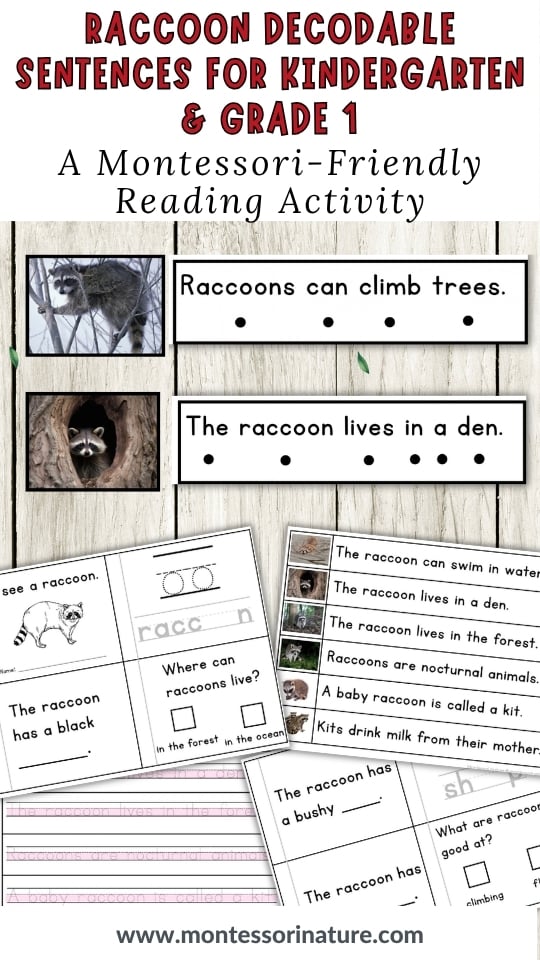
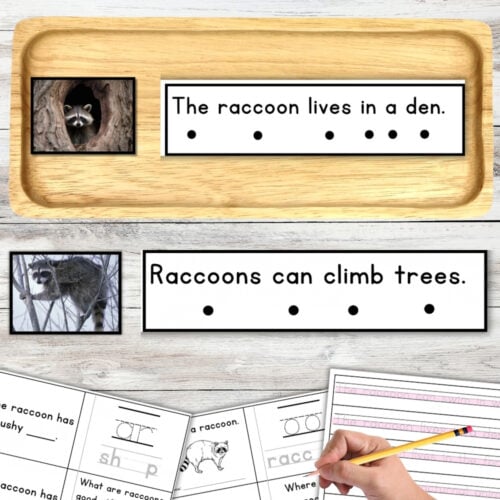
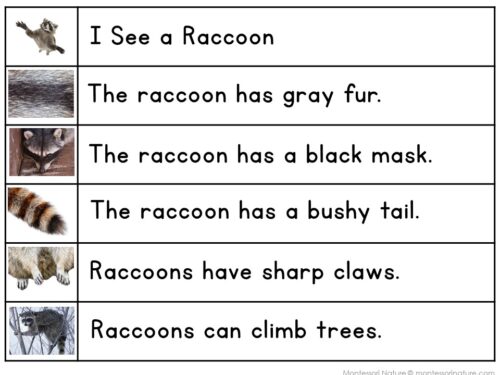
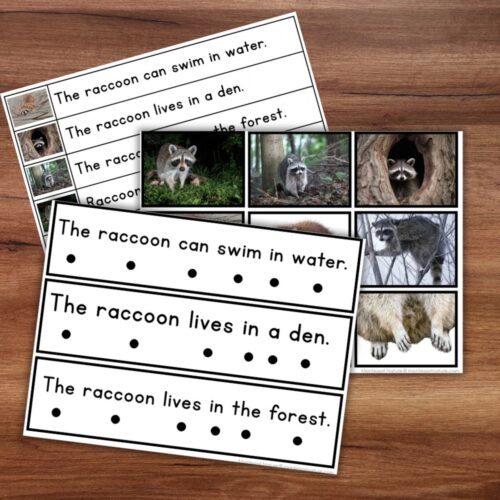
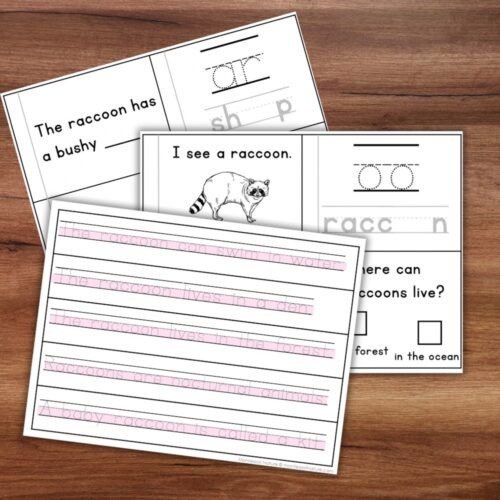
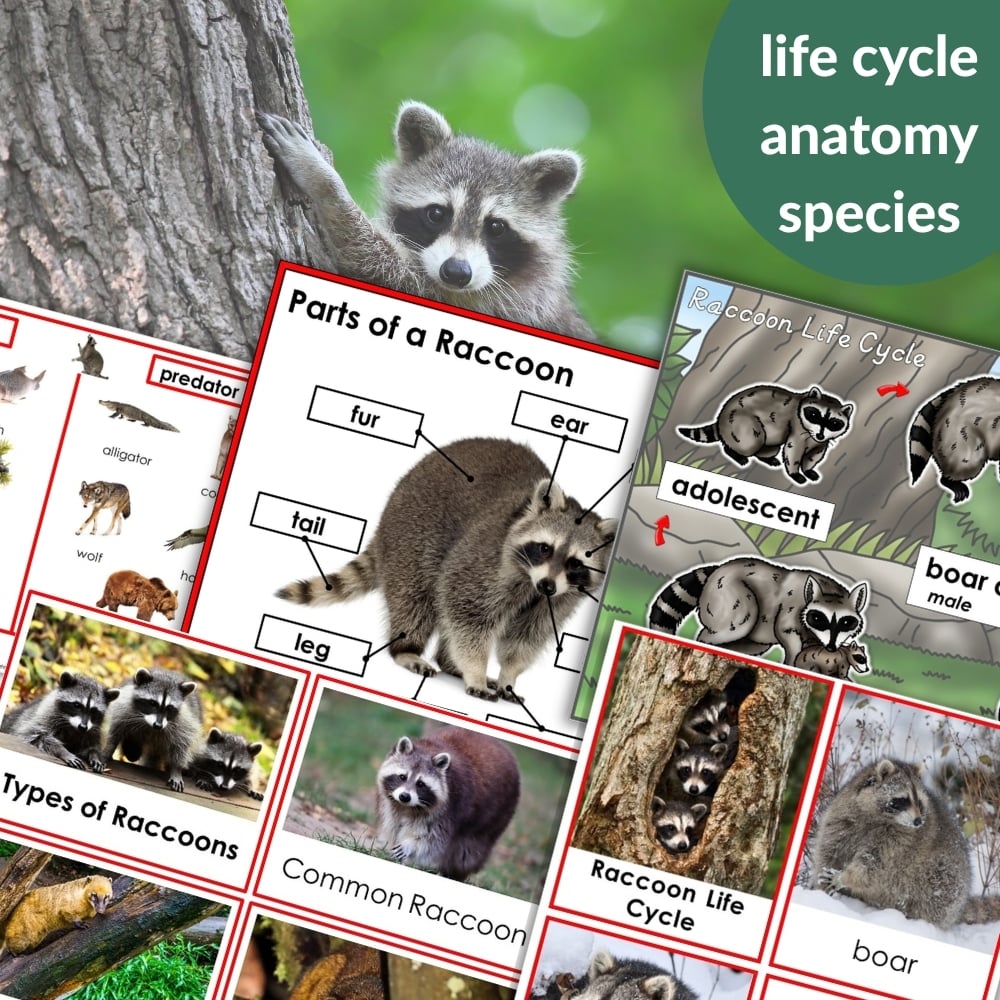
If you’ve been looking for learning to read resources that feature woodland animals, this Raccoon Decodable Reader might be exactly what your classroom needs. Designed for kindergarten and Grade 1, it pairs simple decodable sentences with real photographs, tracing practice, and comprehension checks. It also works beautifully alongside the Montessori Moveable Alphabet, giving young readers a tactile way to decode, build, and verify their own work.
Raccoons are medium-sized mammals, roughly the size of a small dog, with black “bandit” masks across their eyes and bushy tails marked by four to ten alternating rings.
Their hand-like front paws have five dexterous digits, allowing them to grasp and manipulate objects with surprising precision. Originally creatures of hardwood forests near water, they now thrive in suburbs, cities, and even storm sewers. They den in tree cavities, brush piles, barns, and attics.
Raccoons are nocturnal, most active from dusk until dawn. Their night vision is excellent, and their sense of touch is extraordinary—so sensitive they can identify objects in complete darkness. That famous “washing” behavior isn’t about cleanliness. When raccoons dapple food in water, they’re examining it by touch.

As omnivores, they eat whatever is available: berries, nuts, insects, crayfish, frogs, bird eggs, mice, and garbage. This flexible diet explains their success in human spaces.
Female raccoons raise their young alone, giving birth to two to five kits in a tree cavity. Newborns are helpless, eyes closed for three weeks. By three months, kits hunt independently but stay with their mother nearly a year. Young males eventually disperse, sometimes traveling 150 miles to establish territory.
Raccoons are famously intelligent. They can open latches, unscrew jar lids, and remember solutions for years. Their curiosity drives them to investigate anything new—a trait that often gets them into trouble.
Why Raccoons Belong in the Classroom
Raccoons connect science, vocabulary, and literacy naturally. A child fascinated by the raccoon’s mask is already motivated to read words like “mask,” “tail,” and “night.” That curiosity does much of the teaching.
When children read decodable text about raccoons, they practice phonics while building knowledge about the natural world. Comprehension grows when reading connects to real topics.
What Works in Early Reading
Phonics with meaning. Decodable text gives children authentic practice applying letter-sound relationships. The goal is automaticity so the brain can focus on understanding.
Short, frequent practice. Lessons work best when brief—around twenty minutes—to maintain engagement.
Self-correction builds independence. When children verify their own work, they learn to notice when something doesn’t make sense and go back to fix it. This skill strongly predicts reading success.
Vocabulary grows through experience. Words stick better when children encounter the real thing: a photograph, a discussion, a drawing.
Extending Raccoon Learning Across the Language Sequence
Pink Series: CVC Foundations
Three-letter phonetic words with short vowels—mat, pin, log.
Moveable Alphabet: Words like den, nut, mud, log, paw fit the CVC pattern
Picture-word matching: Real photos paired with simple labels
“I Spy” games: “I spy something that starts with /t/… tail!”
Blue Series: Blends and Longer Words
Consonant blends—st, sn, mp, nd.
Blend word building: nest, stump, hand, hunt
Phrase strips: “the black mask,” “a bushy tail”
Sentence matching: “The raccoon hunts at night” paired with photos
Green Series: Phonograms
Letter combinations like igh, oa, ai, ee.
Phonogram hunt: Find igh in “night,” ea in “water”
Vocabulary expansion: Nocturnal, omnivore, adaptable through conversation
Reading booklets: Short texts with controlled vocabulary
Practical Tips
Pair with science materials. Place raccoon nomenclature cards or habitat photos near reading work.
Use real photographs. Children need to see actual raccoons—their masks, paws, habitat.
Let children move. The Moveable Alphabet engages hand, eye, and ear simultaneously.
Follow the child’s interest. Not every child loves raccoons. Offer rich materials for those who do.
Raccoons are curious, resourceful, and mysterious—qualities that make them fascinating to young learners. Pair that natural interest with systematic phonics, and reading practice becomes investigation. The child isn’t just learning to read. They’re learning to read about something.
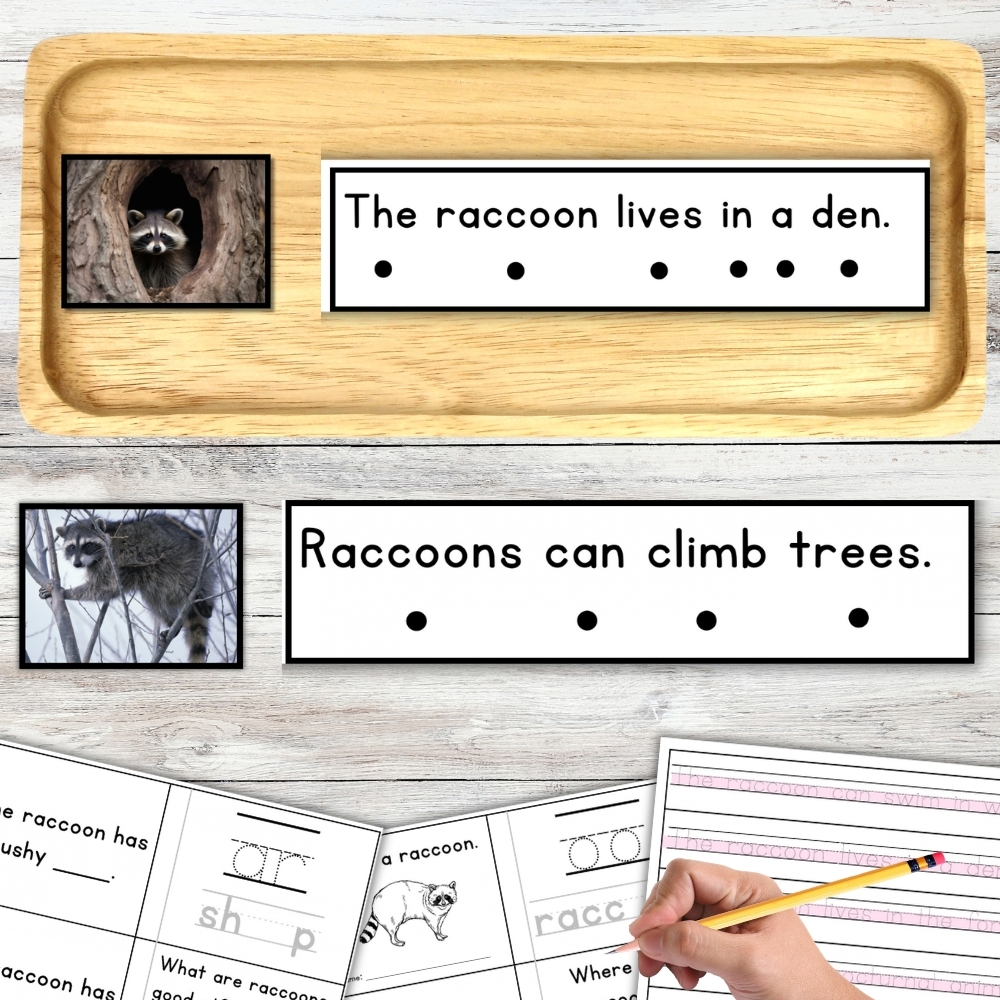
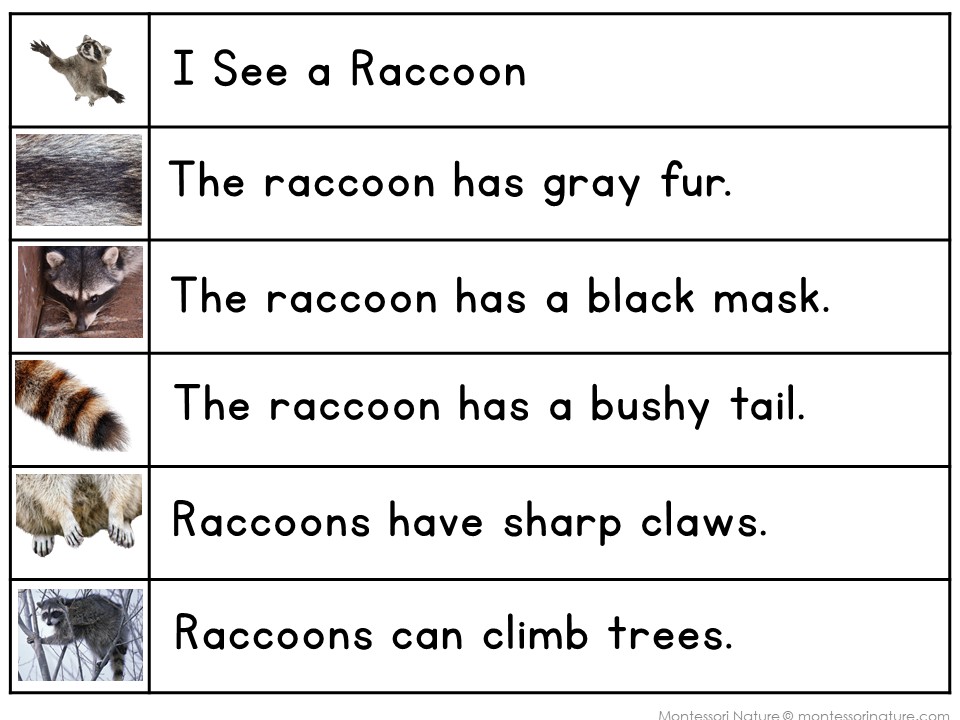
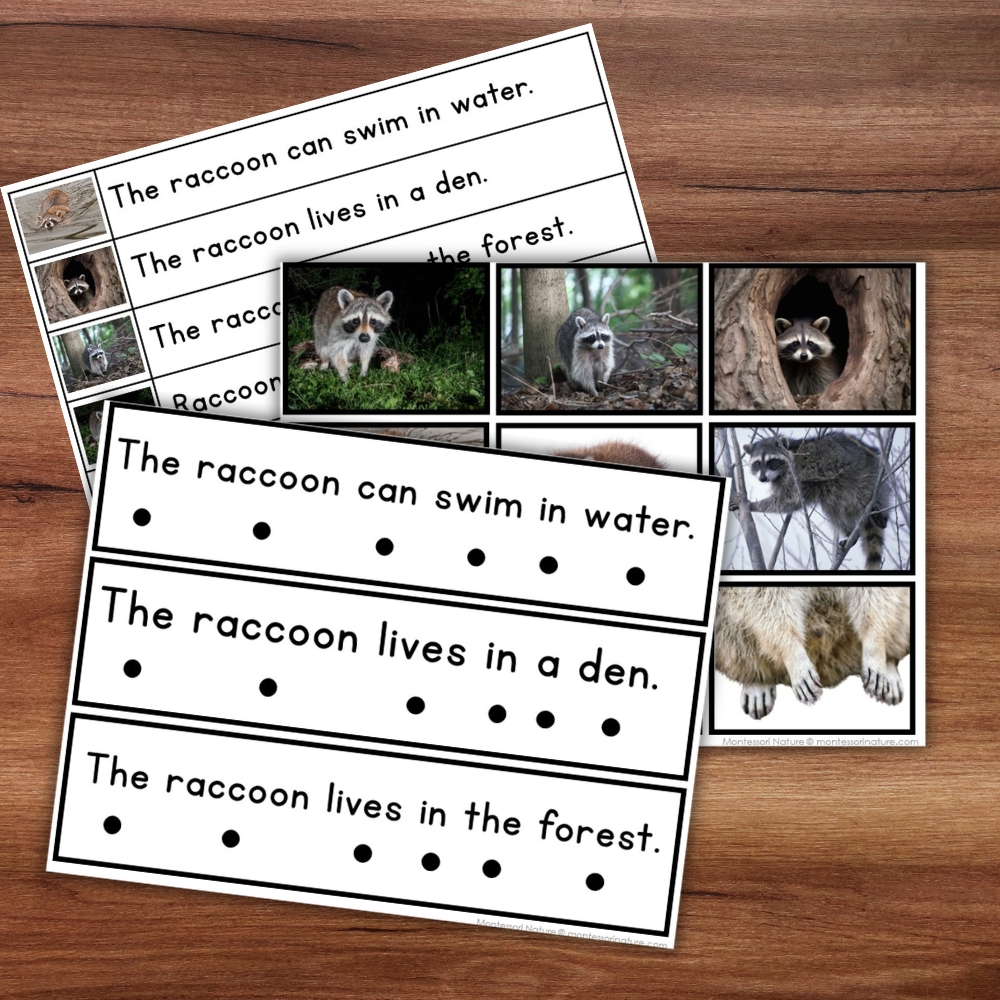
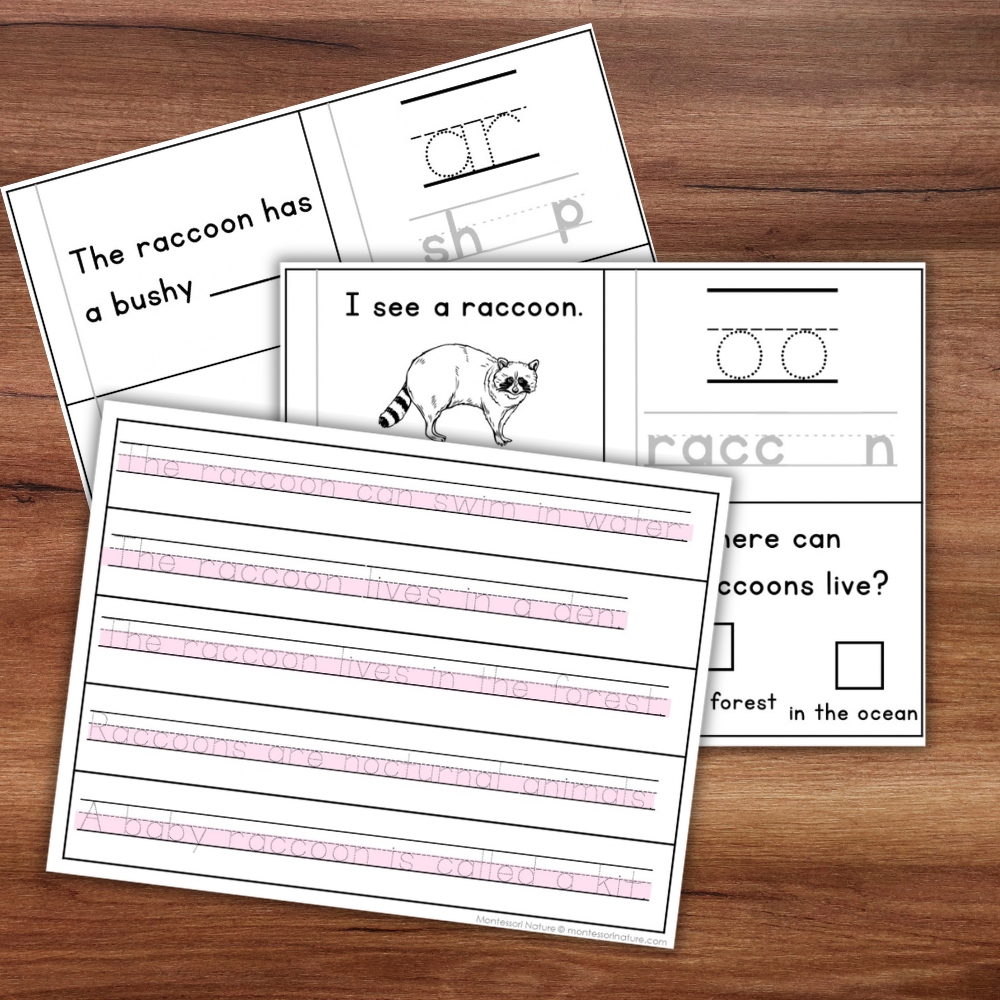
All About Raccoons Decodable Phonics Reader Comprehension Forest Animals
Introduce your students to the clever raccoon with this decodable phonics reader and comprehension activity! Perfect for Kindergarten and Grade 1, this printable builds reading confidence while supplementing your raccoon unit, forest animals study, or nocturnal animals unit.
Recommended products
About Anastasia | Anastasia is an early childhood teacher with over twenty years of experience in Montessori classrooms and homeschooling. With a Master’s in Information Science, she blends education and information design to create clear, organized, research-backed resources. As founder of Montessori Nature, she develops evidence-based, nature-inspired printables that support holistic child development and foster curiosity, independence, and a love of learning. Explore more in her shop and Teachers Pay Teachers store.