
Pushpin (or pin poking) activity is one of the popular fine motor activities in the Montessori classroom. I want to share with you different ways to use pins and pin poking, which greatly benefit the child’s development. You will find that pins are often used in activities for different purposes.

Push pinning is a popular Montessori activity that involves using a push pin to create designs or letters on a piece of paper. This activity helps children develop their fine motor skills, hand-eye coordination, and concentration. It also fosters creativity and allows for self-expression. To ensure safety, children are taught the proper use and handling of the push pin and are always supervised during this activity. Push-pinning is a fun and engaging way for children to explore their artistic abilities while also promoting their physical and cognitive development.
By using push pins to create designs on a board, children improve their ability to grasp small objects, manipulate them with precision, and focus on a task for an extended period of time. Additionally, push pinning can also enhance a child’s sense of order, as they must follow a pattern and complete each step before moving on to the next.
Some examples of push pinning activities include tracing and coloring designs on paper with a push pin, creating art with pinboards, and pinning letters or numbers to match their corresponding pictures. These activities also encourage creativity and independent exploration, as children are free to create their own designs and patterns with the push pins. Overall, push-pinning activities are a fun and beneficial way for children to learn and develop important skills.
how pin activities benefit a child’s development
- help develop deeper concentration
- prepare for writing
- enjoyed by children
- exercise patience and attention to detail
- help perfect fine motor
- strengthen finger muscles
there are many variations of pin-poking activities
- The metal inset extension activity – the child pin pokes the shape after tracing a metal inset shape.
- The knob puzzle extension activity – the child pin pokes outline after tracing a shape.
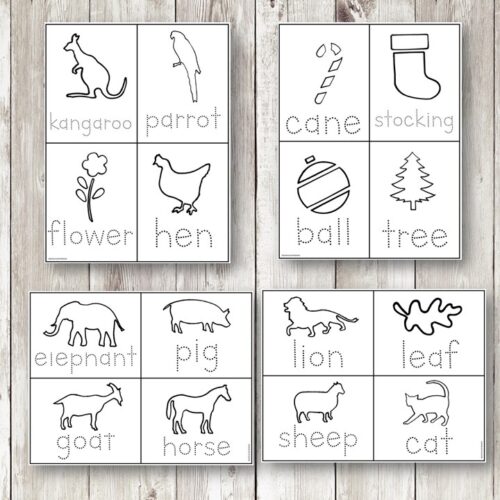
- Pin-poke a picture outline.
Here are a few examples of introducing pin activities to children
Here is a way to present Montessori push pinning to a child:
- Introduce the child to the activity and explain what push pinning is.
- Show the child how to hold the push pin and demonstrate how to use it to create a pattern or design on a corkboard.
- Allow the child to try it for themselves, offering assistance if needed.
- As they become more comfortable, encourage them to experiment with creating different designs and patterns.
- Emphasize the importance of safety and proper use of the push pin throughout the activity.
- Finally, praise and celebrate the child’s achievements and efforts, acknowledging their creativity and perseverance in completing the activity.
PRESCHOOLER
Print a picture outline on regular paper or construction paper and cut cards to match your push pin mat size. Place cards in a box on a tray along with a push pin or the Montessori puncher, corkboard, or wool mat to absorb the pricks of the poking stylus.
Invite the child to punch holes in the line and take him or her to the window to look through the light and make sure the holes are close together. Show them how to gently tear the punched shape from the rest of the paper, get a glue stick, and glue it to the construction paper. The child may also like to color the shape first.
As I mentioned earlier, children often enjoy pin-poking continents of the world after working with the Montessori Continent Knob Puzzle. However, this can be done with every puzzle that has knobs. Puzzle pieces with knobs make it easier for children to trace outlines.

-

Push Pinning Cards
$0.00

Children’s resources for hands on learning
-
Summer Playdough Mats Fine Motor$3.30
-
Compassion and Peace Preschool and Kindergarten Pack$8.10
-
Sports Pack I am an Athlete Preschool and Kindergarten$8.10
-
Dinosaur Pack I am a Paleontologist Preschool and Kindergarten Pack$8.10
-
Push Pinning Tracing Cards$2.10
-
Winter Pin Punching Cards: Fine Motor$2.10



About Anastasia | Anastasia is an early childhood teacher with over twenty years of experience in Montessori classrooms and homeschooling. With a Master’s in Information Science, she blends education and information design to create clear, organized, research-backed resources. As founder of Montessori Nature, she develops evidence-based, nature-inspired printables that support holistic child development and foster curiosity, independence, and a love of learning. Explore more in her shop and Teachers Pay Teachers store.


